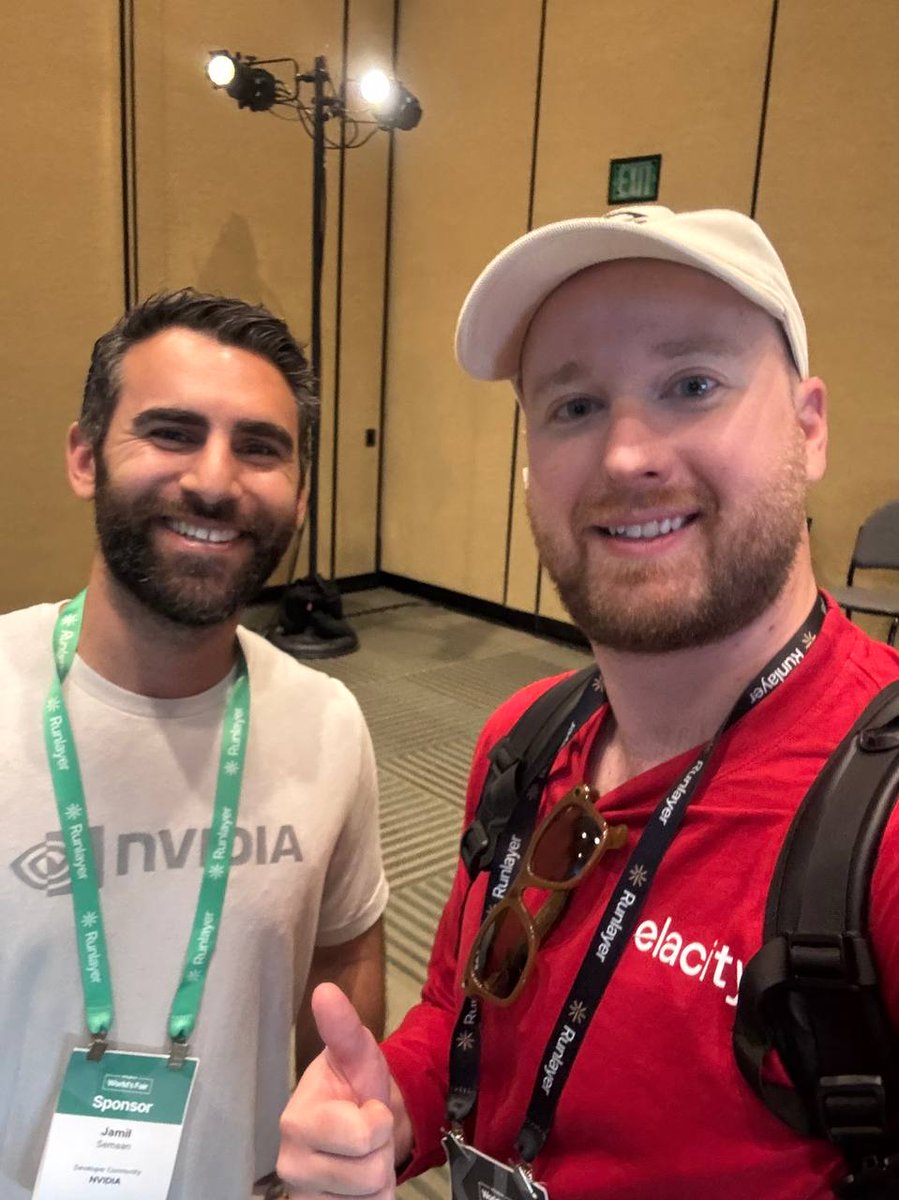
Given we've been using NVDIA Jetsons and wanting to work more with their hardware for sovereign compute, it's really awesome to meet the team and be accepted into their network, i'm confident it will bring many downstream benefits. Full details in link below!
A computer that answers to you. We are pleased to share that Elacity has been accepted into the NVIDIA Inception program, building sovereign computing on NVIDIA Jetson today, with DGX Spark next.
Own the hardware. Own the AI. Own your work. Learn more here! https://t.co/ACqALlRi43
Using the concept of fractals as a metaphor for Elastos is quite profound—
IoT smart sensors and peripherals are essentially embedded computers in disguise.
Of course, PCs are computers.
Website clouds also function as elastic virtual computers.
Enterprise virtual private networks are computers as well. The popular phrase “The network is the computer”—a concept popularized by Sun Microsystems in 1992—illustrates this point.
Ultimately, the entire internet can be considered the Elastos World Computer.
——
A computer is a Turing Machine, a concept dated back 80 years ago, which consists of three fundamental components:
1. Computes (Processing Elements): These are the units responsible for performing calculations and executing instructions.
2. Drives (Storage Elements): These are the units that store data and information.
3. The Machine (Control Mechanism): This is the switching/routing system that ensures that the right computes can read from and write to the appropriate drives.
It’s important to note that the network (Bus is the more accurate jargon) functions as an integral part of the machine, similar to the role of the read/write head in a hard drive.
Users and application developers should not need to have a deep understanding or direct interaction with these underlying Machine components.
“You can’t hack what you don’t see.” Let that sink in.
https://t.co/YfRXEiKLZN
The past two weeks made the Elastos World Computer thesis clearer.
One user-owned execution layer, four environments coming together: PC2, Runtime, Carrier, and Blockchain.
PC2 is the personal cloud, Runtime is the trusted app engine, Carrier is the private network, and Blockchain is the rights and settlement layer.
We tokenize royalties. Every time someone licenses a song, a piece of training data, or a creator’s IP, the rights holder gets paid in real-time, on-chain , not in 90 days through gatekeepers.
This matters right now because AI agents are about to license content at machine speed, billions of micro-transactions, and no rails exist. We’re that layer.
This creates a brand new yield-bearing asset class. Productive cashflow from real-world IP, paying yield natively, uncorrelated to anything in a DeFi portfolio.
Elastos DAO Term 7 elections are live 🔥
ELA holders can now vote, and candidates can register for the next Council term.
12 seats. One year. A key moment for the DAO and the future of the SmartWeb.
Vote or register through Elastos Essentials:
https://t.co/zlaWJDn5Vu
I feel fortunate and grateful that the Elastos World Computer is scheduled to ship v1.2 this month—April 2026—after many detours on its long and arduous journey. To a large extent, the initial mission outlined in the 2018 whitepaper has now been accomplished.
Building the World Computer is one thing; operating it is another. The Elastos World Computer requires no permissions and no inherent ELA token rights from its founders—only blessings.
When we launched the project in January 2018, four fundamental guidelines for the token-issuing entity, EF, were followed:
• Build only one SmartWeb World Computer, not multiple as a business;
• Build it without operating it;
• Issue ELA as tokens of appreciation;
• Refrain from holding, promoting, or managing ELA tokens.
Once the first prototype is finished or funds exhausted, nobody should expect the new SmartWeb could ever be completely built by the entity. At that point, the entity should dissolve.
I hope our community can now understand why these guidelines were—and remain—so important.
ElastOS v1.2 is getting close ⚡
A lot has been happening this week as the team keeps pushing toward release later this month. Work has continued across the runtime, dDRM V3, dApps running directly inside PC2, block explorer progress, and bringing council node costs down.
That includes more testing around room-based permissions, more work on separate ElastOS computers interacting with each other in real time, continued progress on getting dApps running properly inside the personal cloud computer, and ongoing infrastructure work to make node operation cheaper while keeping the same stability.
And that is only part of this weeks progress..
Visit https://t.co/GByRtkCNsI for ElastOS roadmap and learn what is coming!
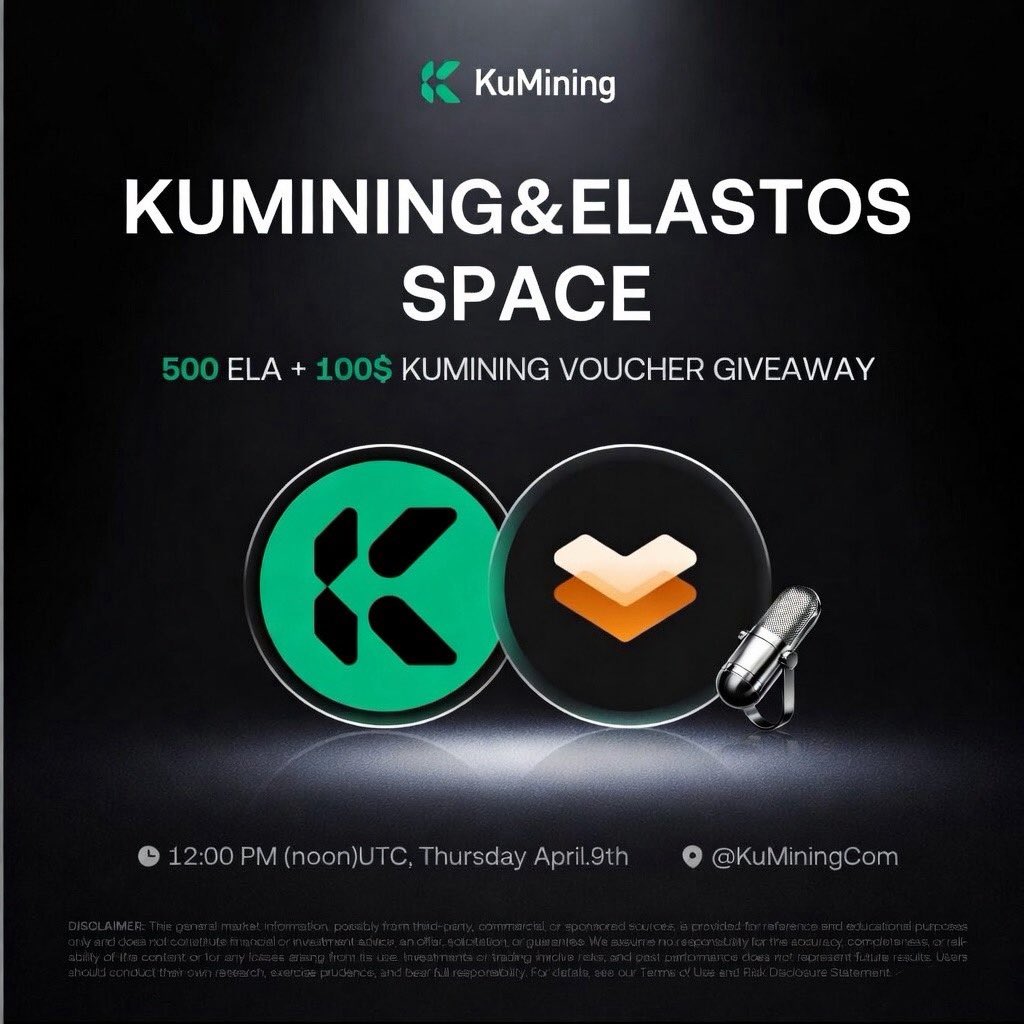
🎙️KuMining & Elastos Space in two days!
Join us live for an exciting discussion + giveaway:
💬We will talk about merge-mining, cloud mining and more.
💰Following a 500 ELA + 100$ KuMining Voucher Giveaway! (will announce winners here)
🗓 When: 12:00 PM (noon) UTC, Thursday April 9th
📍Where: https://t.co/e625PTUbh0
To qualify you MUST:
1. Follow @KuMiningCom& @ElastosInfo
2. Join both Telegrams:
• KuMining → https://t.co/g7T3ClK7Wv
• Elastos →https://t.co/Y16FBXTHqC
3. Retweet/Repost this post
4. Join & actively participate in the live Space (attendance verified)
5. Have your KuCoin ID ready (to receive reward)
See you in the Space in soon 👀
The devil is in the details.
When we replace humans with computers, robots, or AI agents, we’re not dealing with just one computer — we’re dealing with two:
- One is the device (phone or computer) directly connected to the network.
- The other is the virtual “brain” that replaces the human — the entity that talks, decides, and interacts through the device.
In this architecture:
PC2 is the host device connected to the network, running the host operating system.
AppCapsule Runtime is the lightweight virtual computer that sandboxes and runs applications in isolation.
ElastOS (the Internet Operating System) sits cleanly in between: it acts as the decentralized carrier layer connecting the lightweight guest runtime (AppCapsule) to the host device (PC2).
The blockchain layer provides the essential foundation: Decentralized Identifiers (DID), verifiable credentials, smart contracts, and more.
This is why Elastos is built on four fundamental pillars:
- App Runtime – the lightweight guest OS (AppCapsule)
- ElastOS Carrier – the decentralized Internet Operating System
- PC2 – the host operating system
- Blockchain VM – the virtual machine layer powering identity, credentials, and smart contracts
You have a phone, and I have a phone. We both have phone numbers, and we can call each other. Simple, right?
When we talk or text, we don’t need to know whether our voices and messages travel via satellite (protocol) or undersea cable (another different protocol). We don’t have to.
No matter how much we talk or message, neither of us can hack the telecom network just by communicating. That’s because phone carriers act as a protective shield, hiding all the complex infrastructure details from us.
Now imagine replacing you and me with two OpenClaw lobsters 🦞 — or, more realistically, with two computers. (After all, phones *are* computers; they’re just trillions of times faster at processing than humans.)
If human voices and messages can’t hack the telecom network, simply running the same actions trillions of times faster doesn’t magically grant hacking powers either.
The real difference isn’t speed or intelligence. It’s the carrier abstraction — the protective layer that sits between phones, computers, AI agents, and the underlying network.
The Internet should have a decentralized carrier — an operating system for connectivity that works on the same simple, shielded principle.
The idea behind ElastOS is straightforward: keep the Carrier abstraction, and the complexity stays safely hidden.
A blockchain is a consensus computer powered by either permissionless miners (public blockchains) or permissioned miners (consortium blockchains). Multiple blockchain computers are actively running across the Internet today.
To incentivize miners to secure and operate these networks, each blockchain typically issues its own reward token or reward points. There are times when one token must be swapped for another — much like exchanging fiat currencies at an international airport.
The Elastos World Computer offers a neutral cyberspace for all digital tribes, enterprises, communities, and organizations. Designed with a BTC merge-mined mainchain as well as Ethereum-compatible sidechains and friend-chains, the ELA token serves as the core asset for decentralized bridges that seamlessly propagate value across the entire SmartWeb, aka Web3.
In other words, ELA is not positioned to compete with BTC, ETH, or other major cryptocurrencies. Instead, it is designed to facilitate the exchange of all digital assets peer to peer — whether crypto tokens or digital merchandise.
The Internet needs an operating system — just like every PC does. Why don’t people understand this?
1. Every app must ship with its own binary loaders, which I call AppCapsule, validates the hash of every module, and cryptographically verifies credentials. Trust nothing.
2. An Internet-scale operating system (such as Elastos) is required to sandbox all third-party AppCapsules. No app should ever be trusted with passwords or secrets in its own execution space.
https://t.co/My9mXG0mer
https://t.co/UcVYTICiIT
ElastOS sovereign cloud with Elacity dDRM markets, a peer to peer economy:
- Run your own cloud OS with decentralised login from anywhere in the world
- Trade tokenised access rights directly from creators smart contracts
- Payments immediately settled to tokenised royalty holders
- Encrypted data downloaded and owned p2p on IPFS file storage system
- Playback inside WASM media player which validates blockchain rights and gets licence key from distributed network.
Now scale this up for every type of asset mixed with agentic support on your own cloud - own your data + distribution. This is digital freedom being realised. https://t.co/I3Pc8zLDr8
@balajis let's grow this into a network state? @buildonbase USDC markets?
I view the PGA sidechain as an experiment for cross-border enterprises or consortiums. PGA is an ERC-20 token that can be renamed as needed.
Imagine a use case where ordinary users have no knowledge of cryptocurrencies. Instead, they rely on familiar payment methods like PayPal, Alipay, or Apple Pay.
Meanwhile, IoT devices, electric vehicles, and similar hardware come with built-in crypto wallets, but payments are still handled in fiat currency. The fiat funds flow to the enterprise—similar to how Tether or Circle operates. The enterprise then issues an equivalent amount of ERC-20 tokens into circulation and distributes the proceeds according to predefined smart contracts.
Hardware and lobster 🦞 owners can later redeem their ERC-20 tokens back into fiat currency through the enterprise’s API.
There is a subtle but important distinction between 'https://localhost/' and 'localhost://'. The former routes traffic back to the device itself using the standard loopback mechanism. The latter, however, directs traffic to the PC2 home server, treating mobile hardware devices as remote client terminals.
Within the Elastos World Computer, three default WebSpaces are defined:
1) https:// — maintained purely for backward compatibility with the traditional World Wide Web.
2) localhost:// — dedicated to the PC2 home server environment.
3) elastos:// — used for bootstrapping and discovering peer WebSpace providers (data‑storage capsules).
You can think of 'elastos://' as the World Computer’s decentralized registration layer—somewhat reminiscent of the old Windows 'regsvr32' command used to register system components.
In Ethereum, the EVM provides consensus-based compute, modeled after the Turing machine’s finite state machine. But where is the Turing machine’s infinite paper-tape counterpart for blockchains? Historically, the ad hoc solution for interacting with the external world has been “oracles.”
In the Elastos World Computer, it’s time to formalize this concept and give it a proper abstraction, i.e., elastos://.