Paul is Emeritus Professor of Public Policy at the Robert Gordon University, Aberdeen. He mainly writes on poverty, benefits, social justice and social policy.
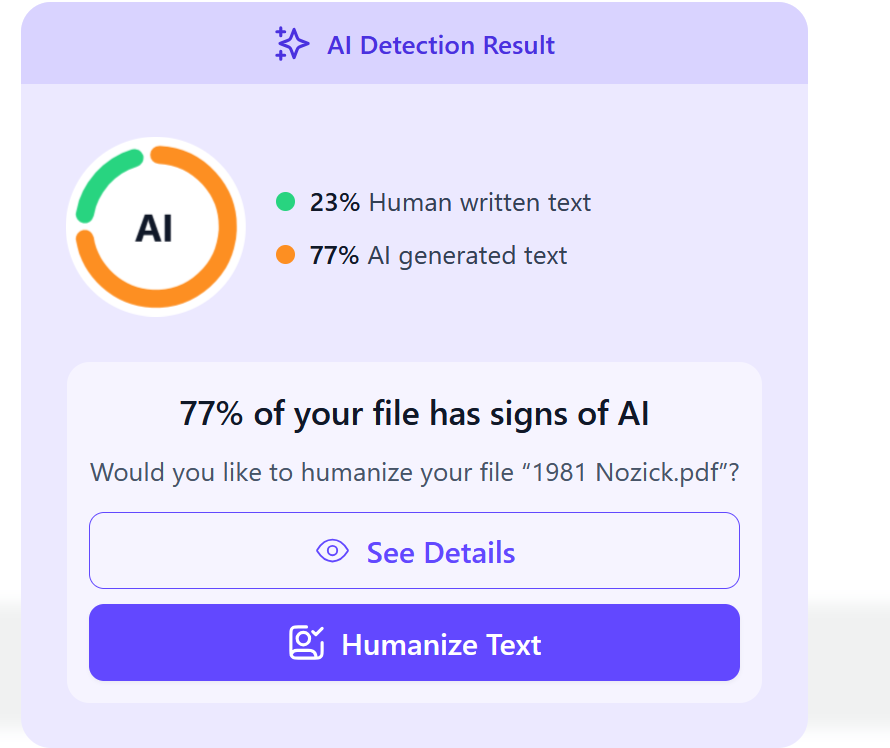
The most plausible explanation is not that this obscure article has been used to train AI, but that a big chunk of my other writing has been - a million words in 60 scraped pieces, including 14 of 23 books. So my writing style has been judged by its similarity to my later work.
I'd love to think that someone out there had read and liked it, but sadly I've no reason to believe that: it has no (zero) citations on Scholar. I've done a little better since ...
Exact same issue for me- I know my previous books and articles have been used to train AI (looking at you anthropic)- & when I run previous articles (written pre-AI) into AI checkers, they can come back as high as 90% AI. It's not artificial intelligence- it's collective human intelligence.
Taking both of these points together you can conclude:
1. Excluding men from a women’s facility is less favourable treatment, even if they have access to a men’s facility.
2. If that exclusion is because of sex, that is unlawful unless there is an applicable exception.
3. On a basic comparator test this is clearly direct sex discrimination: if the man was female he would have been included.
4. Since you can only rely on the Schedule 3 exceptions if you’re operating a service based on biological sex, anything other than that is not covered.
Therefore a service based on anything other than biological sex which excludes men from a women’s service (and vice versa) necessarily engages in unlawful sex discrimination without an applicable exception.
Poverty is really about social relationships; but even if one insists it's all about low income, this is ill-informed. Prices are relative - they reflect demand, and so the ability of *other people* to pay. Therefore the value of income is also relative. https://t.co/Z5aSMPpKrC
@HamishMcRae5 writes in the i paper that "If people have to pay more in tax they will have less money to spend on other things." That isn't a problem for transfer payments - higher taxes to pay for higher benefits. There's no good economic argument for child poverty.
"Countries that have cut back on certain types of #Benefits have nevertheless found themselves constrained to leave some forms of income support in place...It’s not an inevitable truth, but it’s something that can be charted and seen." @PSpicker@geomill
https://t.co/kqbU1G8Wu8
Listen to @geomill and @PSpicker talk about some of the historical roots, moral foundations, and practical workings of different #Welfare systems. #WelfareState
https://t.co/kqbU1G8Wu8
New in the ‘What Is It For?’ series, ‘What Is the Welfare State For?’ discusses the institutions and methods that characterise #WelfareStates around the world. @PSpicker
https://t.co/0I5uYVOvEo
@premnsikka Private equity doesn't rely on 'profit', in the conventional sense, so much as on the extraction of value - often achieved by converting current value into long-term debt. The model represents an existential threat to public services.
My new book has shipped: https://t.co/MTFU1mMbKU .
"A brilliant critical contribution and powerful overview about how we got here and what is at stake" (Camilo Perez-Bustillo)
"Concise and superbly written" (Daniel Béland)
@policyatkings@kcl_sfg The key question I have is this: what has been done to mitigate the known vulnerabilities of RCTs - the risk of random findings (e.g. https://t.co/fdRxGDaMML) , and 'bracketing off' the things that matter (see Pawson and Tilley, Realistic evaluation).
After 25 years and more than eight million views, I am closing down my educational website, 'An Introduction to Social Policy'. A legacy copy, and my blog, will still be available at https://t.co/xpAHaYsZ0D
Other posts will be at @paulspicker.bsky.social
It doesn't seem to matter how many warnings are posted, some kids playing in the cemetery will try to bring dead ideas back to life. Zero-based budgeting implicitly favours 'core' (in-house) spending over 'peripheral'. Voluntary organisations beware.
Zero-based budgeting is back, reviewing all spending commitments to determine their contribution to key objectives/outcomes - despite being lectured on this platform by 'budgetary experts' about wasteful spending, including those objecting to WFA being targeted on the most needy.
A legal case in France is challenging the principle that the benefit authorities can select suspects to monitor by using an algorithm.
https://t.co/O7bJhRuFzO
@kateesummers I've written both on managed complexity and on using different elements in the income package, rather than personalization, to achieve different outcomes. The claimed 'simplification' of UC was always nonsense.
💥New! The apparent simplicity of Universal Credit conceals the complexity of people’s different circumstances. @kateesummers and David Young argue that Labour's welfare reforms should recognise complexity and relieve claimants from managing it alone.
https://t.co/m63QEFfthR
@jdportes@Heather_Rolfe@britishfuture We see the same pattern in public rejection of social security, where only about a fifth of spending is for people out of work and most of that is for long-term sickness. Stigma fuels the misperception of numbers.