I'm a Senior Fellow at a neoliberal think tank. Have been for a quarter century now. We're the people who actually invented privatisation for Maggie Thatcher.
We're not really very worried about capitalism. Think it's useful but have no objection to voluntary socialism - workers coops and all that - at all. Y'know, what folk want to do.
We are though absolutely insistent that this all has to happen within a market economy.
The right sold out entire industries and left communities to rot.
They replaced real production and decent jobs with an economy based on speculation and service alone.
Now they sneer at the consequences.
The answer isn't to strip away welfare but rebuild jobs and communities.
@resfoundation Woot! Huge surprise! Groundbreaking finding!
Richer people take some portion of their increased income, wealth, in more leisure!
No one ever knew.
Joyously, all the money collected to pay benefits comes from within the country. You know, the money in offshore tax havens doesn't pay for it for a fairly obvious reason.....
But this makes logical sense. Sierra Leone was, more than anything, where the Royal Navy dropped off the slaves they'd liberated from slaving ships after 1807. Those liberated slaves coming from all along those coasts, from Angola (and thus Bantu) northwards.
We would naturally expect the genetics of those from Sierra Leone to be an admixture of everything from roughly Dakar to Luanda.
Ah, we have another cretin ruling us then. So, what was the population of Pendle and Clitheroe before the industrial revolution? Did people move from other areas to then go and work in the mills that replaced the limestone industry? Why, yes they did in fact.
The reason this shouldn't happen again is?
@RoisinMichaux Rather fun really. Politics works on personability, who can read the room, the individual. The talent to actually do things might not be so associated with this political necessity.....
An example. The irruption of Aldi and Lidl into the British groceries market cut the net profit margins of the *other* supermarket chains from 6% to 3%. Sure, the Germans are getting rich from this. But more of the benefit flows to consumers than to the capitalists. Same was true of Walmart in the US: https://t.co/XpUbc9aSbz
@mattwridley As ever, the actual economic argument - Nordhaus, yes Stern too - is only do those policies that are worth doing. Which isn't how politics works, as we know.
Ho, Ho, Ho. Everyone agrees that an autarkic (sorry, the word is autarky, not autarchy, different meanings) economy can grow. As can a non-autarkic one shrink.
The observation is that the level from which one does so will be wildly lower for the autarkic one.
And N Korea thriving? Jeebus are you deluded.
Je vous présente une des pires pays d'extrême-droite d'Europe, le Danemark 🇩🇰
- 10 points de moins de dépenses publiques que la France
- Excédents budgétaires et dette publique de 29% du PIB
- Licenciement sur simple lettre du patron. Taux de chômage de 3%.
- Pas de SMIC imposé par l'Etat
- Age de départ à la retraite à 67 ans, bientôt 68
- Retraite partition limitée à un minimum vieillesse égal pour tous. Les compléments de retraite se font uniquement par capitalisation
- Environ 48 % de la population a une assurance santé privée
- Politique d’immigration très restrictive : protection temporaire par défaut, regroupement familial difficile, obligation d’intégration réelle
- Résidence permanente seulement après 8 ans + langue + preuve d’emploi soutenu
- Fin du visa automatique pour les migrants au chômage depuis plus de 3 mois
- « Paradigm shift » sur l’asile : protection temporaire par défaut, objectif prioritaire de retour au pays plutôt que d’intégration définitive
- Contrat ordinaire pour l'immense majorité des employés du service public
- Durée de travail limitée à 48h par semaine par l'Etat. Majorité des conventions collectives à 37h par semaine.
- Un des taux d'activité les plus élevés au monde
- Allocation chômage conditionnée à une recherche d’emploi très active : au moins 2 candidatures par semaine, obligation d’accepter des jobs hors de son domaine, risque de perte des droits si on ne prouve pas sa disponibilité
- Interdiction du droit de grève pour certains fonctionnaires
- Impôts sur les bénéfices parmi les plus faibles d'Europe
- Aucun impôt sur la fortune
- Protection de la propriété et justice parmi les meilleures du monde
- Création d’entreprise en 1 jour, entièrement en ligne.
- Classé 7e à l'indice de liberté économique contre 65e pour la France.
- Classé 4e pays de l'OCDE où il est le plus simple de faire des affaires. La France est avant-dernière.
Ça fait peur, très peur. Un véritable enfer néolibéral.
Les heures les plus sombres, à 1 heure de Paris en avion.
That capitalism only turned up 250 years ago is a pretty good clue that this isn't the case - also that v few economists believe it is. A very useful system, perhaps yes, but either natural or inevitable not so much.
My own view, for whatever little that is worth, is that I'm not very worried by capitalism or not capitalism. I am hugely worried by market or non-market systems of economic organisation.
Emergency text telling us the swimming pool is closed. Storm coming in from Lisbon way, flooding, high winds on the way. OK. Close your shutters, don't stand under trees, steer clear of areas known to flood etc. All sensible.
It's just "Floods coming, swimming pool closed" is a nice touch.
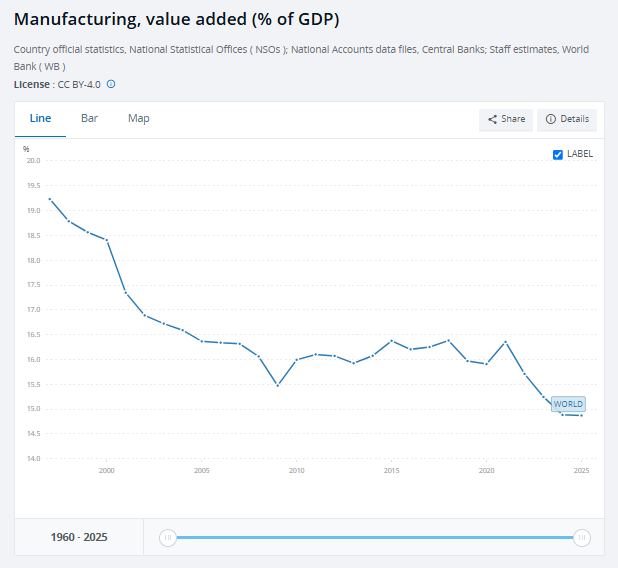
@gmchambers I can read statistics, yes. Industrial output (manufacturing if you prefer) has fallen as a percentage of global economic output in recent decades.
@Evanshm Not really, no. Nairu is a measure of how the microfoundations of the economy restrict macro policy choices. You can, after all, change Nairu by altering your labour market policies.....