$DELL earnings matter this week because it will show whether hyperscalers are actually deploying AI servers, or if the spending is still mostly going into chips and optics.
The important thing to pay attention to is AI servers and backlog, not a beat from PCs or storage.
If AI servers beat and they raise the backlog, GPUs, memory, connectivity, and optics usually go up with it.
If the beat is coming from PCs or storage and AI servers are only in-line, chips and optics may drop.
I've become more convinced over the last few years that if you come into trading solely to make $$, you're probably setting yourself up for disappointment.
I know that sounds weird coming from someone who has an unhealthy obsession with the market, but hear me out & yes, this gets much deeper than surface level.
I've tried to be concise with my wordage, so excuse me for the longer writeup.
First off... of course I care about making money. Don't we all to some degree??
I have bills to pay, goals I want to reach, and things I want to do with the people I care about. Money matters. But I've also realized that constantly thinking about "what I could make" has never once made me a better trader.
If anything, it's usually done the opposite. I've seen it with my own 2 blue eyes...
I've caught myself looking at a potential opportunity and immediately thinking, "If this works, that's a $10,000 trade." Before I've even clicked the buy button, I'm already mentally spending money I haven't made yet. And, psychologically speaking, I'm already attached to the OUTCOME rather than the PROCESS.
I hesitate to take a stop because I don't want to lose the potential. I take profits too early because I'm afraid they'll disappear. The trade hasn't changed... but my psychology has.
Personally, I don't think the number actually matters.
Let's think about it...
1) Someone out there is praying they can finally have their first profitable month.
2) Someone else wants to make enough to pay rent.
3) Another trader is trying to go from making $100 a day to $1,000 a day.
4) Another is frustrated because they're "only" making $10,000 a day and wants to get to $100,000.
I've realized we're all chasing a different #, and yet we're all chasing the exact same feeling. And the problem with feelings is they change from time to time.
I remember thinking, "If I can just get to this account size, I'll finally feel like I've made it." Then I got there.
It felt good... for about a good ole' 5 minutes.
Then my brain immediately found another mountain to climb. And you probably know how this goes...
Because of this, I've realized that if my happiness is always tied to the next milestone, I'm never actually going to ENJOY where I am. I'm just going to spend my entire career MOVING the goalposts.
So somewhere along the way, my relationship with trading began to slightly shift in a more positive light... I became less obsessed with the money and way more obsessed with figuring out WHO I AM.
Life's biggest questions:
1) where do we come from?
2) what is the meaning & purpose of life?
I believe if you sit down honestly with yourself, making $$ trading will not be at the top of that list.
Trading has this weird way of exposing every flaw you have. It doesn't care how smart you are, or your ego. It'll show you your impatience & show you your fears. Trading will show you how badly you want to be right, and exactly how disciplined you THINK you are v.s. how disciplined you actually are.
The majority hate this about trading... but realistically that's become the part I love. I hate to break it to you, but there is no mastery in this business. It's a never-ending industry of learning more about yourself.
I genuinely enjoy sitting down every weekend, reviewing my trades, and asking myself, "Where did I get in my own way this week?"
Not because I enjoy making mistakes. I think we all hate making the same mistakes over and over. It took me 2 years+ to figure out that every mistake teaches me something about myself.
I don't think I struggled for the first couple of years because I hadn't found some magical strategy. I think I struggled because I didn't have the emotional maturity to execute 1 system consistently.
I'd jump from scalping to day trading to swing trading. I'd read one new idea and convince myself it was the missing piece. I'd have one bad week and question everything instead of questioning my execution.
> I WASN'T LACKING INFORMATION.
> I was lacking DISCIPLINE.
That's why I always tell people who come to me who are interested in trading/investing to slow down & think more long-term. You don't need another strategy every freakin' week. You probably don't need another 100 indicators. And you definitely don't need to compare yourself to someone posting P&L screenshots on X all day.
What you need is one process that fits YOUR OWN personality, the humility to admit when you're wrong, and the patience to refine it over hundreds of trades.
I think social media makes this harder than ever because all we see is the tip of the iceberg. Massive gains + perfect entries & huge P&Ls. Nobody posts the years of confusion, the weekends spent reviewing mistakes, or the nights where they questioned whether they were ever going to figure this thing out.
I lived through those early years, and hell, I still have a lot more to learn about myself.
These days, I still care about making money. I just don't wake up thinking about it anymore. I wake up thinking about executing my process well & to the best of my ability.
Because I've learned that if I take care of the process long enough, the money usually takes care of itself. And if it doesn't... at least I'll know exactly what needs to improve next week.
What I believe now is a much healthier way to live than constantly chasing ##'s that were never going to satisfy me in the first place.
Choose the process & get rid of the ego.
This is my personal experience.
Best of luck, family!
- iain 🩵
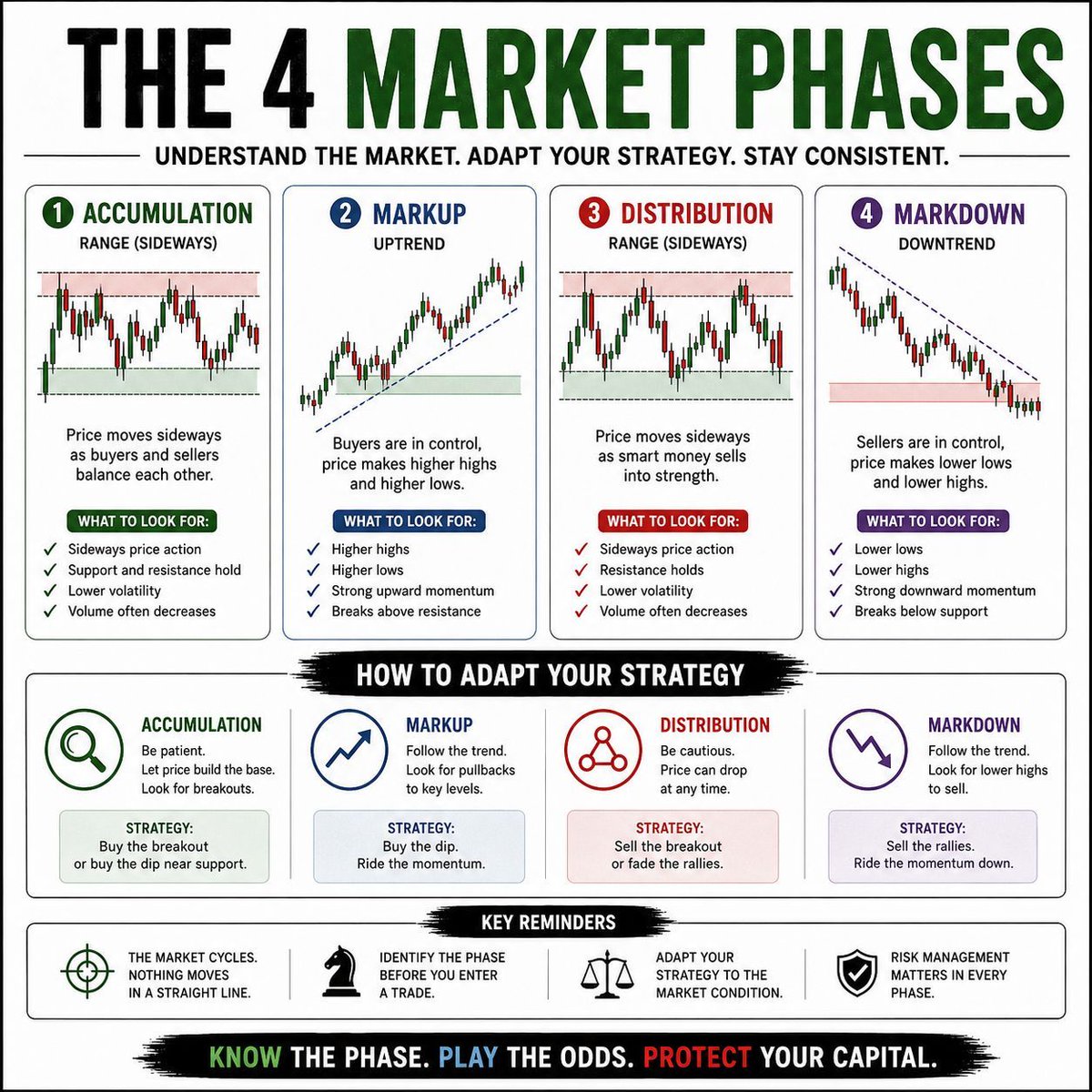
One of the biggest trading mistakes is using the same strategy in every market condition.
The market is always changing.
Sometimes it trends.
Sometimes it ranges.
Sometimes it breaks out.
Sometimes it breaks down.
The key is identifying the phase before you enter the trade.
📈 Markup = Higher highs and higher lows
📉 Markdown = Lower highs and lower lows
↔️ Accumulation = Building a base
↔️ Distribution = Smart money taking profits
Different environments require different approaches.
The traders who adapt survive.
The traders who force trades struggle.
Before your next trade, ask yourself:
What phase is the market in?
That single question can completely change your results.
Know the phase.
Play the odds.
Protect your capital.