🎉New publication alert!
🧠The key finding: Not all forms of ingroup positivity benefit ingroups. Collective narcissism may act as a “sweet poison”, fostering belief in ingroup conspiracy theories.
📝Read and download the full paper with open access:👇
https://t.co/htVLznmcDV
New publication in British Journal of Psychology.
The key finding: After perceiving health-related existential threats, individuals generate outgroup conspiracy beliefs through increased hypersensitive agency detection and illusory pattern perception.
https://t.co/583Smpo0CG
New publication alert!🎉
Excited to announce the publication of our latest paper, “Conspiracy Theories: Groups, Ideology, and Status as Three Distinct Bases for Expressions in Society”, in Current Directions in Psychological Science.
Read more here:
https://t.co/1DkZzonC9E
The NYU Social Psychology Program is looking for people passing through New York next year who want to share their research in our Speaker Series.
We welcome self-nominations and scholars from all career stages. Just add your info in this form:
https://t.co/0aTs0cpmkf
We often get emails from people visiting for sabbatical, conferences, etc. This is designed to make the process more open and accessible and help diversify our speaker series (funds normally limit our invitations to local scholars).
Thanks to @laura_k_globig and @KareenadelRosa : They will be coordinating and overseeing the NYU Social Program Speaker Series this year.
Please share with anyone who might be interested!
📢 Call for collaborators: Predictors of Political Violence Project 📢
We are launching a global study to learn more about the drivers of support for political violence, w/ a special focus on victimhood.
Sign up form: https://t.co/ToGPFyjrUH
Please share! More info 👇:
The spread of misinformation threatens democratic societies, hampering informed decision-making. Partisan identity biases perceptions of reality, promoting false beliefs.
Our new paper provides an Update of the Identity-based Model of Belief: https://t.co/PrRJWQlBIz
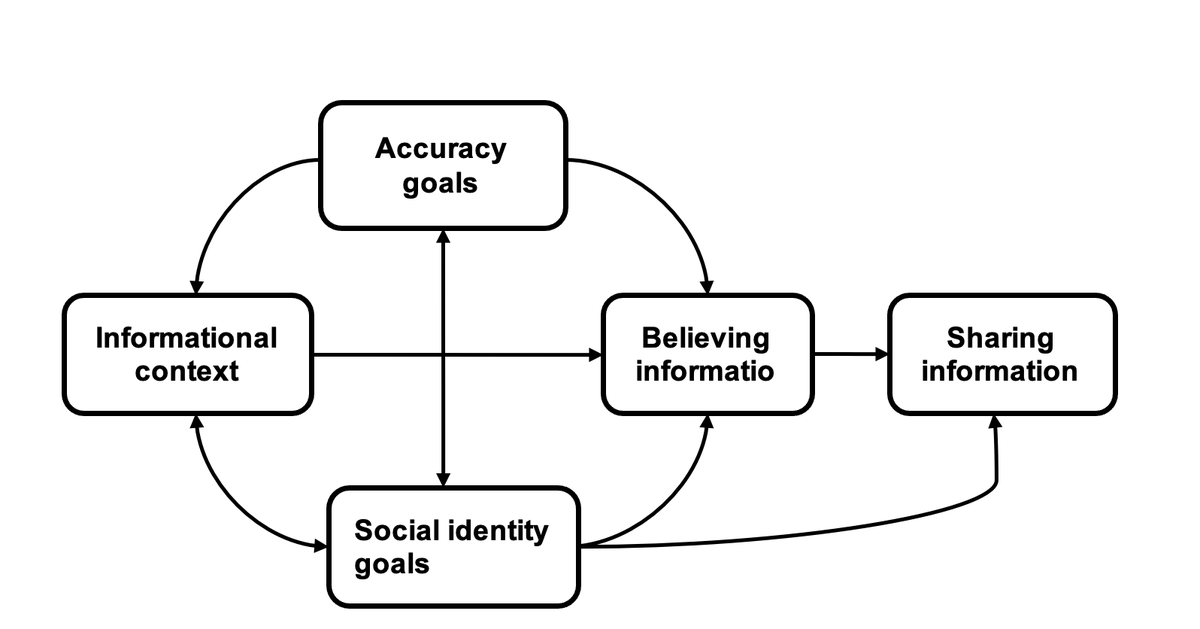
The Identity-based Model of Political Belief explains how social identity shapes information processing and contributes to misinformation.
According to this model, social identity goals can override accuracy goals, leading to belief alignment with party members rather than facts.
We propose an extended version of this model that incorporates the role of informational context in misinformation belief and sharing. Partisanship involves cognitive and motivational aspects that shape party members' beliefs and actions.
This includes whether they seek further evidence, where they seek that evidence, and which sources they trust. Understanding the interplay between social identity and accuracy is crucial in addressing misinformation.
This is an extension of my prior TICS paper and addresses the last 5 years of research on misinformation as well as several good critiques of our original paper: https://t.co/OFpX1JdDDH
Thanks to @vlasceanu_mada @steverathje2 and @ClaraPretus for helping me write this paper (which has been conditionally accepted at Current Opinion in Psychology)
We are hiring! Looking for a Level B/C continuing position in Social Psychology and/or Research Methods at the School of Psychology, The University of Queensland.
For full details see: https://t.co/RMeoTuv1d7
@BaoHWS Thank you! bruceR is awesome! The 1st round had only two reviewers, but lasted about four months. But my colleague's 1st round only took 2 months. So, it really depends. Hope everything goes well with you! Fingers crossed!🤞🏻😁
Our new paper is in the British Journal of Social Psychology. It’s my first time as the corresponding author, guidance and participate in the project. We explored the relationship between economic inequality and conspiracy theories in the context of China. https://t.co/w0r56viR6Q
** We have just posted an updated version of the conspiracy theory research database. You will find it on my webpage: https://t.co/TngvHX6p5f Happy reading! **
Welcome to access and share our new published article Explaining the paradox of conspiracy theories and system‐justifying beliefs from an intergroup perspective - Mao - Political Psychology - Wiley Online Library I hope you enjoyed this research! https://t.co/vtxiDItEBz
An interesting paper by Jiayan Mao et al:
Explaining the paradox of conspiracy theories & system-justifying beliefs
"Our findings suggest that ingroup conspiracy theories decrease system justification and outgroup conspiracy theories increase [it]."
https://t.co/1uYvufma85.