@kaidi_wu@AdamGalinsky Our recent findings on how Asian and Black men and women are stereotyped in natural language: Bao, H.-W.-S., & Gries, P. (2024). Intersectional race–gender stereotypes in natural language. British Journal of Social Psychology. https://t.co/uZNoEdl6et
@RichardHanania Our recent findings on how Asian and Black men and women are stereotyped in natural language: Bao, H.-W.-S., & Gries, P. (2024). Intersectional race–gender stereotypes in natural language. British Journal of Social Psychology. https://t.co/uZNoEdl6et
📢 MCI’s @BaoHWS & @PeterHaysGries just published an open access article on #intersectionality, using a new approach to Natural Language Processing to uncover prevalent stereotypes about Asian/Black men/women in the Anglophone world.
📽️ Article intro: https://t.co/0uGzrxDayw
I like this recommendation to report confidence intervals not as 3.5 [-2.0, 8.7] but as subscripts ₋₂.₀ 3.5 ₈.₇
https://t.co/FoSGb21BAD
Not the biggest thing, jut but seems a tiny bit easier to process.
Google Scholar automatic extraction from online PDF can annoyingly MISIDENTIFY author information (esp. for one with a strange name like me). My authorship of a recent manuscript PDF was wrongly identified by Google Scholar as a "row" of people listed in the acknowledgments (!).
📢 Enter the 2024 #International#Photo#Competition🇬🇧🇨🇳 and win cash prizes of up to £500!🏆💸
🤳 Use your smartphone to capture a #daily#ritual, add a short title and blurb, and submit them to [email protected] 📨
🔗 Full instructions: https://t.co/xu6yQksH2b
🚨 JOB ALERT: 2-year postdoc in China Studies at the #MCI 🚨
🏛️ Join us @OfficialUoM, a UK leader in China studies, to produce world-class research on #China with impact beyond academia.🌏
🔔 Apply by 1 March
📩 Enquiries: @PeterHaysGries
🔗 Learn more: https://t.co/B90L8Gsseo
@psy_john0416 Congrats! I got a notification of being cited. Thanks for using and citing bruceR! By the way, how long did it take for the 1st round review of your paper? I also have an article now being under review in BJSP.
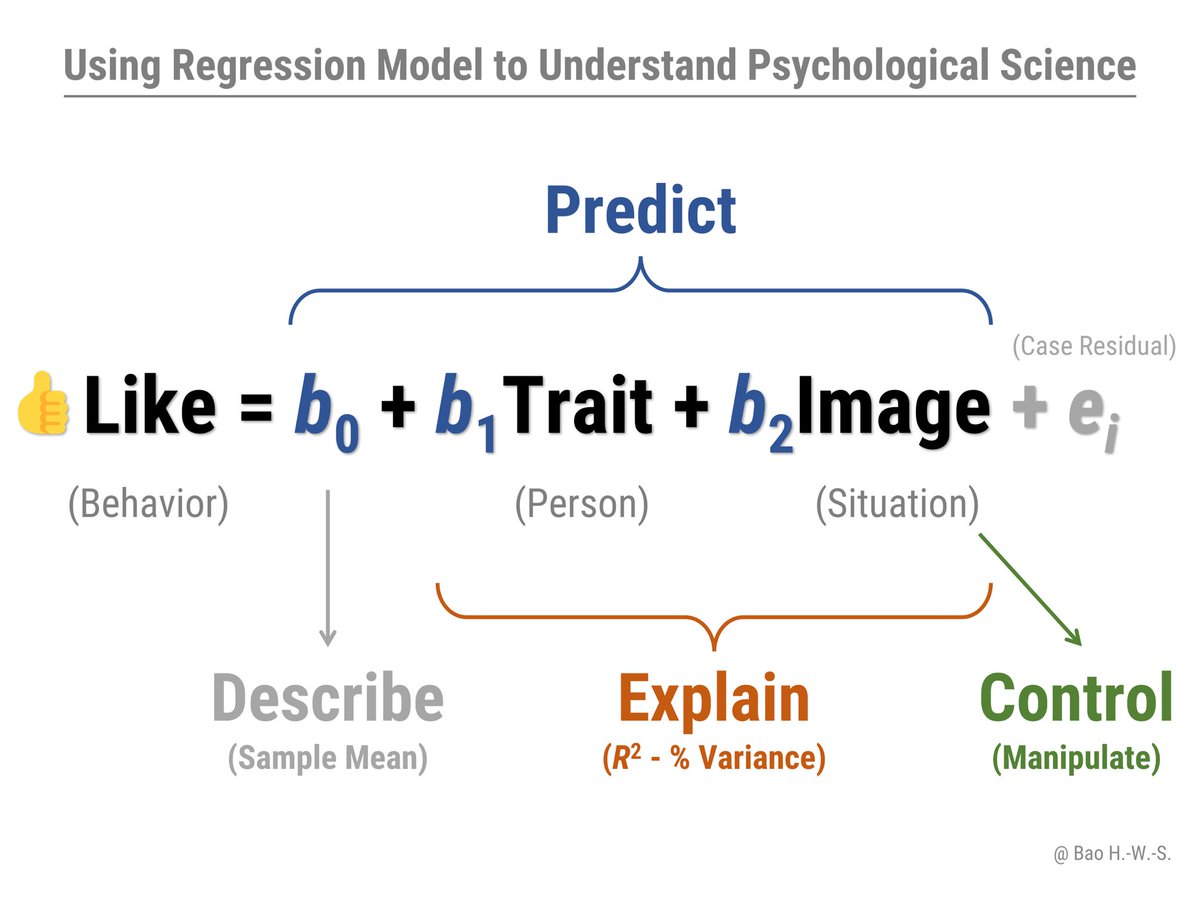
NOTE 2: The intercept (i.e., the expected Y value when all Xs = 0) can be interpreted as sample mean ONLY WHEN all predictor variables have been mean-centered.
Just a simple example illustrating what psychological studies typically do and seek for, using a formula of regression model. From here we see that psych science (or sometimes casually labelled as "quantitative study") is not only description and doesn't care about single cases.
NOTE: This example uses a trait variable (e.g., agreeableness of people who saw a tweet) and a situational variable that can be randomly manipulated (e.g., whether a tweet attaches an image) to predict their liking behavior.
@Ye_Tian_1223 Not sure, but at least not qualified for reviewing this paper, otherwise he/she would not use "complicated methods" but directly criticize the methods with reason or suggest better approaches. Again almost no quant person would say "quant" unless they talk to qualitative persons.
@Ye_Tian_1223 And qualitative scholars can provide good antecedent or anecdotal evidence, inspiring more systematic quant research. But they seem also to have some stereotypes of quant, like "only using numbers or complicated methods to describe common sense".
@Ye_Tian_1223 Well most "quant" reviewers (and scholars in general) never explicitly say "quant". Using quant methods has been an ordinary norm in scientific disciplines so that we rarely state "we are quant persons" but focus more on robustness, replicability, theoretical implications, etc.


![lakens's tweet photo. I like this recommendation to report confidence intervals not as 3.5 [-2.0, 8.7] but as subscripts ₋₂.₀ 3.5 ₈.₇
https://t.co/FoSGb21BAD
Not the biggest thing, jut but seems a tiny bit easier to process. https://t.co/QTzPzcxcOi](https://pbs.twimg.com/media/GLBTUjVXMAAhia9.jpg)