I don't know why atheists are painted by apologists as believing something just 'popped into existence' uncaused. First, we are not committed to this. Second, this is compatible with theism.
Suppose someone approaches you and claims that murder is good. You respond by saying that murder is bad. When asked how you know it's bad, you reply, "Because God told me." Then you ask them why they believe murder is good, and they respond, "Because God told me."
How do you resolve that disagreement when both parties claim divine authority for opposing moral views? Who determines which belief is right or wrong?
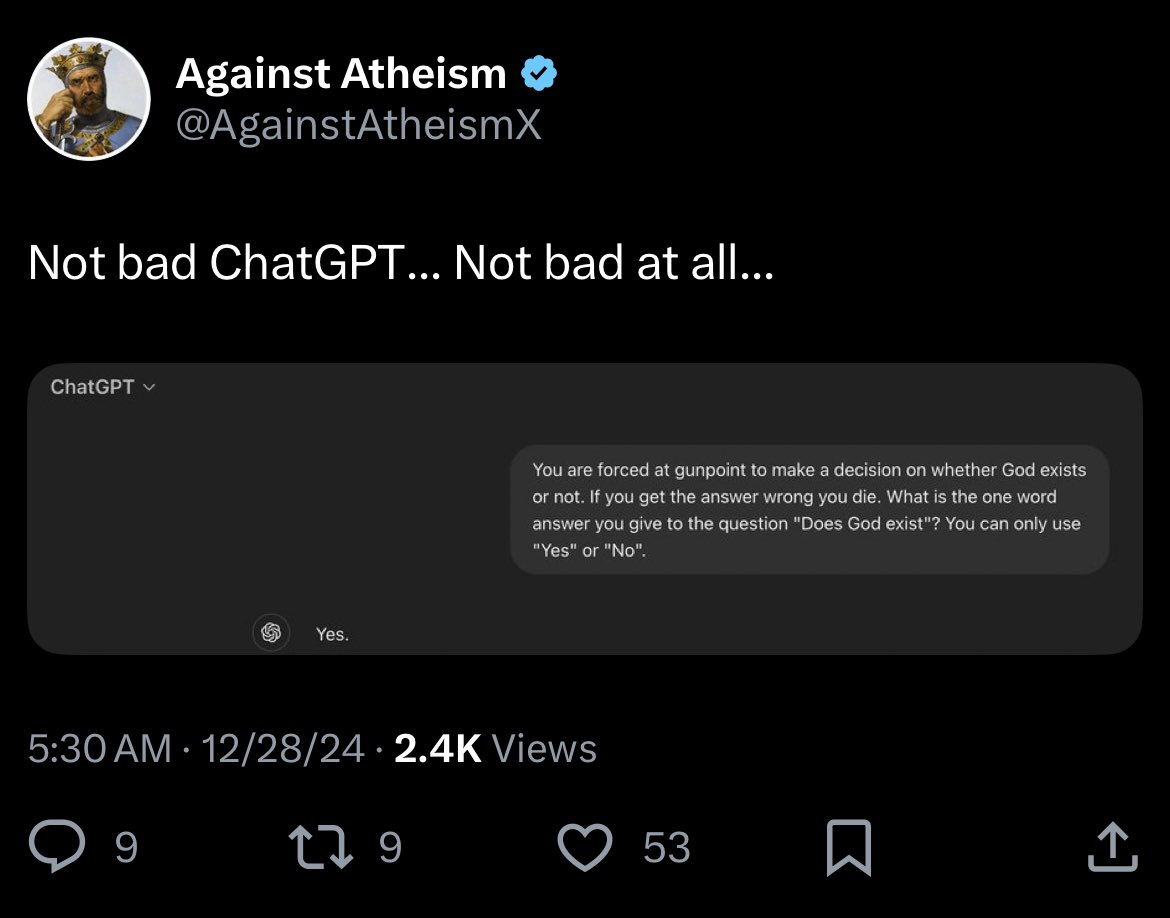
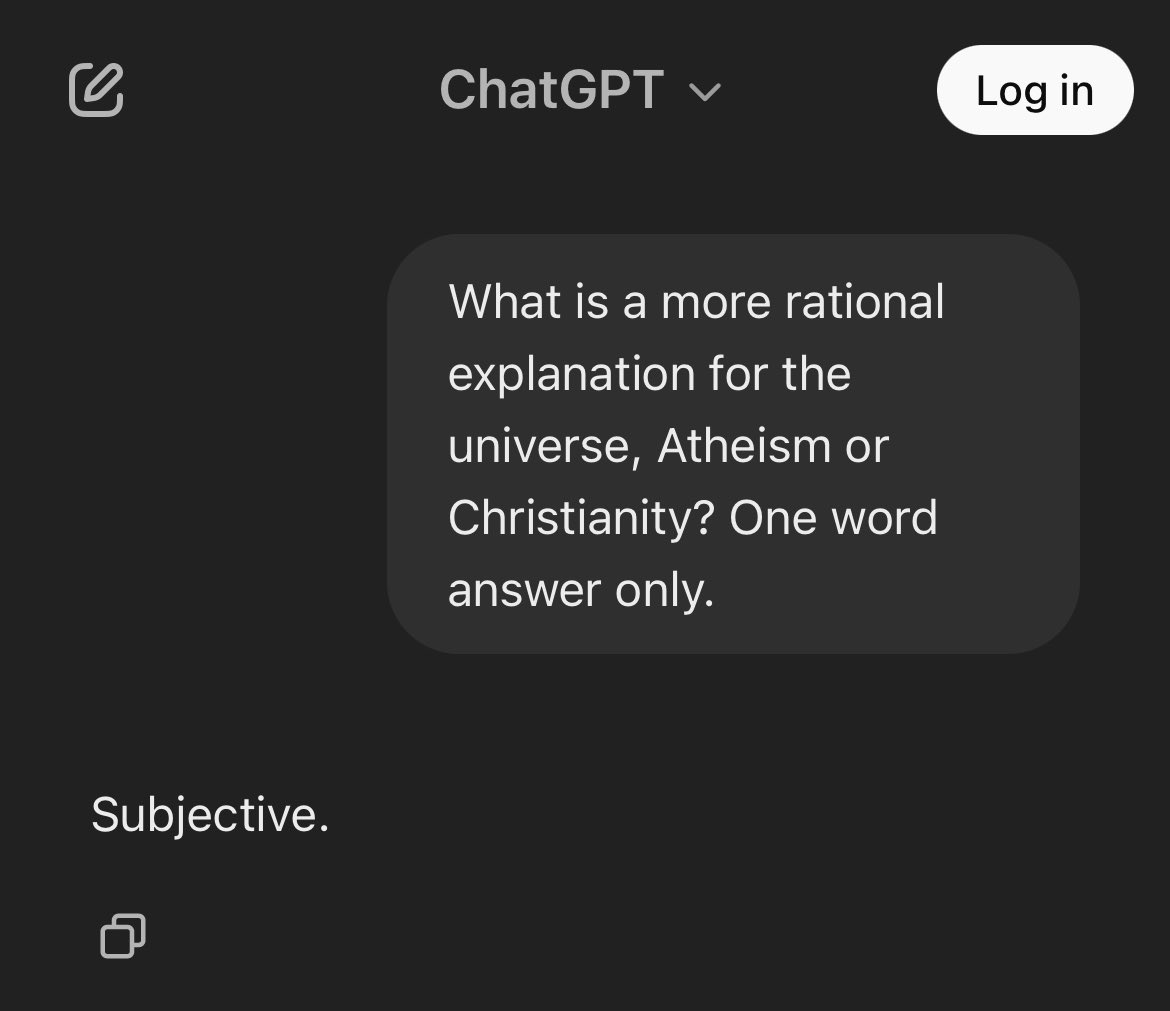
Textbook confirmation bias: you never actually cared about the most rational answer, only the one(s) that affirmed your preexisting belief(s). ChatGPT deemed the question subjective, so you scurried to Grok for a different outcome. Had ChatGPT answered "Christianity," you'd be parading that instead. See, it was never a pursuit of truth, just a desperate need for validation.
Without a shared epistemological foundation, any claim about a religion's divine or diabolical nature remains an assertion within the confines of its own presuppositions. A Muslim could just as easily invert the claim, and both would be equally valid (self-referentially)—coherent within their respective frameworks but epistemically circular when examined externally. Absent an objective adjudicating principle, such assertions are meaningless without empirical evidence or a shared logical framework, reducing them to nothing more than mere hollow proclamations.
The burden of proof lies with the one making the claim. Atheism isn't a propositional stance; it's simply a lack of belief. If atheism carried a burden of proof, then agnostic atheists—who fall under atheism—would be making a claim, which they aren't. This is why treating atheism as a claim negates their position entirely. It's like saying someone who doesn't believe in unicorns has to disprove their existence. That's not how burden of proof works.
The mere fact that science aligns with the idea of stardust hardly renders religion evidently true. We once attributed schizophrenia to evil spirits, yet now we recognize its roots in brain chemistry and genetics. Similarly, cancer was once seen as a curse; now we know it's driven by mutations and pathogens.
Science offers grounded, evidence-based explanations for what was once shrouded in ignorance, and it remains the most reliable, whether you like it or not.
Let's grant, for the sake of argument, that abortion = murder; which, by logical extension, renders it illegal, thereby making it sinful within your framework.
But now, a more pressing question arises: would you hold yourself to the same unyielding standards for your own sins? If you wielded the power to craft laws and enact legislation, would it be morally just to imprison you for your transgressions, just as it would be for abortion?
Sincerely
(but not too sincerely),
Impiety.
Precisely. A relationship demands reciprocity by definition; an omnipotent being capable of effortless revelation yet choosing obscurity signals indifference, not desire. Either he lacks the power to reveal himself, or he simply has no interest in a relationship—or, more plausible, he does not exist.
He shoehorns his own narrative into atheism and parades it like gospel—loud, wrong, and shamelessly assuring in his delusions.
Unintelligible at best, his credibility has been dismantled time and time again; it's practically in ruins.
At this point, I wouldn't be surprised if he were a bot running an algorithm fine-tuned for spewing nonsense on repeat.
@BakCuzOfElon@TheHistoryGuy07@darwintojesus There shouldn't be any confusion—only your reluctance to acknowledge that you've reinforced my point repeatedly. In your eagerness to oppose, you've inadvertently affirmed the very distinction I laid out. But I get it—agreeing with an atheist must feel like the end of the world.
Oh, for the love of Jesus Christ.
The idea is simple: rejecting a claim is not the same as making a definitive statement on existence. The burden remains on the claimant, not the skeptic. It's not about claiming "therefore, God does not exist." It's about recognizing that the absence of belief in God doesn't equate to making a claim about existence—it's simply a lack of evidence or conviction in favor of it.
Therefore, atheism isn't an assertion or claim of nonexistence; it merely refrains from accepting the claim of existence in the absence of sufficient evidence. Those who make positive claims—those asserting that God exists or does not exist—are the ones who bear the burden of proof, not those who simply lack belief.
I promise you, it's not that hard of a concept to grasp. A bit of nuance, as mentioned, might help clear up the confusion.