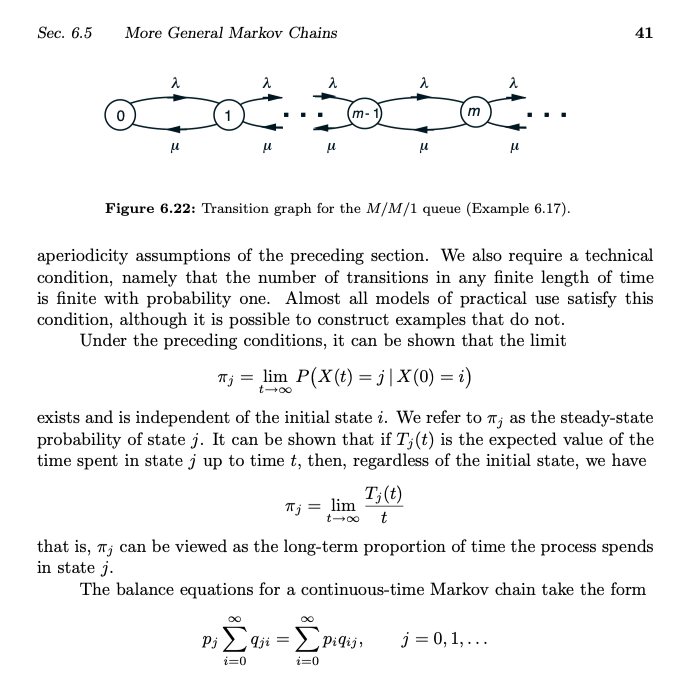
"Introduction to Probability" is an excellent set of freely available MIT lecture notes on probability theory.
The book covers probabilistic models, conditional probability, independence, Bayes' rule, discrete and continuous random variables, probability distributions, expectation, variance, covariance, correlation, conditional expectation, transforms and convolutions, Bernoulli and Poisson processes, Markov chains, the laws of large numbers, and the central limit theorem.
The explanations are clear, the mathematics is rigorous without being unnecessarily complicated, and the book includes many examples and problems with complete solutions. It is especially useful for self-study or as a reference when you need to review a specific topic in probability.
Save it to your bookmarks. It may be useful.
https://t.co/MEBjTdhPgy
@paulg I wouldn’t do that. I would want to understand how LLMs work, will read about it, will realize that it’s a big “black box” between inputs and outputs, and will lose interest.
The statement “abortion is morally permissible” is a prescriptive statement. The statement “panpsychism is true” is a descriptive statement. I don’t think the comparison between philosophical theories and abortion works.
Physicalism, dualism, panpsychism, and idealism are *philosophical theories*.
The scientific data on consciousness is, and always will be, neutral between all of these.
It's like asking: How can we test experimentally the thesis that abortion is morally permissible?
@Philip_Goff ….the philosophical theories. Just because a theory is proposed in philosophy doesn’t make it neutral and exempt from inductive probabilistic interpretations
@Philip_Goff The statement “abortion is morally permissible” is a prescriptive statement. The statement “panpsychism is true” is a descriptive statement. I don’t think the comparison you’re making here works. You need better premises to support the claim ‘scientific data is neutral between…
@MacrinePhD “40% of voxels with significant BOLD changes during various tasks showed reverse oxygen metabolism particularly in the DMN”
That’s the expected result considering the brain doesn’t recruit DMN during active tasks. IMO the story here is consistent with classic fMRI interpretations