@ImSandroGarcia@ElevenLabs O correto, dado o contexto de alcance global da marca, é fornecer todas as variações do idioma. Mesmo que, tecnicamente, pt-BR seja tratado como o padrão.
@ImSandroGarcia@ElevenLabs Trazendo um pouco mais de contexto, para evitar debate desnecessário: o português é uma língua pluricêntrica. Portanto, muitas empresas se baseiam em dados ao fornecer uma, ou mais, variante de um idioma. O CLDR do Unicode Consortium define o pt-BR como sendo o padrão para "pt".
Watch a team of humanoid robots running a full 8-hr shift at human performance levels. This is fully autonomous running Helix-02 https://t.co/IdZR0T1F5I
@videotech Os cara compra a versão mais cara com acesso antecipado mas a @Microsoft@Xbox@ForzaHorizon libera pra galera de graça 😂😂 é um tapa na cara de quem comprou
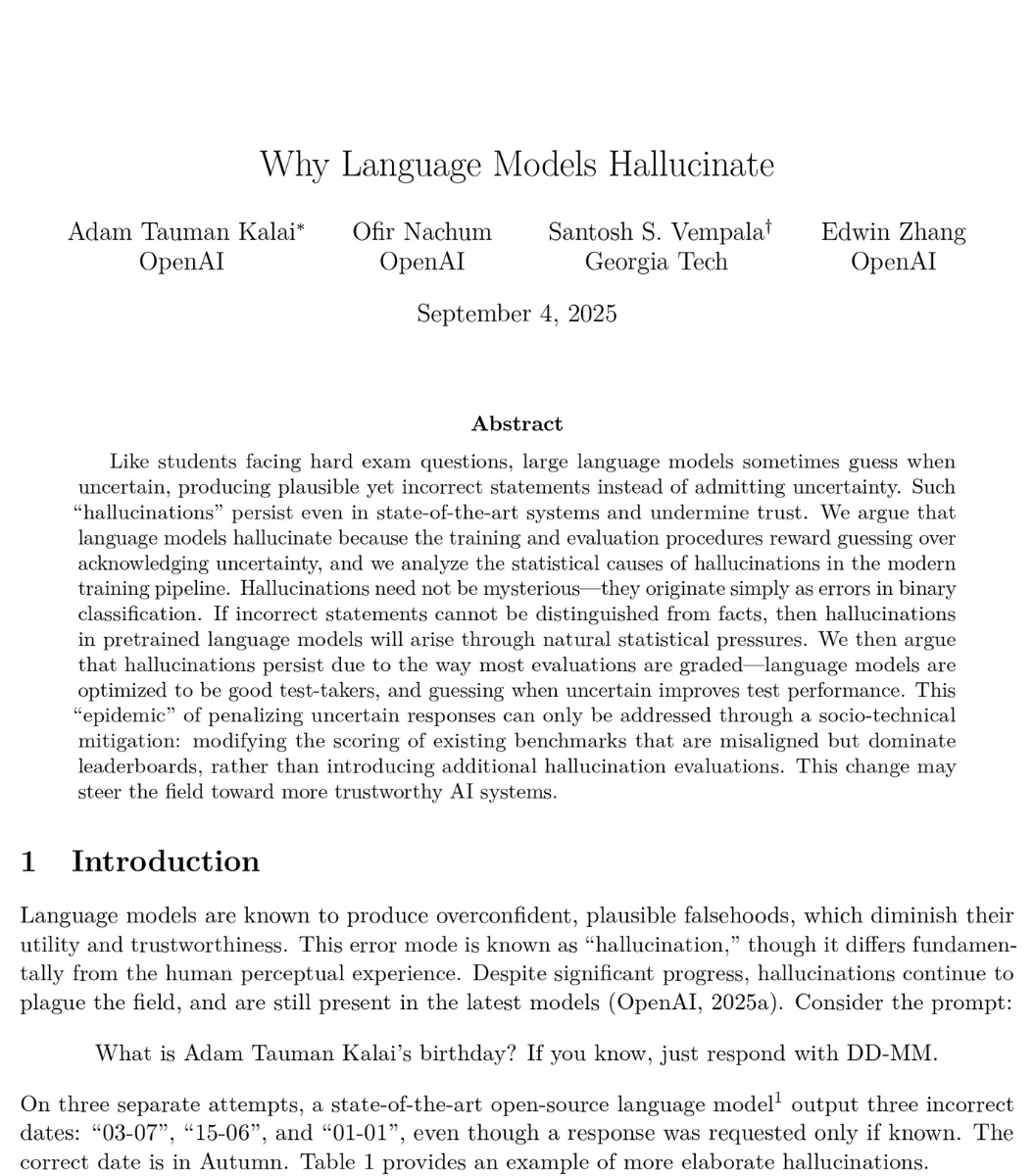
🚨BREAKING: OpenAI published a paper proving that ChatGPT will always make things up.
Not sometimes. Not until the next update. Always. They proved it with math.
Even with perfect training data and unlimited computing power, AI models will still confidently tell you things that are completely false. This isn't a bug they're working on. It's baked into how these systems work at a fundamental level.
And their own numbers are brutal. OpenAI's o1 reasoning model hallucinates 16% of the time. Their newer o3 model? 33%. Their newest o4-mini? 48%. Nearly half of what their most recent model tells you could be fabricated. The "smarter" models are actually getting worse at telling the truth.
Here's why it can't be fixed. Language models work by predicting the next word based on probability. When they hit something uncertain, they don't pause. They don't flag it. They guess. And they guess with complete confidence, because that's exactly what they were trained to do.
The researchers looked at the 10 biggest AI benchmarks used to measure how good these models are. 9 out of 10 give the same score for saying "I don't know" as for giving a completely wrong answer: zero points. The entire testing system literally punishes honesty and rewards guessing.
So the AI learned the optimal strategy: always guess. Never admit uncertainty. Sound confident even when you're making it up.
OpenAI's proposed fix? Have ChatGPT say "I don't know" when it's unsure. Their own math shows this would mean roughly 30% of your questions get no answer. Imagine asking ChatGPT something three times out of ten and getting "I'm not confident enough to respond." Users would leave overnight. So the fix exists, but it would kill the product.
This isn't just OpenAI's problem. DeepMind and Tsinghua University independently reached the same conclusion. Three of the world's top AI labs, working separately, all agree: this is permanent.
Every time ChatGPT gives you an answer, ask yourself: is this real, or is it just a confident guess?
@daniellimae Sugiro usarem um status page. Fica muito fácil atualizar, e até automatizar, e os clientes fazem subscrição para receber da forma que quiserem.