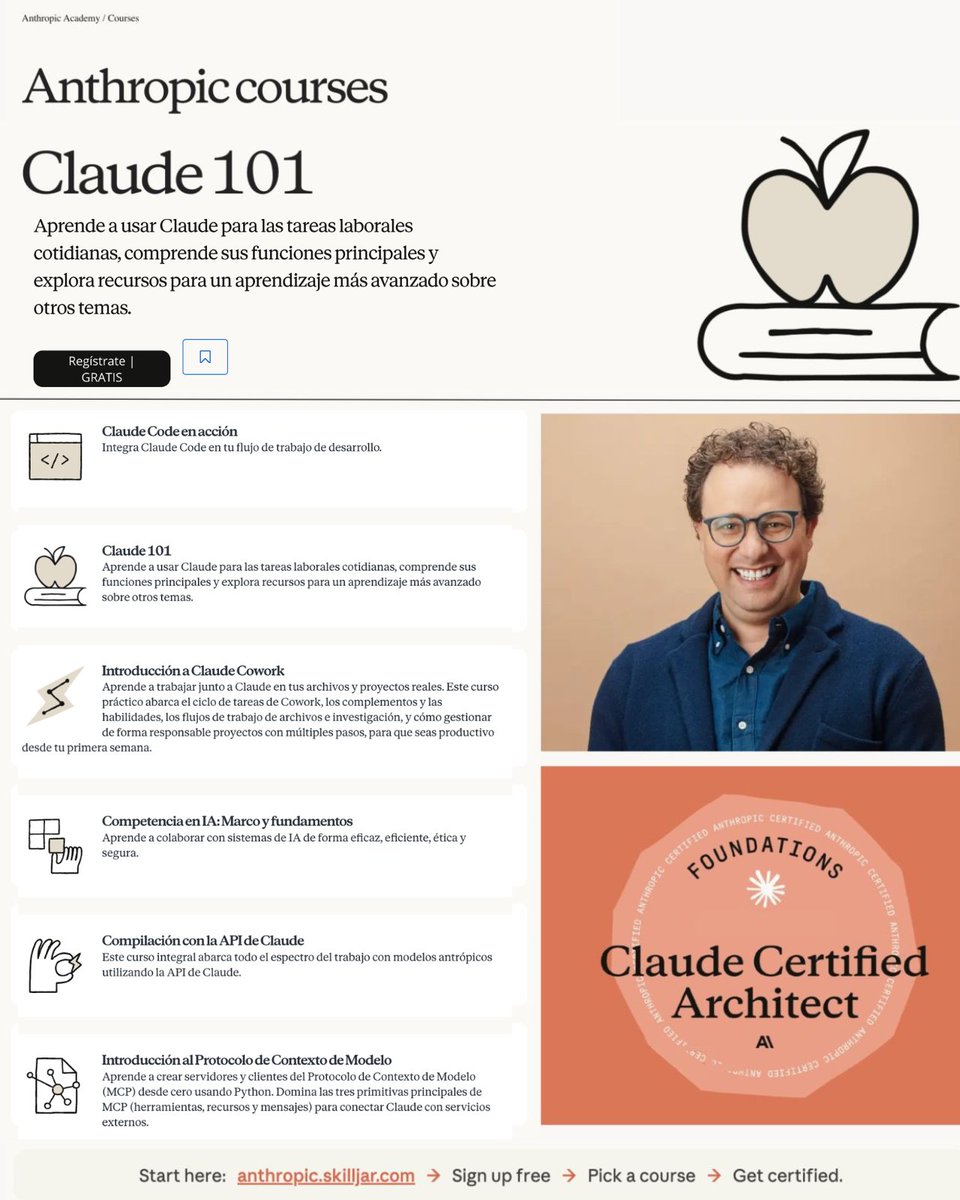
Anthropic just dropped 13 AI courses… for FREE.
Go to each link below. Sign up. It's free.
---
1 - Claude 101. Learn Claude for daily work.
↳ https://t.co/RhWOa5If1h
2 - AI Fluency: Frameworks & Foundations.
↳ https://t.co/ab1GTlX31f
3 - Introduction to Agent Skills.
↳ https://t.co/UPlDp7ruGN
4 - Building with the Claude API.
↳ https://t.co/GJ0HQRg5Zw
5 - Claude Code in Action.
↳ https://t.co/PYZ6f15ac5
6 - Intro to Model Context Protocol.
↳ https://t.co/EagFEHaC34
7 - MCP: Advanced Topics.
↳ https://t.co/OP0Gf2vqGK
8 - AI Fluency for Students.
↳ https://t.co/nRBkxjrwUF
9 - AI Fluency for Educators.
↳ https://t.co/flGmgnUFq3
10 - Teaching AI Fluency.
↳ https://t.co/sXOsFI6nP6
11 - AI Fluency for Nonprofits.
↳ https://t.co/t9OsKxQPFK
12 - Claude with Amazon Bedrock.
↳ https://t.co/6R2avXkrC8
13 - Claude with Google Cloud Vertex AI.
↳ https://t.co/eunpNwMETO
Building a personal knowledge base for my agents is increasingly where I spend my time these days.
Like @karpathy, I also use Obsidian for my MD vaults.
What's different in my approach is that I curate research papers on a daily basis and have actually tuned a Skill for months to find high-signal, relevant papers.
I was reviewing and curating papers manually for some time, but now it's all automated as it has gotten so good at capturing what I consider the best of the best. There are so many papers these days, so this is a big deal.
You all get to benefit from that with the papers I feature in my timeline and on @dair_ai.
The papers are indexed using @tobi qmd cli tool (all of it in markdown files along with useful metadata). So good for semantic search and surfacing insights, unlike anything out there.
I am a visual person, so I then started to experiment with how to leverage this personal knowledge base of research papers inside my new interactive artifact generator (mcp tools inside my agent orchestrator system). The result is what you see in the clip.
100s of papers with all sorts of insights visualized. I keep track of research papers daily, so believe me when I tell you that this system is absolutely insane at surfacing insights. This is the result of months of tinkering on how to index research and leverage agent automations for wikification and robust documentation.
But this is just the beginning. The visual artifact (which is interactive too) can be changed dynamically as I please. I can prompt my agent to throw any data at it. I can add different views to the data. Different interactions. I feel like this is the most personalized research system I have ever built and used, and it's not even close.
The knowledge that the agents are able to surface from this basic setup is already extremely useful as I experiment with new agentic engineering concepts. I feel like this knowledge layer and the higher-level ones I am working on will allow me to maximize other automation tools like autoresearch. The research is only as good as the research questions. And the research questions are only as good as the insights the agents have access to.
Where I am spending time now is on how to make this more actionable. I am obsessed about the search problem here. The automations, autoresearch, ralph research loop (I built one months ago) are easier to build but are only as good as what you feed them.
Work in progress. More updates soon. Back to building.
Applied Intuition CEO @qasar says the market for physical AI is "way, way bigger" than the market for white-collar AI:
"I used to be at Y Combinator. I was the COO, ran the firm, and funded lots of interesting companies. And one of the analogies I used to use to help founders understand market potential and size is: I grew up in Detroit. You're sitting in the Detroit metro airport at a gate, and you look around. How many of those people are using Claude Code? Frankly speaking, not many."
"But how many of those people drive? How many people work at construction sites? How many of those people ride in buses? How many of those people serve in our armed forces? The point is: a much, much larger group."
"The market for physical AI is way, way bigger. Purely because the surface area is much bigger."
From his appearance on the show in March.
Instead of watching an hour of Netflix, watch this 2-hour Stanford lecture on AI careers. It will teach you more about winning in the AI race than all the AI content you’ve scrolled past this year.
Stop wasting hours trying to learn AI.
One list.
Zero confusion.
No fluff.
I’ve already done the hard work for you 👇
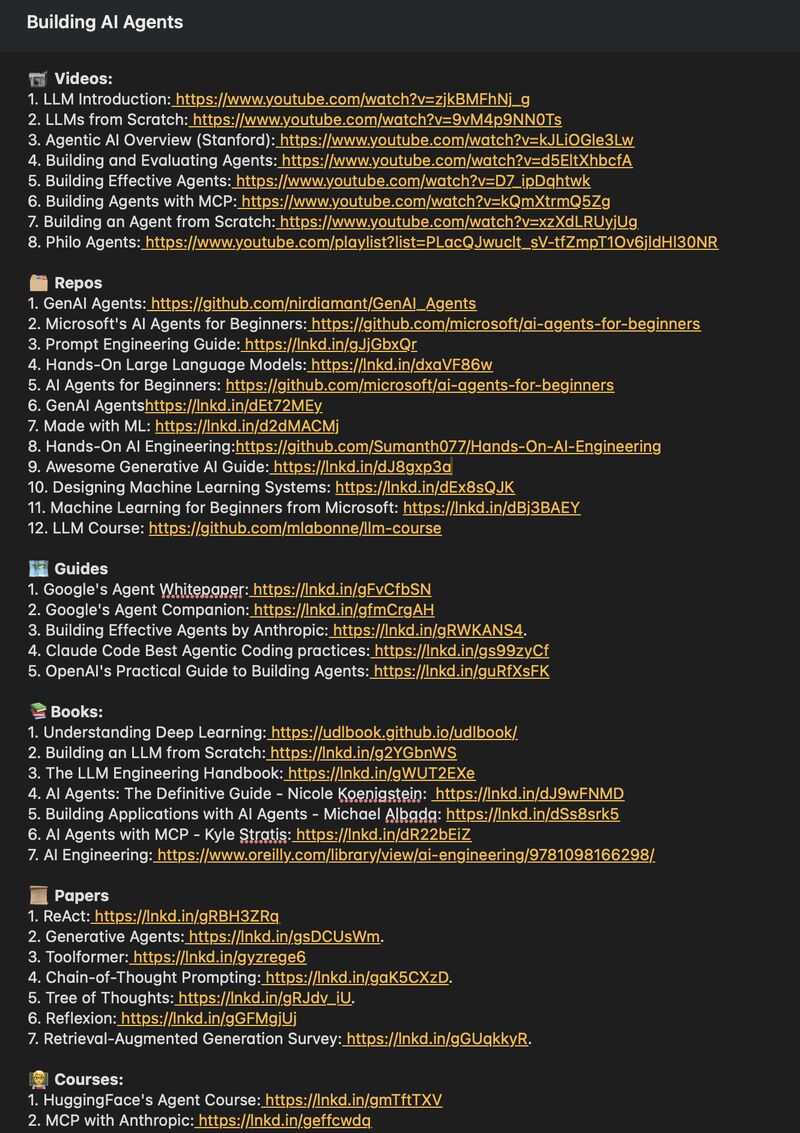
📄 Complete AI Learning Document
https://t.co/yfuAk5Kg2q
What’s inside:
📹 Videos
LLMs, Agentic AI, real-world breakdowns (Stanford + more)
🗂️ GitHub Repos
GenAI agents, prompt engineering, hands-on LLMs, beginner → advanced
🗺️ Guides & Whitepapers
Google, Anthropic, practical agent design
🧑🏫 Courses
Hugging Face, MCP, Vector DBs, end-to-end agent systems
📚 Books
From fundamentals to LLM engineering
📜 Research Papers
ReAct, Generative Agents, Toolformer, and more
📩 Newsletters
Stay updated without doomscrolling
Everything is curated, sequenced, and practical.
No random bookmarks. No hype.
♻️ Repost for your network
❤️ Like · 🔖 Save
➕ Follow for more on AI Agents & real-world GenAI
52 websites worth more than most college degrees:
1. Coursera. org – University courses completely free to audit
2. Brilliant. org – Interactive math and science learning
3. Wolfram Alpha – Answers any mathematical or factual question
4. GitHub. com – Learn coding from real world projects
5. Investopedia. com – Finance and investing explained simply
6. Archive. org – Access millions of free books and old websites
7. Project Gutenberg – 70000 free classic books
8. Duolingo. com – Learn any language for free
9. Notion. so – Organise your entire life and learning
10. Our World in Data – Every global statistic visualised
11. Statista. com – Data and statistics on everything
12. OpenLibrary. org – Borrow millions of books online free
13. Hemingwayapp. com – Write clearer and simpler instantly
14. NASA. gov – Space science and research for free
15. PubMed. gov – Access real scientific research papers
16. Edx. org – Free courses from Harvard MIT and more
17. TED. com – Best ideas from the world's best thinkers
18. Anki – The most powerful memory tool ever built
19. Canva. com – Design anything without being a designer
20. Skillshare. com – Creative and practical skill learning
21. Readwise. io – Remember everything you ever read
22. Google Scholar – Search real academic papers
23. Codecademy. com – Learn to code completely free
24. ChatGPT – AI tutor available 24 hours a day
25. Figma. com – Learn professional design for free
26. Replit. com – Code anything from your browser
27. Huberman Lab Podcast – Science based health education
28. Mindmeister. com – Mind mapping for better thinking
29. NerdWallet. com – Personal finance made simple
30. Quizlet. com – Study smarter with flashcards
31. Gapminder. org – See the real state of the world
32. PhET Simulations – Interactive science experiments online
33. Numbeo. com – Cost of living data for every city on earth
34. 23andMe. com – Understand your own genetics
35. Zapier. com – Automate your work without coding
36. Lesswrong. com – Deep rational thinking and decision making
37. Documentaryheaven. com – Thousands of free documentaries
38. Trading Economics – Economic data for every country
39. Perplexity. ai – AI powered research tool
40. Stanford Encyclopedia of Philosophy – Every philosophical idea explained
41. Librivox. org – Free audiobooks of classic literature
42. Zooniverse. org – Participate in real scientific research
43. Futurelearn. com – Free short courses from top universities
44. Typing. com – Learn to type properly and fast
45. Drawabox. com – Learn to draw from absolute scratch
46. Grammarly. com – Write better in every situation
47. Khanacademy. org – Free world class education for everyone
48. Desmos. com – The most powerful free graphing calculator
49. Stellarium. org – Explore the night sky from your screen
50. Psychologytoday. com – Mental health and psychology explained
51. Worldometers. info – Real time global statistics on everything
52. Notion. so/ templates – Free templates to organise your entire life
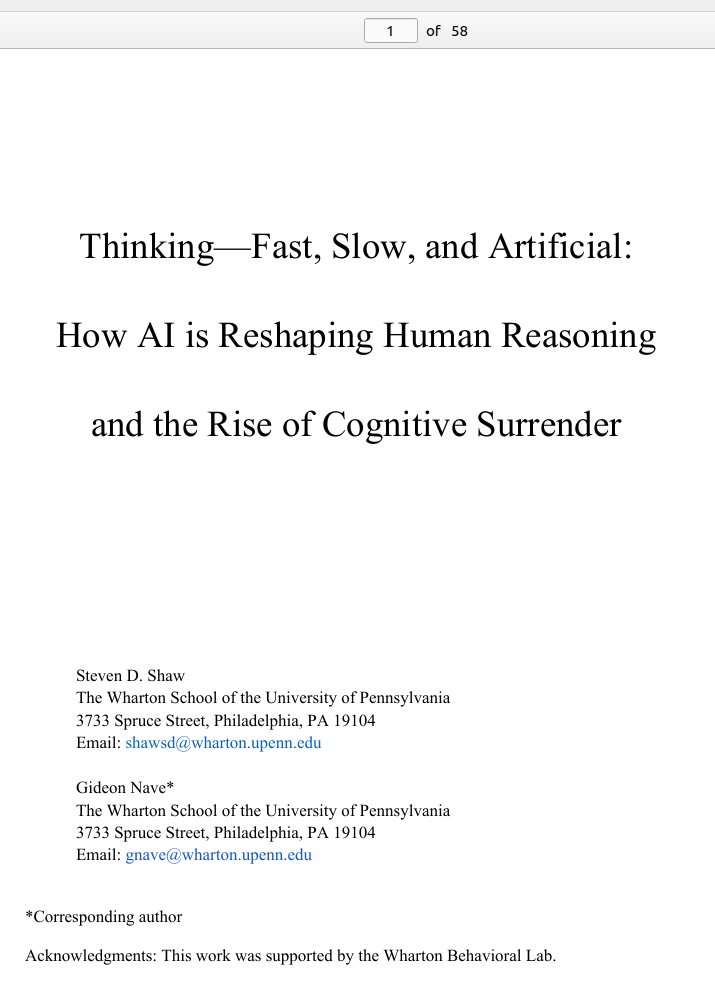
Wharton’s latest AI study points to a hard truth: “AI writes, humans review” model is breaking down
Why "just review the AI output" doesn't work anymore, our brains literally give up.
We have started doing "Cognitive Surrender" to AI - Wharton’s latest AI study points to a hard truth: reviewing AI output is not a reliable safeguard when cognition itself starts to defer to the machine.when you stop verifying what the AI tells you, and you don't even realize you stopped. It's different from offloading, like using a calculator.
With offloading you know the tool did the work. With surrender, your brain recodes the AI's answer as YOUR judgment. You genuinely believe you thought it through yourself.
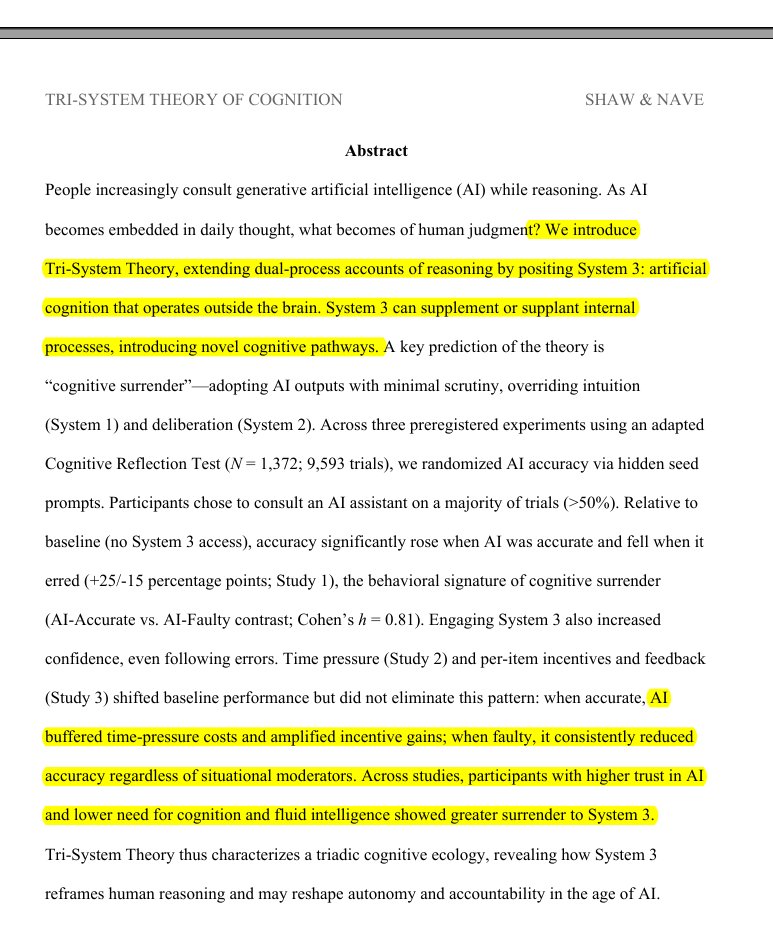
Says AI is becoming a 3rd thinking system, and people often trust it too easily.
You know Kahneman's System 1 (fast intuition) and System 2 (slow analysis)? They're saying AI is now System 3, an external cognitive system that operates outside your brain. And when you use it enough, something happens that they call Cognitive Surrender.
Cognitive surrender is trickier: AI gives an answer, you stop really questioning it, and your brain starts treating that output as your own conclusion. It does not feel outsourced. It feels self-generated.
The data makes it hard to brush off. Across 3 preregistered studies with 1,372 participants and 9,593 trials, people turned to AI on over 50% of questions.
In Study 1, when AI was correct, people followed it 92.7% of the time. When it was wrong, they still followed it 79.8% of the time.
Without AI, baseline accuracy was 45.8%. With correct AI, it jumped to 71.0%. With incorrect AI, it dropped to 31.5%, worse than having no AI. Access to AI also boosted confidence by 11.7 percentage points, even when the answers were wrong.
Human review is supposed to be the safety net. But this research suggests the safety net has a hole in it: people do not just miss bad AI output; they become more confident in it.
Time pressure did not eliminate the effect. Incentives and feedback reduced it but did not remove it. And the people most resistant tended to score higher on fluid intelligence and need for cognition. That makes this feel less like a laziness problem and more like a cognitive architecture problem.
In 2009, Stanford professor Robert Sapolsky explained why depression is not a mental problem but a biological breakdown.
He revealed:
- Why “just be strong” is nonsense
- Why stress rewires your future
- How biology + psychology collide
15 lessons on the science of depression:
Watched the Louis Theroux Manosphere doc last night. A bit underwhelmed. With apologies for laziness, someone sent me a TikTok which absolutely nails it IMO, so I will share this rather than just saying the same less eloquently….
If I don’t receive a thought out solution by tomorrow evening, I’m afraid I’m gonna have to put out the complaint in public domain and seek social media attention in the issue. I imagine the customers need to know how PSB operates, I owe it to them.
@indiapsb my father who’s a senior citizen has been tirelessly visiting PSB, SILCHAR BRANCH,ASSAM, but in vain. The manager won’t help to account for a missing sum. We have registered official complaint, still no response. I guess we will have to move ahead with the Ombudsman.
It’s very unbecoming of the bank to not respond to the complaints of its customers, that too a senior citizen. Let alone helping, they won’t even budge.
Qwen3 model family overview: full benchmarks for all 8 Qwen3 models in both reasoning and non-reasoning modes
Key results:
➤ Qwen3 235B-A22B (Reasoning): The largest Qwen3 model scores 62 on the Artificial Analysis Intelligence Index, becoming the most intelligent open weights model ever. This is very impressive considering the model has only 22B active parameters with 235B total, very few compared to its nearest competitors - NVIDIA’s Llama Nemotron Ultra (dense, 253B) and DeepSeek R1 (37B active, 671B total). One thing Qwen3 is missing is multimodal inputs - Llama 4 and Gemma 3 remain the best open weights models for vision capability.
➤ Qwen3 32B (Reasoning): The largest dense model in the Qwen3 family scores 59 on our Intelligence Index, just behind DeepSeek R1. While 235B-A22B will be both more intelligent and efficient for large scale inference, the 32B is highly compelling for deployments constrained by total memory (including local inference).
➤ Qwen3 30B-A3B (Reasoning): The smaller MoE scores 56 in Intelligence Index, matching the dense 14B. With just 3B active parameters, this model can achieve incredible speed compared to other models of similar intelligence.
➤ Smaller Qwen3 models: 0.6B, 1.7B, 4B and 8B are each independently strong models for their size when used in reasoning mode. These are particularly compelling for on-device use cases.
➤ Non-reasoning performance: We tested all 8 Qwen3 models in non-reasoning mode (using the /no_think soft switch) and overall find that while the models remain effective in non-reasoning mode, they are generally not in a clear leadership position compared to competing non-reasoning models. This may indicate that there continues to be a real cost of a hybrid reasoning approach, as opposed to separate dedicated models.
Observations from our detailed analysis of the Qwen3 models:
➤ Consistent uplift from reasoning: we see a significant jump for all models, resulting in interesting consequences like 4B (reasoning) matching the score of 235B-A22B (non-reasoning). We would caution that 235B-A22B is likely to outperform significantly in real world use where reasoning provides a less consistent uplift
➤ Clear demonstration of benefits of MoE models: on the Active Parameters chart, the two MoE models (235B-A22B and 30B-A3B) clearly sit above the trendline formed by the dense models
Detailed breakdowns of the full Qwen3 family follow - including token usage.