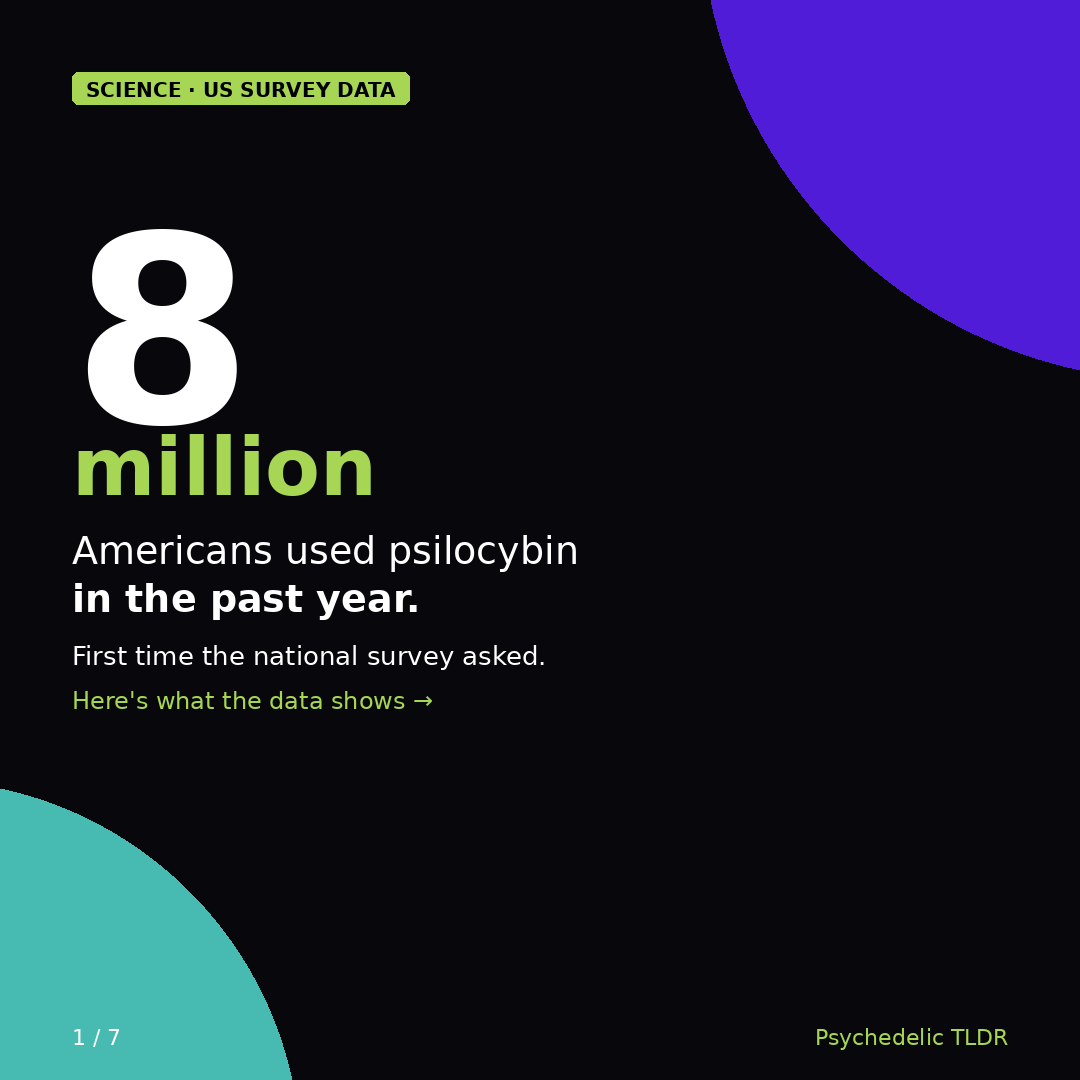
For the first time, the National Survey on Drug Use and Health asked specifically about psilocybin.
The answer: 2.8% of Americans 12+ used it in the past year.
That's roughly 8 million people. 🧵
8 million past-year users, independent of any clinical trial population.
That's the first real addressable-market number for psilocybin products and services in the U.S.
This week's full psychedelic medicine roundup: https://t.co/ldrxhyOSgT
For the first time, the National Survey on Drug Use and Health asked specifically about psilocybin.
The answer: 2.8% of Americans 12+ used it in the past year.
That's roughly 8 million people. 🧵
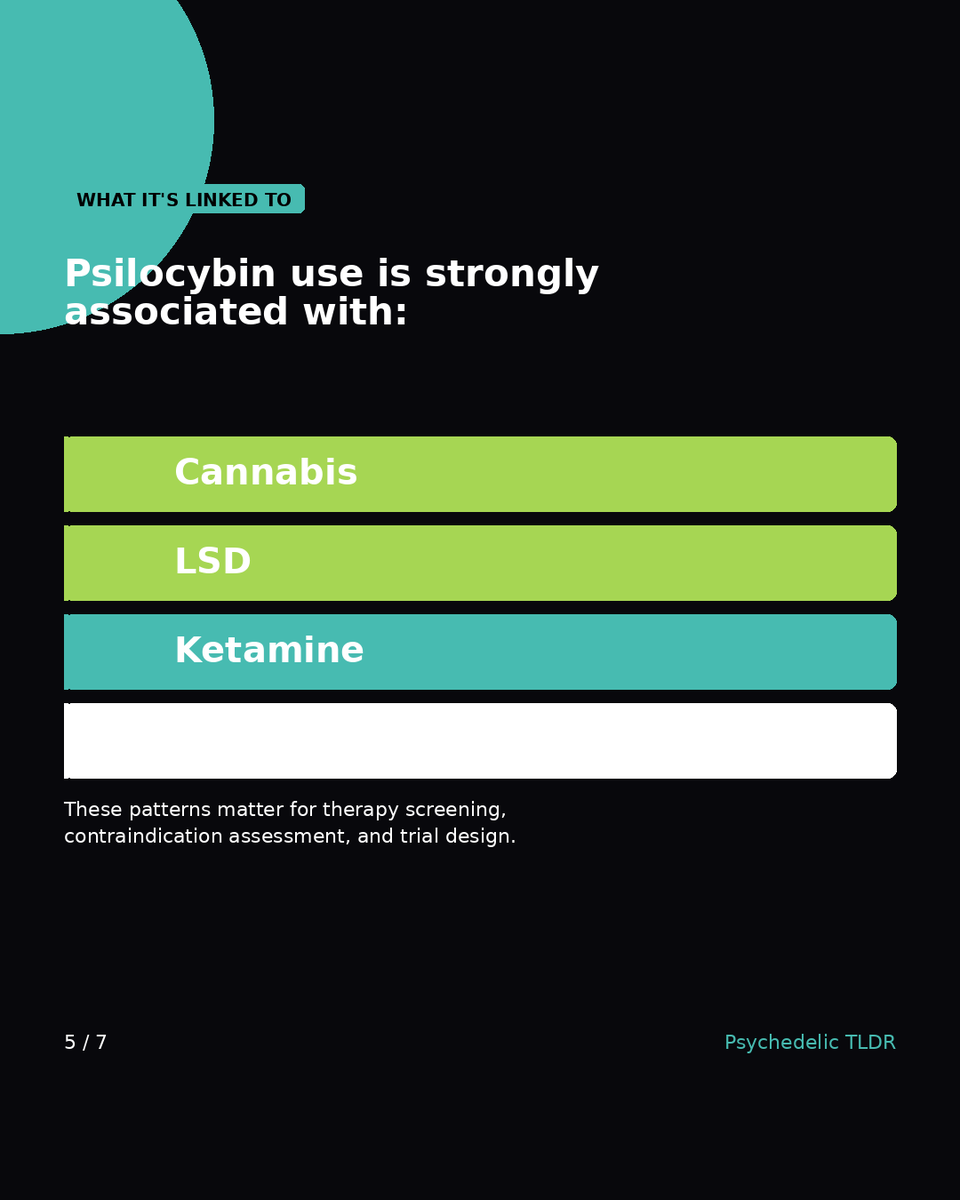
Use was strongly linked to cannabis, LSD, and ketamine use. Worth holding in view: this is unsupervised, largely illegal use — the demographic skew may not represent who eventually accesses regulated therapy if cost and access barriers follow other mental health treatments.
If you are involved in any psychedelic research, please consider completing this short, anonymous questionnaire from an Exeter student studying individuals’ metaphysical beliefs.
https://t.co/rCpJ7xQY5M
Market dynamics playing out in Oregon.
Oregon's psilocybin program director at the APA annual meeting in San Francisco: "We've gone through the honeymoon phase."
Fewer operators than projected. Budget shortfall. Higher licensing fees incoming. The unregulated market is larger, cheaper, and often the preferred option.
Oregon is the longest-running regulated psilocybin access program in the world. Every jurisdiction building a regulated market is watching this play out.
Music is a beautiful and powerful thing. It can be used as a tool for not only creative exploration and pleasure, but it can also unite us through rhythm, melody, and harmony.
Whether we’re listening, performing, or creating, music is a wonderful part of the human experience.
Psychedelics are generally safe w/ very low addiction potential & toxicity relative to other psychoactive drugs. They have real therapeutic potential, which is the focus of our research. But they also clearly have risks, and these are also a research and clinical priority for us.
There’s a rainbow bridge of energies that wave and flicker between ourselves and the ones we love and care for. Let us remember to be present and connect. Illness can bring us closer to the divine by contemplating our vulnerability and mortality. Buddha declared that death is the greatest teacher. This is because the remembrance of dying helps us see the fleeting and unpredictable nature of incarnation and the preciousness of our health and time in the body. A sacred relationship can form between a person who is ill and their healer. Trust is essential between them. This enables the one who is sick to have faith in their path to betterment.
Caring, 2001
Love feels like a cosmic force. We can't explain it, or measure it with instruments, yet the knowledge and experience of love is proof enough and validates the fundamental insights of the mystical traditions. Many religions declare the likeness of God and Love. Beyond the skin, primordial energies of eros channel through us. Truly miraculous that our biochemistry and anatomy support the experience of our imaginations' projections of passion.⠀
How would the universe exist, were it not for the love rites of Shiva and Shakti? Love is the attraction, tension and dynamism that plays itself out on every level in our lives. Doesn't the electron love the nucleus? Taoism abstracts this principle with the yin-yang symbol. Hinduism and tantric Buddhism use symbols of the union of cosmic lovers: Shiva and Shakti or Samantabadhra and Samantabhadri. Temporal form is secretly and erotically interpenetrated by timeless, formless primordial reality. This is the real sacred marriage, the true "hieros gamos." Love is the mystic background to the foreground of the surface reality.
Love is a Cosmic Force, 2009
The being smiled as a slow cascade of jewels,
patterns and dots rolled down its glowing face.
I acknowledged and thanked the spirit being that
seemed to welcome me to a new chapter in my art.