Open-source advocate & lifelong learner. Bhakti yoga student. Animal rights activist, Vegan straight edge. Cripto researcher. You grow when you make mistakes.
Some observations on Kimi:
1. It's a very good model! I don't think its performance can be explained away by distillation or anything like that. In agentic coding sessions, it seems pretty much on par with the best public models of Q1 2026. In my fairly limited use, it also seemed very token hungry. It's not obvious to me that this model is actually that cheap to run.
2. I am personally surprised the Chinese state continues to allow the open sourcing of models this good, given potential risks. To be clear, I *myself* might be fine with models presenting this level of marginal risk being open weight, but I am surprised that China is fine with it. I suspect the reason they are is 75% explained by strategic blindness/lack of AGI-pilledness (the CCP is very Yann Lecun-y in its views of AI). The other 25% or so is their lack of compute for customer inference (making China's open-weight strategy an unintended byproduct of US export controls) and the normal Chinese strategy of aggressive exports. For the companies, as opposed to the government, the decision to open source is partially ideological and partially because they are behind, and they know that very few people would pay for sub-frontier models from China.
3. Open-weight models are inherently decelerationist, and I'm continually surprised to see the so-called "accelerationists" so excited about open-weight models. I suspect the reason they are is that they know open-weight models are effectively ungovernable, and they simply like the overall cloak of ungovernability open-weight models create over the whole of AI. It's not a bad strategy; it reminds me of James Scott's recounting of the hill people in "the art of not being governed." Still, in the end, open-weight models deter further AI capex.
4. One probable outcome of an open-weight-model-dominant world is full AI communism, which is precisely what China proposes: rather than a market product, AI is a "public good" which will ultimately be provided by the state as a kind of "digital public infrastructure." This future strikes me as a dystopian hellscape, but I've never met an open-weight models advocate who doesn't ultimately concede this is where things end. You'd be surprised how many 'accelerationists' lobbied me, while I was in government, to support an eleven or twelve-figure federally funded data center so that startups could train models at a subsidy and then give them away for free. There was no other way for AI to progress, they said. Perhaps this is the logical end state of things. Nonetheless, I find myself surprised to see supposed accelerationists excited about such an outcome. I think many of them just don't know what they're doing. Many accelerationists do not view the creation and serving of frontier models as a legitimate business.
5. I would guess that the Trump Administration will at some point realize that their best strategy here would be to create large amounts of regulatory risk around the use of open-weight Chinese models. You don't need to "ban open source" (one of the dumber motifs of AI policy discussion). You just need to direct every agency to issue soft law that creates FUD. "A Federal Reserve Advisory Bulletin found that there may be backdoors in Chinese AI models." It needn't be that well justified. You just create enough regulatory risk that every regulated enterprise backs off. You probably don't want to create so much regulatory risk that you scare off the hyperscalers from serving Chinese models; this will just drive startups to sketchier providers. There's a happy middle ground here. I'd assume they will do some version of this.
6. It's probably true that open-weight models of this capability make the world a bit more dangerous, but not so much more that you'll really notice. At some point the models will be capable enough that you will notice. "A nonliving, invisible, dangerous, and infinitely self-replicating agent escaped from a Chinese lab," you say? Color me shocked.
🔴 ¡GOOGLE LIBERA GEMMA 4!
Cuatro versiones abiertas muy interesantes:
👉 31B Dense y 26B MoE: rendimiento equivalente a alternativas más grandes en tamaños muy accesibles!
👉 E4B y E2B: ligeros con procesamiento en tiempo real de texto, visión y audio!
https://t.co/S929Q159Ln
"Not having a coding experience is becoming an advantage."
Replit CEO Amjad Masad:
"You don't need any development experience. You need grit. You need to be a fast learner."
"If you're a good gamer, if you can jump in a game and figure it out really quickly, you're really good at this."
"Coders get lost in the details."
"Product people, people who are focused on solving a problem, on making money, they're going to be focused on marketing, they're going to be focused on user interface, they're going to be focused on all the right things."
"I think this year it's gonna flip, and I think not having a coding background is gonna be more advantageous for the entrepreneur."
@amasad with @jackneel
Baywatch” actress Alexandra Paul was arrested in Wisconsin over the weekend for allegedly taking part in a caught-on-camera animal rights sting to free beagles from a controversial breeding facility.
The 62-year-old actress was among 20 animal rights protesters nabbed for trespassing following the operation at Ridglan Farms — a breeding facility in Blue Mounds, about 30 miles west of Madison, authorities said.
The 90s’ star and roughly 60 fellow activists — all clad in white protective suits — were filmed breaking into the facility on Sunday morning and clutching the pooches tightly as they filed out.
Well done Alexandra
Baywatch icon Alexandra Paul was arrested in Wisconsin over the weekend after taking part in an operation that freed beagles from a controversial breeding facility.
The actress, 62, was taken into custody on Sunday morning and later booked in county jail on one count of trespassing, according to the Dane County Sheriff's Office.
A robotic Olaf from Frozen brings #NVIDIAGTC’s keynote with CEO Jensen Huang to a close, showcasing a partnership between Nvidia, Disney, and DeepMind AI.
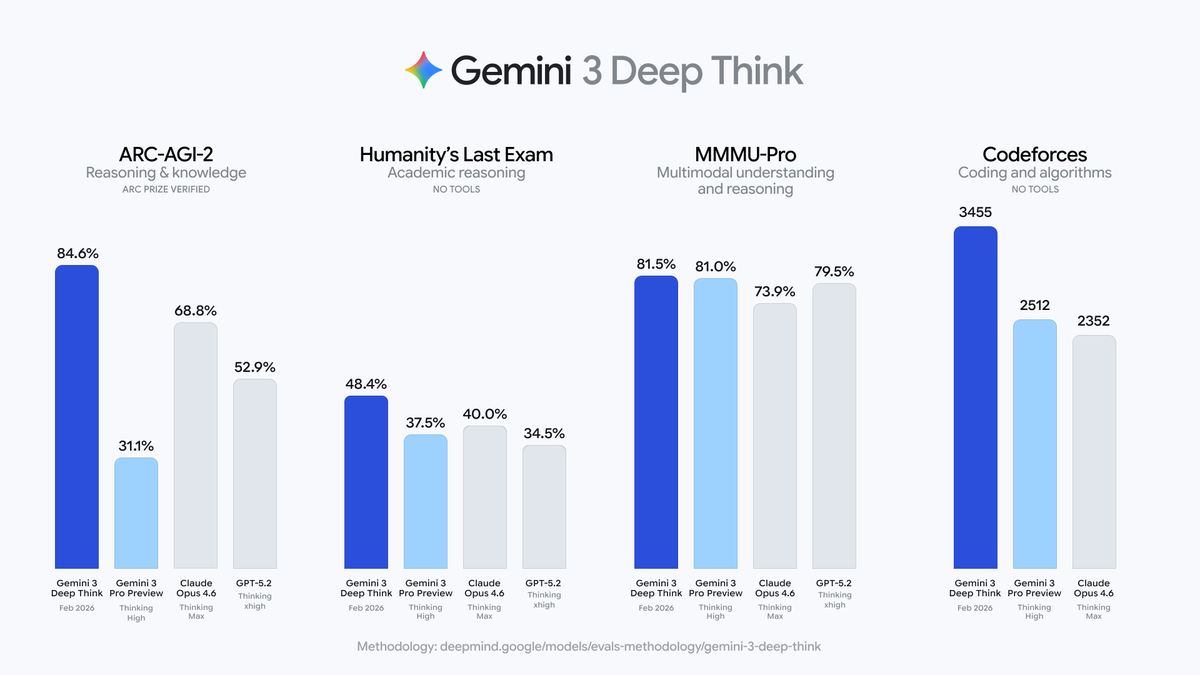
Thrilled to announce a big upgrade to Gemini 3 Deep Think that hits new records on the most rigorous benchmarks in maths, science & reasoning - including 84.6% on ARC-AGI-2, 48.4% Humanity’s Last Exam without tools, and 3455 Elo rating on Codeforces!
A heartwarming moment where a stranger patiently connects with an abandoned stray dog who didn't trust humans. Calm, kindness, and love ultimately prevail.
This innocent #cow was blindfolded to lull him into a false sense of security before cutting his throat. His friends are terrified and tried to offer comfort.
I'll never again pay others to do this stuff to animals. 😢 [photo: @iman.hamikhah / @animalsavemvmt]




![JohnOberg's tweet photo. This innocent #cow was blindfolded to lull him into a false sense of security before cutting his throat. His friends are terrified and tried to offer comfort.
I'll never again pay others to do this stuff to animals. 😢 [photo: @iman.hamikhah / @animalsavemvmt] https://t.co/EN9fZGdN3Q](https://pbs.twimg.com/media/G41PAGSWEAAjmVL.jpg)