Junior group leader in neuroscience - calcium imaging, ephys, plasticity, microscopy, data analysis. PhD with @RainerFriedri12, postdoc with @FritjofHelmchen.
Very excited to share our new preprint! We explore the link between the locus coeruleus (LC) and arousal for astrocytes, pyramidal cells, interneurons in the hippocampus. A fantastic collaboration with Sian Duss @BohacekLab, and many others: https://t.co/xzEibyWIXn 1/5
A great meeting in Braga, with awesome science and fabulous people, that ended up almost two years later with this paper: https://t.co/w1zHoE1RPy Yay! Thank you @Joao_F_Oliveira, Christian Henneberger and all the authors!
My review focuses on a point where data and interpretations across labs seem to diverge: the prevalence and importance of dendritic calcium and voltage events decoupled from the soma. I'd be interested in hearing more opinions on that!
There have been several impressive recent studies on dendritic voltage and calcium imaging in hippocampus. In this blog post, I review some of them: https://t.co/E4T0wAF42T
Great work by @BHL1117, @XiangWu96, Adam Cohen, @attila_losonczy, Balazs Rosza, Kevin Gonzalez, and others!
@HistedLab Of course it is a bad thing! Your explanation does not convince me at all. The damage to science done by high-impact work that is wrong or overstated is beyond any measure.
That's what happens when the title of a paper is misleading. The paper isn't about predictive coding - it's about predictions learned via temporal-difference learning. Those are very different frameworks. It's not the fault of the reader (@BetterCallMedhi) but of the authors.
i just finished reading a study published in Nature in January by researchers from McGill & Harvard and it broke my brain a little
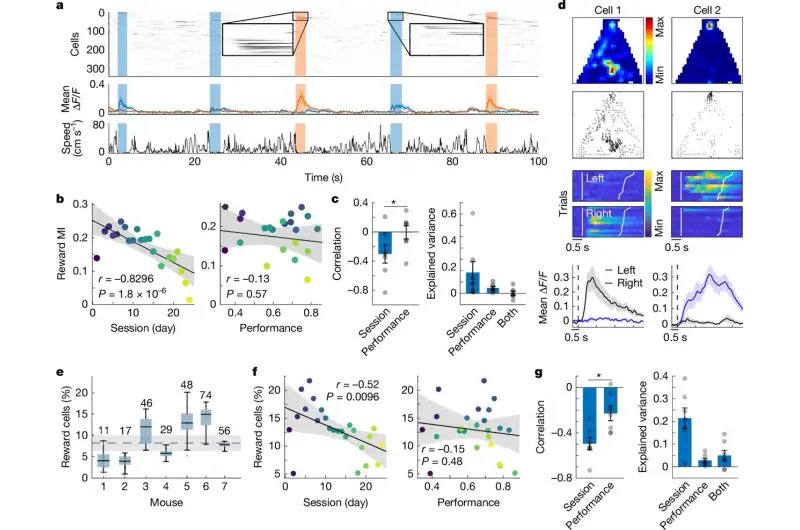
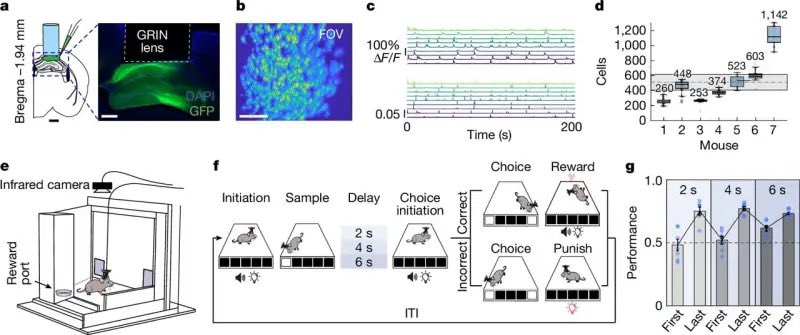
they tracked neurons in the hippocampus over several weeks while mice were learning a complex task and what they found is wild
the hippocampus does way more than store memories like a hard drive, it actively reorganizes them to predict what’s going to happen next, the neurons literally rewire their firing timing to start shooting BEFORE a reward shows up instead of after your brain is basically running a real time simulation of the future built entirely from past experience
and this is where it gets crazy when you think about AI
every foundation model we have right now learns through backpropagation which is a math trick from the 1980s that has absolutely nothing to do with how actual neurons learn, it works absurdly well but it’s also why training GPT-5 burns hundreds of millions of dollars & eats the energy of a small city
your brain does something arguably more impressive on 20 watts which is literally a light bulb
how? because the brain runs on predictive coding, it predicts what’s about to happen at every single moment and only bothers transmitting the stuff it got wrong, everything it predicted correctly gets suppressed
evolution basically invented the most insane compression algorithm imaginable and we’ve been pretending it doesn’t exist for decades
the most fascinating part is that tomorrow’s AI will look absolutely nothing like what we know today:
sparse event driven predictive architectures running on a fraction of current energy & the thing is the solution has been sitting inside your skull for 600 million years, evolution already did the work except nobody in this industry wants to face it because it’s easier to throw billions at compute than to sit down and study how a mouse brain outperforms everything with a light bulb
we’re spending billions reinventing the wheel when a mouse brain already outperforms our best models on the energy of a nightlight, the day this industry sits down & seriously studies what’s happening between our ears everything changes
@yaghoubi_mh@BetterCallMedhi It's true that both definitions are being used. But "predictive coding/processing" is a technical term that refers to a broad but specific theory. Labeling anything that has to do with "predictions" as "predictive coding" is in my opinion not a good idea.
@ShahabBakht@EliSennesh@BetterCallMedhi Is this really true? One paper is about "predictive learning", the other discusses "predictive shift" but mislabels it as "predictive coding". It's true that terms like predictive coding/processing were already diluted before, but blurring them further doesn't help in my opinion.
📷
For more context, here's our original paper describing Cascade: https://t.co/ok1f5ruCvt
And here's our preprint describing the models trained for use with GCaMP8 indicators: https://t.co/iv07VXJyY1
Interested in deep learning-based spike inference with Cascade? We re-implemented the code in Torch -previously in Tensorflow - for better compatibility.
Blog: https://t.co/fwqM1ryw5C
GitHub: https://t.co/a9ytcilS36
A new preprint introduces aDISCO, a DISCO-based clearing approach that makes whole archival FFPE human tissues transparent and antibody-compatible, enabling true 3D light-sheet histology across brain and multiple organs at cellular resolution. Adriano Aguzzi and Fritjof Helmchen teams.
https://t.co/cIMdH5Gp4e
#DISCO #clearing #3Dimaging #lightsheet #HumanTissue #FFPE #Histology
@LecoqJerome@BohacekLab However, a lot of prior work suggests that arousal-related signals in astrocytes are primarily driven by NE, so based on that one would still expect similar population patterns for NE release alone and for natural arousal. That’s why the lack of similarity was surprising.
Very excited to share our new preprint! We explore the link between the locus coeruleus (LC) and arousal for astrocytes, pyramidal cells, interneurons in the hippocampus. A fantastic collaboration with Sian Duss @BohacekLab, and many others: https://t.co/xzEibyWIXn 1/5
@LecoqJerome@BohacekLab In our design, "natural arousal" was essentially spontaneous running on the treadmill, so it wasn’t driven by an external stimulus. Of course, running still drives local circuit activity, and astrocytes may be activated through channels other than NE.
@LecoqJerome@BohacekLab Yes, but the suprising detail is that the population pattern of activation by norepinephrine did not correlate with the population pattern of activation arousal (which is thought to be mediated by norepinephrine for astrocytes).