Blockchains and stablecoins are powerful primitives. But there’s a need for an interop layer that makes them *just work*. Relay is that layer.
This is one of the most interesting challenges in crypto right now. Real demand, huge impact. Come work with us!
Announcing Relay's $17M Series B, led by @archetypevc & @USV.
And we're launching the Relay Chain — purpose-built infrastructure for instant crosschain settlement ⛓️
Any asset, any chain, instantly.
@karrisaarinen@andrewingram Yeah, I like this direction. It allows you to clearly articulate the core areas and structure of the company for both agents and people to understand
@karrisaarinen@andrewingram Sounds like you're using Linear "Teams" to represent a product/surface. Do you recommend this?
These days, a small team of people can be responsible for multiple products. And it feels like it can make sense for each product to have clean space.
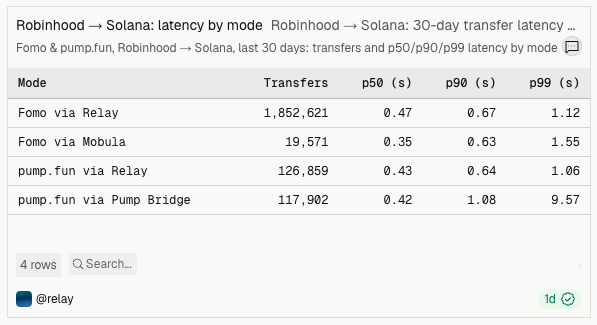
Two apps on Relay can see wildly different performance depending on how they’ve integrated. We’ve shipped a lot lately, so reach out and make sure you have access to all the latest and greatest.
Back to building. 🫡
@kyle What do you think are more important: buys or sells? Very different requirements. Sells are much closer to same chain. Just need to repatriate the proceeds afterwards. Buys require unique cross-chain solution.
@ThogardPvP What's the difference between the "stream the route ingredients" and "submit a backup route or two"? Are you just checking more routes, or some extra magic?
can take a look at the tx if you want. sounds like the recipient wallet is compromised, so as soon as funds landed, attacker swept them out.
this is unfortunately very common. it looks related to Relay, because it happens soon after a Relay tx, but it's actually just that the attacker is waiting for new funds to arrive. would recommend rotating wallets ASAP
@danbuildss Unfortunately this means that either you accidentally used a phishing site, or your wallet itself is compromised (before using Relay). If you have a tx hash, we can help figure it out for you
TLDR:
Relay is not compromised, nor does it ever do unlimited approvals. But there is definitely heightened phishing activity that you need to watch out for.
More detail:
- There are phishing sites out there that send txs through our router (which is basically just a multicall contract), to try and trick people. Make sure you are on the correct domain for whichever app you are using!
- Because of an uptick in this activity, Blockaid is now showing a warning on our contract to try and warn people. They've whitelisted all the major legit sites, so it won't show on those sites. So if you're seeing the warning, you are either on phishing site, or another site needs to be added to the list (let us or Blockaid know)
- We are planning to update our router to make it harder for phishers to abuse. To be clear, there is no protocol or contract vulnerability. Any multicall contract is open ended by design, and can be used by an attacker to mask a malicious transaction. We will just limit what ours allows, to make harder for bad actors to piggyback on it. It won't stop people landing on phishing sites (which is the actual problem), but will minimize some of the confusion
TLDR:
Relay is not compromised, nor does it ever do unlimited approvals. But there is definitely heightened phishing activity that you need to watch out for.
More detail:
- There are phishing sites out there that send txs through our router (which is basically just a multicall contract), to try and trick people. Make sure you are on the correct domain for whichever app you are using!
- Because of an uptick in this activity, Blockaid is now showing a warning on our contract to try and warn people. They've whitelisted all the major legit sites, so it won't show on those sites. So if you're seeing the warning, you are either on phishing site, or another site needs to be added to the list (let us or Blockaid know)
- We are planning to update our router to make it harder for phishers to abuse. To be clear, there is no protocol or contract vulnerability. Any multicall contract is open ended by design, and can be used by an attacker to mask a malicious transaction. We will just limit what ours allows, to make harder for bad actors to piggyback on it. It won't stop people landing on phishing sites (which is the actual problem), but will minimize some of the confusion