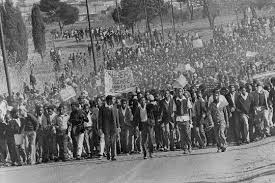
The father of the Pan African movement in South Africa. Robert Sobukwe he was jail by the apartheid when his time was finished, they refused to release him. A special law was created in his name to justify lock him up in a separate prison by himself.. everyone knows about Nelson Mandela, but not this freedom fighter.
Israel killed 3 Indonesian UN peacekeepers in South Lebanon.
They were wearing blue helmets.
They were in UN uniforms.
They were peacekeepers.
Israel bombed them anyway.
Not a peep in Western media.
Not a word from the international community.
Kick Israel out of the UN.
Please watch and let tag Standard Bank to answer.
This lady alleges Standard Bank hired thugs with AK47s to intimidate her so she could close the case against the bank.
@StandardBankZA
General Khumalo made a submission on the Madlanga today that Jabu Mthethwa is the person who called Hawks to come and disturb PKTT when they were arresting Katiso Molefe, claiming KT Molefe was his brother.
Jabu Mthethwa is seen on the video clip below with Kenny Kunene.
Kenny Kunene was also in the house of Katiso Molefe when his arrest was conducted.
#MadlangaCommission
WATCH - 21 March 1959: Robert Mangaliso Sobukwe and men from Dube/Mofolo/Orlando West areas of Soweto arrive at Orlando Police Station. On the day, the PAC's Anti-Pass campaign began. In 2nd frame -Sobukwe reacts to news about Sharpeville massacre. @Sobukwe_Trust@PetersWonderboy
Like all Africans and beyond, I am deeply saddened by the situation in the Eastern Congo.
I want to pass my condolences to South Africa on the death of its soldiers who have died in pursuit of peace in the DRC, and everyone who has been killed by this crisis.
Today I took time to understand the issues and the root cause of the Great Lakes crisis, you can’t understand it all in a day.
I am not an expert on the Great Lakes, but I found two insightful videos featuring Tanzania’s founding father, Mwalimu Julius Nyerere, and former South African President Thabo Mbeki explaining it.
Both leaders were actively involved in efforts to address the Great Lakes issue, with Nyerere engaging as far back as 1992 and earlier.
The problem can be traced back to 1885 during the Berlin Conference, where Africa was partitioned among European colonial powers and borders were drawn regardless of ethnic sensitivities.
Belgium, the colonial power in the DRC, and Germany, the colonial power in Rwanda, drew borders that divided the Rwandan Kingdom, incorporating parts of it into what is now the DRC.
As a result of this partitioning, the Banyarwanda (including the Banyamulenge) ended up living on both sides of the border—in Rwanda and the DRC. Just like the Tswanas in South Africa and Botswana.
Despite being Zairean (Congolese) citizens, the Banyarwanda in the DRC were often treated as foreigners by successive Congolese governments, and they faced significant discrimination.
The situation worsened after the Tutsi genocide in Rwanda in 1994 which was carried out by the Hutus, when perpetrators of the genocide fled into the DRC, particularly to areas where Congolese Banyarwanda lived.
These perpetrators formed a militia called the Democratic Forces for the Liberation of Rwanda (FDLR).
The FDLR, which opposes the current Rwandan government, was later incorporated into the Congolese army, causing Rwanda to view their presence in Eastern Congo as a significant security threat.
Rwanda objected to the persecution of the Congolese Banyarwanda by the Congolese Government and the FDLR in the DRC.
Rwanda’s said its involvement in the DRC is rooted in its efforts to neutralise the FDLR and protect its national security, as well as to address the marginalisation of the Banyarwanda in Eastern Congo.
However, this involvement has also sparked significant controversy and accusations of resource exploitation and destabilisation by the DRC.
The M23 (March 23 Movement) originated from the National Congress for the Defence of the People (CNDP), a Tutsi-led rebel group in the DRC that operated in the mid-2000s.
The CNDP was mainly focused on protecting the rights of Congolese Tutsis (Banyarwanda) who faced discrimination and violence, particularly after the 1994 Rwandan Genocide.
Reports by Human Rights Watch in October 2022 revealed that the Congolese military supported the FDLR in their military operations against the M23 rebel group.
At the same time, the Congolese government has accused Rwanda of supporting the M23 militarily.
Currently the conflict involves the M23 and the Congolese army, with the DRC accusing Rwanda of deploying its troops on Congolese soil.
As Nyerere points out in the video, the Zairean government stripped the Banyarwanda in the Congo of their citizenship, rendering them stateless. However, they are Congolese due to the colonial borders.
What is clear is that this crisis is not an overnight problem, it has been there for decades, long before both Presidents Paul Kagame and Félix Tshisekedi were in power.
What is lacking is leadership from the region and the continent to help both countries resolve this crisis once and for all.
It is like a volcano that has been erupting periodically, the crisis is crying out for a modern day Nyerere or Mbeki.
It is now unrealistic to expect Presidents Kagame and Tshisekedi to invite each other for coffee, it needs someone with gravitas to invite them.
This crisis has no military solution except dialogue.
🎉 Huge congratulations to Prof Siphokazi Magadla for being shortlisted for the debut prize at The University of Johannesburg Prize (UJ Prize) for South African Writing! 📚✨ Here's to many more accolades to come! #UKZNPress
We provide a brief profile outline of the featured book cover freedom fighter
Name:
- Nomvo "Poqokazi" Booi
Birth:
- May 16, 1929, in Zagwityi, Gcuwa (Butterworth)
Political Involvement:
- Joined ANC Youth League, later moved to PAC in 1959
First woman imprisoned for anti-apartheid activities in 1962
Role in PAC/APLA:
- Active in Poqo/APLA, served as intelligence operative, supported military efforts
- Worked in multiple regions including Lesotho, Tanzania, and Zimbabwe in various capacities
- Held position as Secretary for Health and Social Welfare in PAC
Sacrifice and Exile:
- Endured multiple imprisonments and torture but remained dedicated
- Respected as a maternal figure among younger exiles, ensuring welfare support
Return and Legacy:
- Returned to South Africa in 1992 for negotiations post the unbanning of political organizations
Passed away:
- on May 7, 2016; remembered for her sacrifice and dedication to liberation
📢 On this day, we remember the Vaal Uprising, which began on September 3, 1984. This pivotal moment in the anti-apartheid struggle ignited widespread protests across the Pretoria-Witwatersrand-Vereeniging (PWV) region, leading to the regional stayaway on November 5-6. Let us honor the courage and resilience of those who fought for freedom! 🖐🏿 #VaalUprising #AntiApartheid #FreedomFighters