The world's largest oil tankers are being ordered at a record pace:
There are currently 262 supertankers on order at shipyards worldwide, the highest number on record.
This marks an over +1,000% surge from the levels seen just 2 years ago.
Each of these vessels can carry up to 2 million barrels of crude oil.
This also exceeds the previous record of ~255 supertankers set in October 2008, which ultimately flooded the market with too many ships, causing the daily rates shipowners charge to crash and tanker company revenues to collapse.
Shipowners are rushing to capitalize on historic supply chain disruptions.
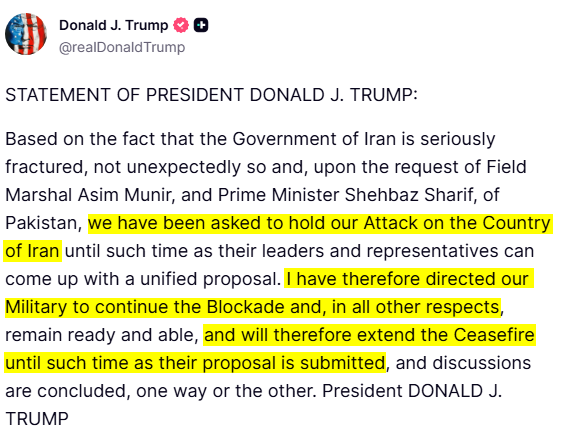
⚠️ BREAKING: Trump on Iran: I will extend the ceasefire until such time as their proposal is submitted, and discussions are concluded, one way or another - Truth Social
No complexity. No accident.
10/10 was caused by irresponsible marketing campaigns by certain companies.
On October 10, tens of billions of dollars were liquidated. As CEO of OKX, we observed clearly that the crypto market’s microstructure fundamentally changed after that day.
Many industry participants believe the damage was more severe than the FTX collapse. Since then, there has been extensive discussion about why it happened and how to prevent a recurrence. The root causes are not difficult to identify.
⸻
What actually happened
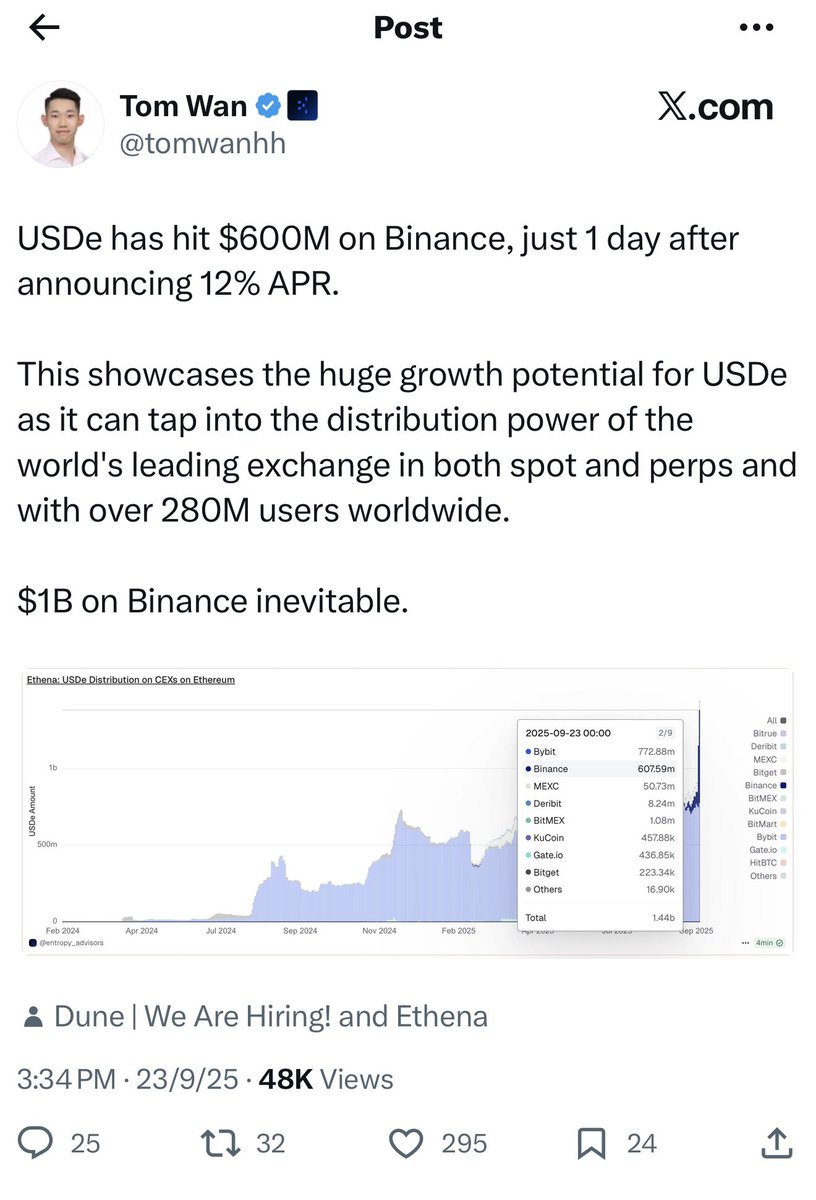
1.Binance launched a temporary user-acquisition campaign offering 12% APY on USDe, while allowing USDe to be used as collateral with the same treatment as USDT and USDC, and without effective limits.
2.USDe is a tokenized hedge fund product.
Ethena raises capital via a so-called “stablecoin,” deploys it into index arbitrage and algorithmic trading strategies, and tokenizes the resulting fund. The token can then be deposited on exchanges to earn yield.
3.USDe is fundamentally different from products such as
BlackRock BUIDL and Franklin Templeton BENJI, which are tokenized money market funds with low-risk profiles.
USDe, by contrast, embeds hedge-fund-level risk. This difference is structural, not cosmetic.
4.Binance users were encouraged to convert USDT and USDC into USDe to earn attractive yields, without sufficient emphasis on the underlying risks. From a user’s perspective, trading with USDe appeared no different from trading with traditional stablecoins—while the actual risk profile was materially higher.
5.Risk escalated further as users:
•converted USDT/USDC into USDe,
•used USDe as collateral to borrow USDT,
•converted the borrowed USDT back into USDe,
•and repeated the cycle.
This leverage loop produced artificial APYs of 24%, 36%, and even 70%+, widely perceived as “low risk” simply because they were offered by a major platform. Systemic risk accumulated rapidly across the global crypto market.
https://t.co/IK2gW4xUOP that point, even a small market shock was sufficient to trigger a collapse.
When volatility hit, USDe depegged quickly. Cascading liquidations followed, and weaknesses in risk management around assets such as WETH and BNSOL further amplified the crash. Some tokens briefly traded near zero.
The damage to global users and companies—including OKX customers—was severe, and recovery will take time.
⸻
Why this matters
I am discussing the root cause, not assigning blame or launching an attack on Binance. Speaking openly about systemic risks is sometimes uncomfortable, but it is necessary if the industry is to mature responsibly.
I expect there may be significant misinformation and coordinated FUD directed at OKX in the near future. Even so, speaking honestly about systemic risk is the right thing to do—and we will continue to do so.
As the largest global platform, Binance has outsized influence—and corresponding responsibility—as an industry leader. Long-term trust in crypto cannot be built on short-term yield games, excessive leverage, or marketing practices that obscure risk.
The industry needs leaders who prioritize market stability, transparency, and responsible innovation—not a winner-take-all mentality where criticism is treated as hostility.
Crypto is still early.
What we choose to normalize today will determine whether this industry earns lasting trust—or repeats the same mistakes again.
My base case for those who don't get the nuanced view:
BTC.D rejected at 0.786 Fib Level (66%) just like it was rejected at 0.618 Fib level (60%) last year.
ALT/BTC is up because ETH/BTC is up
But ALT/ETH is bleeding
So ETH is better than ALTs.
Remember ALT/BTC pairs have found a local low every June from 2022-2025).
ALT/BTC rally will likely end by late August at the latest
BTC.D rally in Sep-Oct
ETH/BTC higher low in Sep/Oct
ALT/BTC pairs lower low in Sep/Oct (could be beginning of Nov).
Hard to know if the next rally by BTC.D leads to a higher high even if ALT/BTC pairs put in a lower low (as it depends on how high the next higher low is for ETH/BTC).
Look at what ALT/BTC pairs did from July-August of 2017 and see how they still dropped to 0.25 by late October.
Look at how while ALT/BTC pairs are up, ALT/ETH pairs are down 40% since ETH "went home."
I could be wrong about any one of these views, but these are my views.
When something I posted above is inevitably wrong, you are welcome to post this receipt and laugh.
Also, I'm not talking about your alt.
It’s ok. Don’t freak out.
This is opportunity.
My longish term analysis atm says bounce sometime this week, retest maybe 119-120k, one more low maybe around 107k, then moon time.
My plan:
1. Act on the bounce this week whenever it comes in case that’s the last low before take off (go long)
2. Reassess around 119-120k.
Weakness = take profits on the long and prepare for more downside (short).
Strength = stay long & TP on the way up
3. If we are weak, prepare for 107k level as next target and look for next epic long there.
This could take all of this month and next but this plan is how I actually trade short timeframes inbetween high TF trends for the best RR.
Share this if you think someone needs to see it today😇