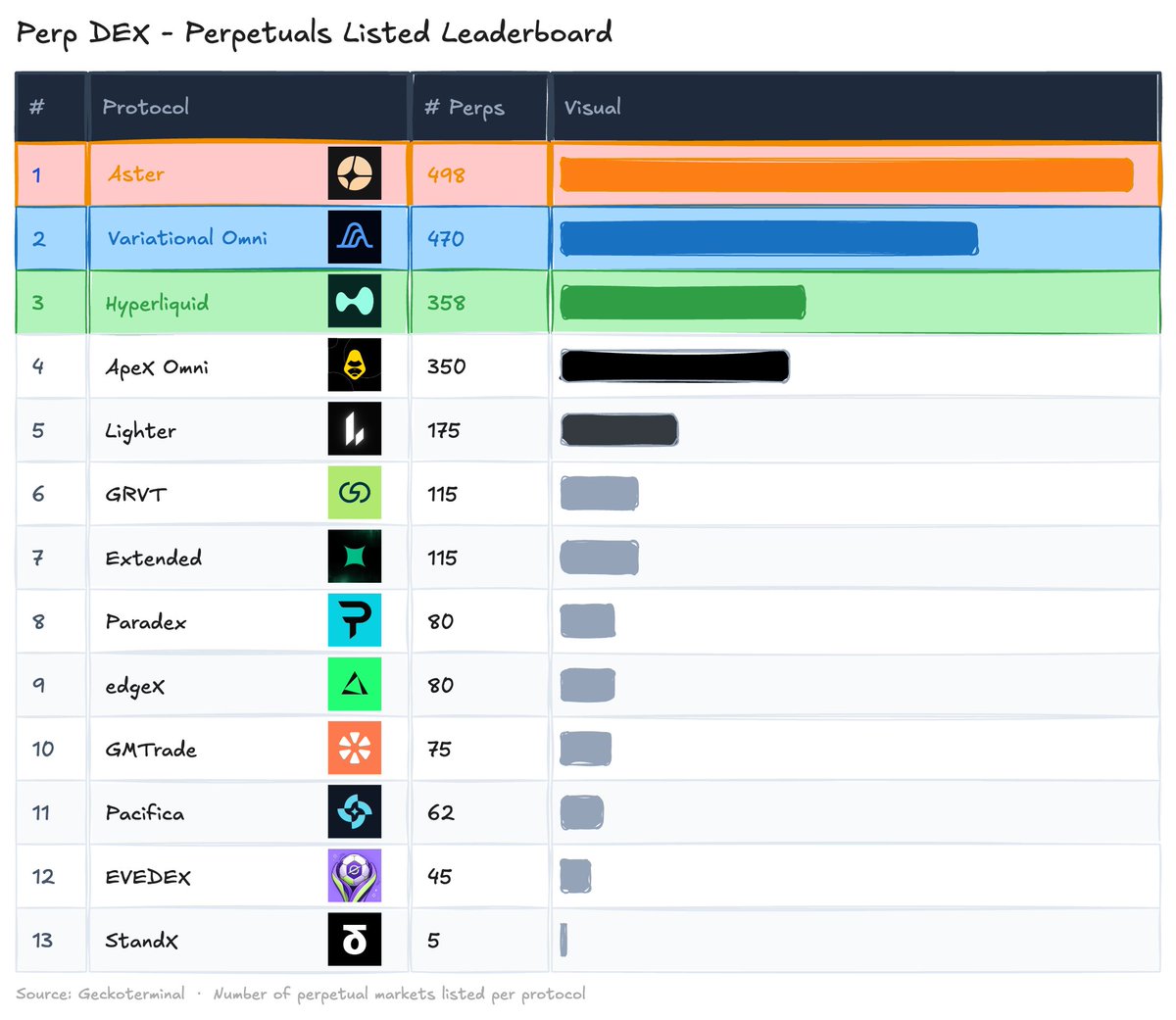
➥ I rank perp DEXs by listing scalability
I care about number of perps because listing count shows how fast a perp venue can expand beyond majors
In perps, depth matters, but coverage also matters
The next trading cycle will likely reward venues that can support more long-tail assets without carrying too much liquidity cost
Here's the rank:
- @Aster_DEX: broad market coverage + CEX-style UX
- @variational_io Omni: RFQ model + permissionless listing framework
- @HyperliquidX: strong liquidity network + native eco demand
- @OfficialApeXdex Omni: multi-chain access + high listing count
- @Lighter_xyz: performance-first perp infra
- @grvt_io: regulated exchange positioning
- @extendedapp: StarkEx-based orderbook model
- @paradex: appchain-style perp venue
- @edgeX_exchange: CEX-like perp UX
- @gmtrade_xyz: established perp niche
- @pacifica_fi: early-stage coverage expansion
– @EVEDEX: small coverage base
– @StandX_Official: minimal market coverage
In the next cycle, I think only few will capture liquidity
➥ Tether alone is ~46% of all tracked 24h protocol rev in the entire crypto industry
- @tether at $16.14M in 24h rev, the top protocol on the board
- @circle is next at $6.44M
- and the top pure crypto app, @HyperliquidX, is at $2.02M
USDT has $186.07B in stablecoin cap & 59.17% stablecoin dominance
Total stablecoin cap is $314.46B, so this is the largest balance sheet in crypto still converting scale into daily cash flow
I would not frame today around DEX volume or ETF flows
- Solana leads chain DEX vol at $2.03B, but the gap is not as decisive as Tether’s rev lead
- ETH ETFs are still showing outflow pressure in recent Sosovalue data
The cleanest signal today is that stablecoin infra is still where crypto’s most reliable rev is being captured iykyk
➥ I’m getting more aggressive on @Theo_Network
I’ve been holding thBILL for a while because I wanted exposure to Theo’s earlier points system
Now I’ve also staked 3,526 thUSD for Season 2
Theo’s core product is thUSD, a yield-bearing stablecoin backed by physical gold, T-bills, and a delta-hedged gold carry strategy
The yield comes from real markets:
- $180B annual gold leasing volume
- $247.7B average gold futures open interest
- $14.8T annual gold futures volume
- Gold volatility around 14.4%, much lower than BTC and ETH
That matters because the yield source is not purely crypto-native lending, emissions, or leverage farming
fyi, thUSD’s yield comes from:
- Gold leasing
- Gold futures basis capture
- Cash-equivalent reserves through thBILL
The team looks serious, Theo gon be next big DeFi protocol after the unexpected $RE
I ran the math so you don't have to
- Season 2 launched and TVL is only around $100M
- Even a conservative scenario of 2% supply at $500M FDV would mean a $10M reward pool on around $100M of deposits
Over a 3-month season, that is roughly 40%+ APR in points alone, on top of the base yield
Mid-range scenarios can push the yield into triple digits, I couldn't help but thinking early deposits are heavily asymmetric
There are 3 main routes:
→ Liquid: hold thUSD / sthUSD
→ Core: fixed-duration vault
→ Boost: fixed-duration vault with looped exposure
I chose to stake and gonna dep into vaults because I’m comfortable being more aggressive here
➥ The winner of retail finance
the super-app thesis becomes increasingly relevant
i’d use these filters to find the winner protocols & categories:
- the intergenerational wealth transfer & super-app
- prediction markets as a new retail asset class
- the mega IPOs drive retail engagement
- L1 as the distribution engine
- TCG bring digital collectors onchain
the list of top protocols i'm into:
[1] Perps: @HyperliquidX
[2] L1: @ton_blockchain@solana
[3] Trading app: @RobinhoodApp
[4] PMs: @Polymarket@Kalshi
[5] TCG: @Collector_Crypt@phygitals
Perps show that retail wants high-speed, self-directed trading
$HYPE became important because it made onchain derivatives feel fast, liquid, and usable
L1s show that consumer distribution still matters
$TON has Telegram distribution + has strong retail culture, apps, and liquidity
prediction markets show that people increasingly want to trade info
Polymarket + Kalshi are turning news, politics, sports, macro data, and public opinion into financial markets
vertically integrated financial super-app poised to benefit from the intergenerational wealth transfer from Boomers to Gen Z and Millennials
the next golden bull is coded, i’ll not stay sideline
➥ THE NEXT RWA WINNERS WILL OWN DISTRIBUTION
I think the next phase of RWAs will be judged by where does the capital actually go after it is tokenized?
Been looking at where tokenized capital actually ends up after issuance
And the data is pointing somewhere most of the narrative hasn't caught up to yet
In TradFi, an asset only becomes useful at scale when it has distribution, liquidity, financing channels, and places where investors can actually put it to work
The same logic applies onchain
After mapping where RWA capital is actually being deployed across chains
I believe @Mantle_Official stands out on a specific metric most people aren't tracking
$90M+ in RWA capital is already deployed across Mantle DeFi, and Mantle currently leads L2s on this specific measure
Small comparison:
- Mantle: $90.55M with total RWA onchain mcap = $238.61M
- Arbitrum: ~$48M
- Base: ~$36M
A meaningful of ~38% of Mantle’s onchain RWA cap is already active inside DeFi
For context, DeFi Active TVL = RWA value deposited, pooled, or used inside third-party DeFi protocols, excluding issuer-managed contracts and exchange wallets
That matters because RWAs win when they can move through an eco, so they need markets, routing, collateral use cases, yield venues
More than that, RWAs need users who can access them without leaving the onchain environment
It naturally proves my main argument:
→ Issuance creates assets
→ Distribution creates utility
→ Utility attracts capital
Growth speed is showing the real picture:
Mantle’s total distributed RWA value is -7.70% over 30D, while RWA holders are up 1.94% over 30D
That means asset value has pulled back, but participation is still expanding slightly
Mantle RWA league table by asset classes
- Active strategies: $115.1M, ~47.27% market share
- Asset-backed credit: $90.5M, ~37.16% market share
- US Treasury debt: $28.7M, ~11.78% market share
- Stablecoins: $5.2M, ~2.12% market share
- Stocks: $4.1M, ~1.67% market share
My most possible macro view is that tokenized capital will follow the same rule as traditional capital
IMO, it will move toward the venues where it has the most utility
→ An RWA that can only be issued is a balance sheet entry
→ An RWA that moves through DeFi is productive capital
That is the part I think the market is still underpricing
$MNT is building around that second thing, it makes more sense when you look at it through that lens




![Nick_Researcher's tweet photo. ➥ The winner of retail finance
the super-app thesis becomes increasingly relevant
i’d use these filters to find the winner protocols & categories:
- the intergenerational wealth transfer & super-app
- prediction markets as a new retail asset class
- the mega IPOs drive retail engagement
- L1 as the distribution engine
- TCG bring digital collectors onchain
the list of top protocols i'm into:
[1] Perps: @HyperliquidX
[2] L1: @ton_blockchain @solana
[3] Trading app: @RobinhoodApp
[4] PMs: @Polymarket @Kalshi
[5] TCG: @Collector_Crypt @phygitals
Perps show that retail wants high-speed, self-directed trading
$HYPE became important because it made onchain derivatives feel fast, liquid, and usable
L1s show that consumer distribution still matters
$TON has Telegram distribution + has strong retail culture, apps, and liquidity
prediction markets show that people increasingly want to trade info
Polymarket + Kalshi are turning news, politics, sports, macro data, and public opinion into financial markets
vertically integrated financial super-app poised to benefit from the intergenerational wealth transfer from Boomers to Gen Z and Millennials
the next golden bull is coded, i’ll not stay sideline](https://pbs.twimg.com/media/HLplvs-a0AAESql.jpg)





