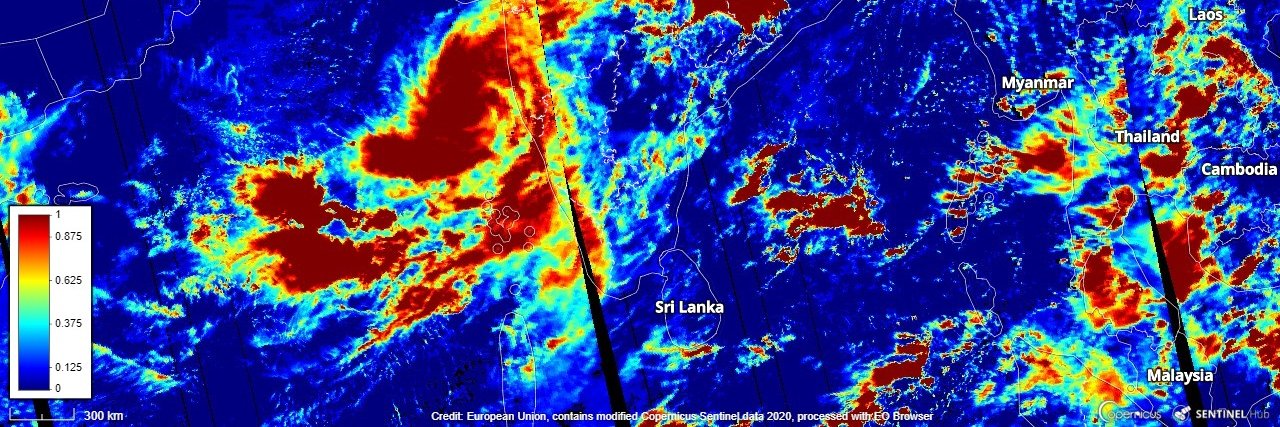
HLOS wind observations for the 16th, 17th, 19th & 20th of May 2020. Blank spots can be attributed to the Cyclone’s movement and position at that time. Wind measurmnts xcd range mentioned in the color bar, it was left as is to maintain positional accuracy. #aeolus#AmphanUpdates
Today, @INSPACeIND short-term Skill Development Course on Satellite Technology: From Fundamentals to Entrepreneurship, organised with IIT Bombay is inaugurated.
The month-long course will equip participants with technical and commercial know-how of satellite technology. @GoenkaPk
A new paper from IBM just tested nine geospatial foundation models on eight Earth observation tasks, and the results suggest most teams are using these models wrong.
The default workflow: take the final layer, mean-pool it, ship it, leaves a lot of accuracy unclaimed for the tasks that matter most in applied work.
Some background on what these models do. A geospatial foundation model takes a satellite image and turns it into a vector of numbers, an embedding, that's meant to capture what's in the scene. You can then train a small linear model on top of that vector to predict things like crop coverage, biomass, or temperature. The promise is that one expensive pretraining run produces embeddings useful for many downstream tasks. The benchmark asks how well that promise holds.
The test bed uses Sentinel-1 and Sentinel-2 imagery, 264×264 patches at 10m resolution, four seasonal snapshots per location. Eight regression targets, grouped into three types. Semantic proportions, what fraction of this patch is cropland or forest. Continuous physical measurements, how much above-ground biomass is here, how hot is the urban surface. Atmospheric state, how cloudy was it. The grouping matters because the results split along these lines.
The first finding is that the choice between a CNN backbone (ResNet-50) and a transformer backbone (ViT-Small) is not a stylistic preference. It changes whether the model works at all on certain tasks. The best ResNet scored R² of 0.05 on biomass and -0.20 on clouds, meaning it predicts worse than just guessing the average. The ViT on the same tasks hit 0.50 and 0.69. On land cover proportions, the two architectures are roughly even.
The second finding is that within the ViT family, the pretraining objective decides what the model is good at. DINO, which learns by contrasting different views of the same image, wins on semantic targets like crops and forest cover. MAE and FGMAE, which learn by masking out patches and reconstructing them, win on biomass and clouds. SoftCon is the most balanced. There's no single best objective.
The third finding upends a default. For CNN backbones, the best embeddings live in the middle of the network, not the end. ResNet-50 has five stages of increasing depth and abstraction. Performance on biomass and clouds peaks at stages 2 through 4, then drops sharply at the final stage. For ViTs the pattern is gentler, performance saturates by layers 3 to 5 and stays roughly flat. The authors verified this isn't a dimensionality artefact by resizing the final layer to match earlier stages.
The intuition is that deep CNN layers were trained to throw away spatial detail in service of classification. That's good for "is this a forest", bad for "how much carbon is in this forest". Anyone using ResNet embeddings should be exporting features from intermediate stages, not the final pre-classifier vector. This is a free accuracy gain that costs nothing except changing one line of extraction code.
The fourth finding is about pooling, which is how you reduce a grid of features to a single vector. Mean pooling wins. CLS tokens are competitive on ViTs. Min and max pooling lose ground on continuous targets because they discard the spatial distribution that biomass and heat statistics actually depend on. This one matches conventional practice.
The fifth finding has direct cost implications. Concatenating embeddings from the same model with different pooling (mean plus CLS) gives almost nothing, around 0.03 R². Concatenating mean embeddings from two different SSL objectives (DINO plus SoftCon, for example) gives 0.04 to 0.07 R². The size of that gain is comparable to the gap between the best and worst single objective. If your storage budget allows two embeddings per location instead of one, the second slot should hold a different pretraining objective rather than a different pooling of the same model.
The main takeaway is that if you're using GeoFM embeddings in a development or climate context, the model selection question matters more than the field's marketing suggests. For mapping cropland or forest fraction, almost any reasonable setup works. For biomass, surface temperature, or cloud-related tasks, architecture and objective choice determine whether your linear probe is useful or noise. The practical defaults that actually fall out of the benchmark: use a ViT, mean-pool it, pick the SSL objective that matches your task type (DINO for categorical, MAE for continuous), and if you can afford two embeddings, store one of each. For CNN users, export intermediate layers, not the final one.
The deeper point is that "foundation model" is being treated as a singular noun in this field when the benchmark shows it's a family of representations with sharply different task profiles. The same encoder weights produce embeddings that are state-of-the-art for one task and unusable for another. Until the field starts publishing task-specific recommendations alongside model releases, anyone deploying these for measurement work should benchmark on their own target before committing to a pipeline.
Link to paper: https://t.co/BRlFYZpLEb
Hon’ble CM @YKhemchandSingh ,
I run a fintech startup in Imphal with a small team of local youths serving global clients. Our work depends on strict international deadlines; for us, Internet is as vital as electricity. Without it, our business cannot survive.
Missing even a few hours of connectivity results in permanent financial losses for our clients and ruins our hard-earned reputation. During past bans, I’ve had to fly to another city just to stay online. This is not sustainable for a local startup.
I humbly seek your urgent intervention to whitelist verified businesses so local startups like us can survive.
@GBA_office@GBAChiefComm Please fix your website and extend the time-line. Most importantly Please stop SMS and calling people who have already paid. It's a nuisance.
Case today : Marriage breaks down within days because girl is in love with someone else for years but parents got her married to this man
She first tried to wriggle out saying this man is impotent
He got his medical tests done. Everything was normal
Then she said she doesn't want to continue marriage because father-in-law has a bad eye on her
Family of man called community meeting & mutual consent divorce is eventually decided. But the girl then asks for alimony
When husband's family expresses inability to fulfill the demand, girl goes ahead files rape case on father-in-law who is a senior citizen
Cases like this happening in smallest of towns now ....
"Howdy Folks, I'm Michael Pyrcz, a professor at The University of Texas at Austin, and I record all of my lectures and put them on YouTube so anyone can follow along!"
...and I kept doing that, and writing a Python package, along with 2 free, online e-books, 100s of Python demonstration workflows, dozens of synthetic datasets, etc. etc.
Why? So anyone can follow along!
Education changes lives. I know because it changed mine. I’m just paying it forward.
@GBA_office@GBAChiefComm Receipt wasn't generated post the online property-tax payment 2025-2026. I keep getting SMS about non payment of property tax. I hope the website is fixed. Please test the website for bugs. Half the problem would be sorted. Please acknowledge this feedback.
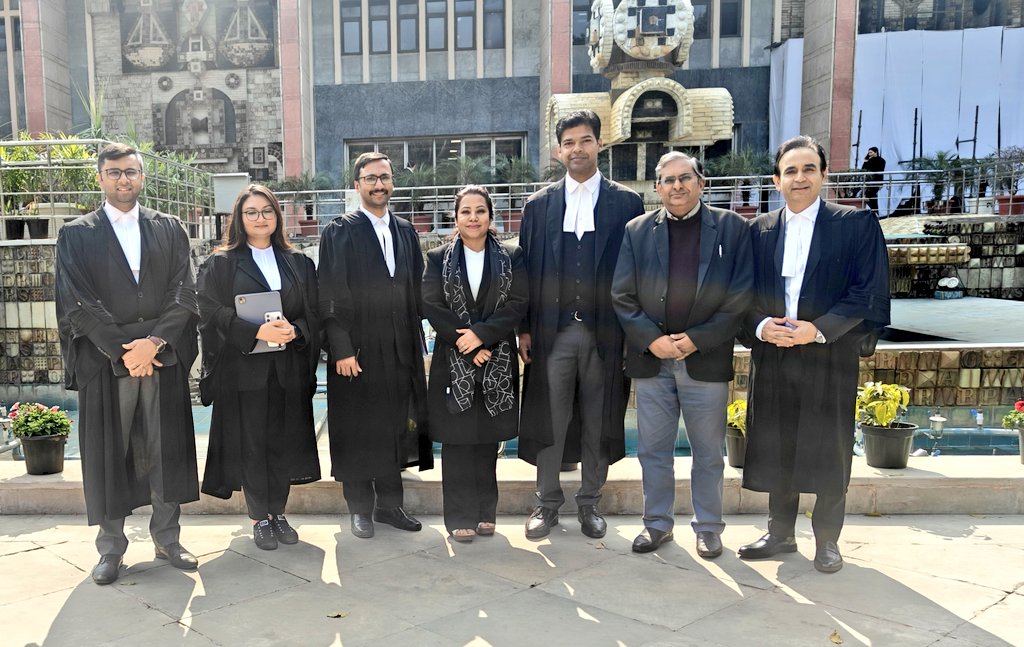
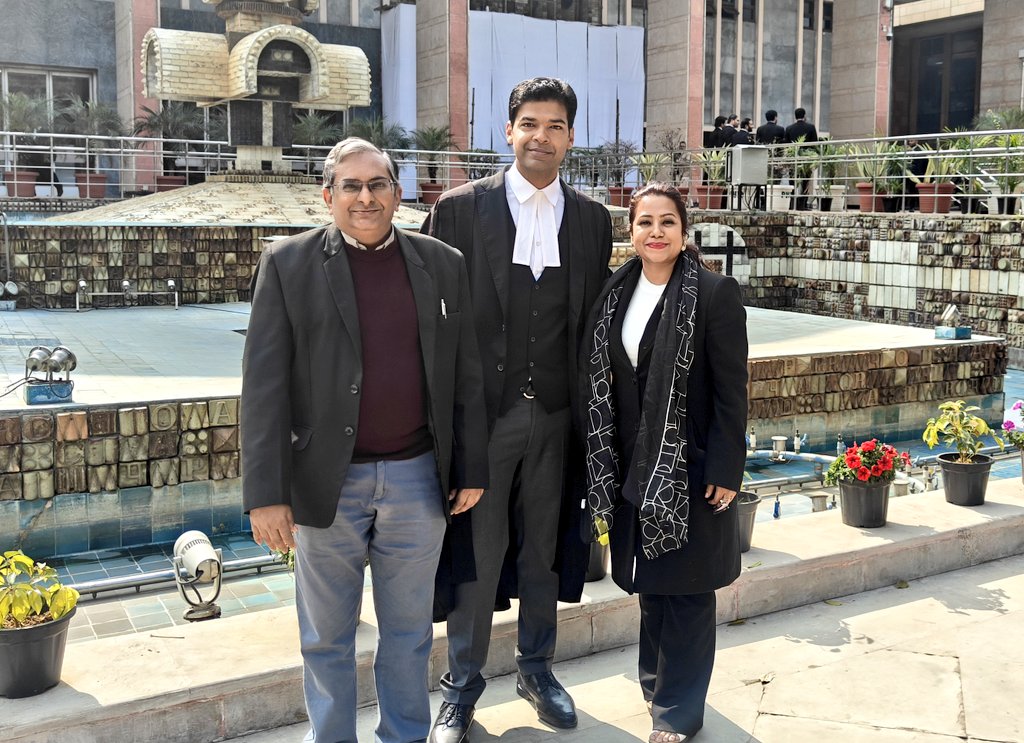
First SUCCESS of 2026 : Delhi High Court has passed an order in PIL filed by @AIFCR_NGO & @ekamnyaay foundation for formulation of Child Access & Custody guidelines adopting shared parenting in Delhi
Extremely thankful to Advocate Manav Gupta & his team for fighting this for us
Shared parenting = better emotional regulation + self-esteem + school performance.
Sole custody = higher loneliness + behavioral issues.
The data is consistent across countries.
Courts need to align with the science of wellbeing.
#AyushmanVoice
https://t.co/68VSCTtRcl
Per Indian laws & SC guidelines, citizens can't be detained at Pol. Station illegaly. IO Suraj Bhan is threatening arrest under 107/ 151 CrPC & possibly Priyash has been manhandled in the police station. Amit Shah Ji, Kindly investigate and
@DCP_NorthWest@CPDelhi@HMOIndia
Activism is about questioning the wrong and the wrong doers.
One of our Activist, Priyash Bhargava has been illegally detained in PS Bharat Nagar of N-W Delhi. Looks like the party which was carrying out illegality that Priyash complained about, has filed a false case in collusion with some errant police officer to force him to take his complaint back which is a common tactic.
IO Suraj Bhan is threatening to arrest under 107/ 151 CrPC and possibly Priyash has been manhandled in the police station.
@DCP_NorthWest@CPDelhi@HMOIndia
If whistleblowers will be pulled down like this, God save the country!
BRILLIANT JUDGMENT BY SUPREME COURT OF INDIA PUTTING TOGETHER A STRUCTURED PARENTING PLAN TO EASE HARDSHIPS FACED BY NON CUSTODIAL PARENT - FATHER IN THIS CASE
The Court said : Meaningful contact with both parents is an integral component for child’s welfare. We believe that where a non-custodial parent demonstrates consistency to be with the child, pays maintenance & arranges his professional
life around child’s calendar, as the appellant has done in the present case, procedure ought not to stand in the way of a predictable schedule.
#sharedparenting #parentalalienation #fathersrights
My name is Prasanna, who previously founded Rippling (worth $10B); I'm going through a divorce. I'm now on the run from the Chennai police hiding outside of Tamil Nadu. This is my story.
@PMOIndia@AmitShah@arjunrammeghwal
Make ##SharedParenting a law then grandparents or father will not be strangers, you will not implement recommendations of law commission 257 as it will affect a billion$ industry. ##biasedJudiciary , taboo on Indian Constitution RIP B.R.A
Meet Renuka Choudhary, the woman behind India's regressive Domestic Violence Law. When confronted about its one-sidedness, she replied, "Let men suffer."
(2006 Devil's Advocate with Karan Thapar)