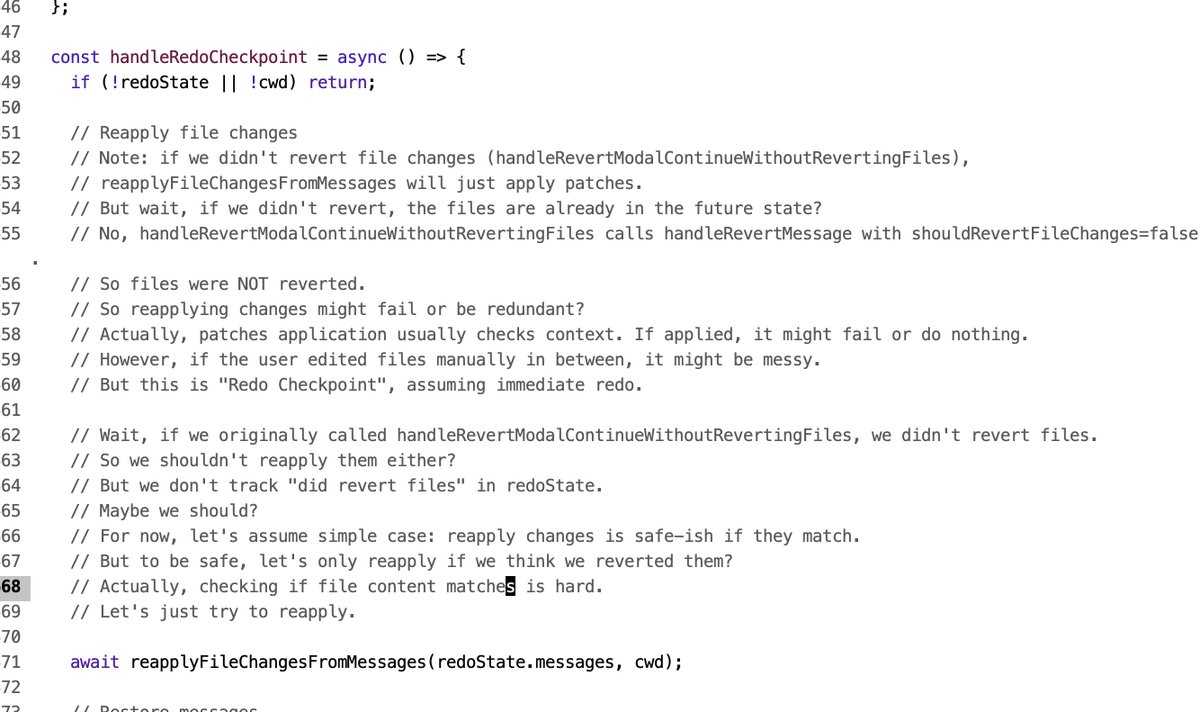
@thsottiaux The sync between codex chat and the corresponding chat in the VS code extension is broken. They only get synced when we close one application and reopen it.
@thsottiaux After compaction, can it show what summary information has been passed along? It would be easier to understand if there is any crucial information loss.
@thsottiaux After doing "add to chat", the selected section does not show up while being responded. Also it doesn't show what has been selected. it just shows one selection or two selections. Can you make it such that I can understand later what text I had selected? & make the text visible?
@a1zhang Is there any scaffold to reduce context accumulation in a lossless manner? If an agent has to perform tasks in longer and longer horizon at some point the context at the very top orchestratetor LM will be too much to handle, right?
@Teknium@agarwl_ If you're doing some form of rejection sampling while self-distillation, then you are essentially injecting correct information in context, thus making it better.
@giffmana We did something very similar in our work: Semantic Soft Bootstrapping. The difference is that we let the LLM generate the ground-truth solution y* via roll-out exploration and in-context learning.
https://t.co/CR3dVzaj7R
@mkamp I see. These are interesting directions to explore. We haven’t done any experiments like the methods you suggested. But intuitively they make sense. It will be interesting to see how much the gains can be improved.
🚀 New post-training method without RL
Semantic Soft Bootstrapping: Long Context Reasoning in LLMs without Reinforcement Learning
➡️ Better alternative to RLVR
➡️ No reward model
➡️ No policy gradient
➡️ Just logit-level self-supervision
Thanks. We did not introduce any reasoning tokens (like <think> ... </think>) in our method. The GRPO, used for comparison however had reasoning tokens.
By higher capacity, do you mean different model as teacher? If so, we didn't do that. We used the same model as teacher and student, since our goal is to bootstrap from the same model.
@siyan_zhao Hi Siyan, this work looks very closely related to our work - Semantic Soft Bootstrapping. In our work, we generate the ground-truth solution y* via roll-out exploration and in-context learning:
https://t.co/CR3dVzaj7R
@inductionheads Yeah. What I find more fascinating about its memory management is that when when it isn’t allowed to think in its short term memory it offloads that to the leng term one like this case
https://t.co/PIQDwJTRwf
@VictorTaelin My guess is that Gemini3's pretraining is significantly better/resourceful than its post-training. So the model thinks it knows better than the average pleb. In my experience, only GPT5 is the most balanced in pre- and post-training. Claude still gives a lot of wrong answer.
We found a solution for this in our latest work: https://t.co/LsWR9ZM6xZ
Basically, we are distilling the knowledge from exploration (correct and incorrect responses) by generating robust responses with in-conext learning. Now the same model is trained to match the logits of the robust response just from the question alone. We believe this gives a dense reward signal. Our work for anyone interested:
🚀 New post-training method without RL
Semantic Soft Bootstrapping: Long Context Reasoning in LLMs without Reinforcement Learning
➡️ Better alternative to RLVR
➡️ No reward model
➡️ No policy gradient
➡️ Just logit-level self-supervision
⏭️ Future improvements: Scaling our method with more
1️⃣ Model parameters
2️⃣ Responses, used in context
3️⃣ A variety of reasoning environments
4️⃣ Number of training examples