सोए हुए समाज को जाग्रत करो, इस राष्ट्र में शक्ति है लेकिन सुप्त है, उसे जाग्रत करो। उस साहस को जाग्रत करो जो इस समाज मे है, उस सामर्थ्य को जाग्रत करो जो इस राष्ट्र में है। पर ध्यान रहे, स्वतंत्रता का यह यज्ञ यौवन का बलिदान मांगेगा, स्वार्थ का बलिदान मांगेगा। #India
ANOTHER IT INDUSTRY SHOCKER AFTER TCS!
NOW: Female Hindu Ex Wipro employee alleges colleague Shahina Rafique pressured her to convert to Islam and establish physical relations with the Country Head.
When she complained, she was threatened by HR Manager Zeeshan Ahmed and forced to resign.
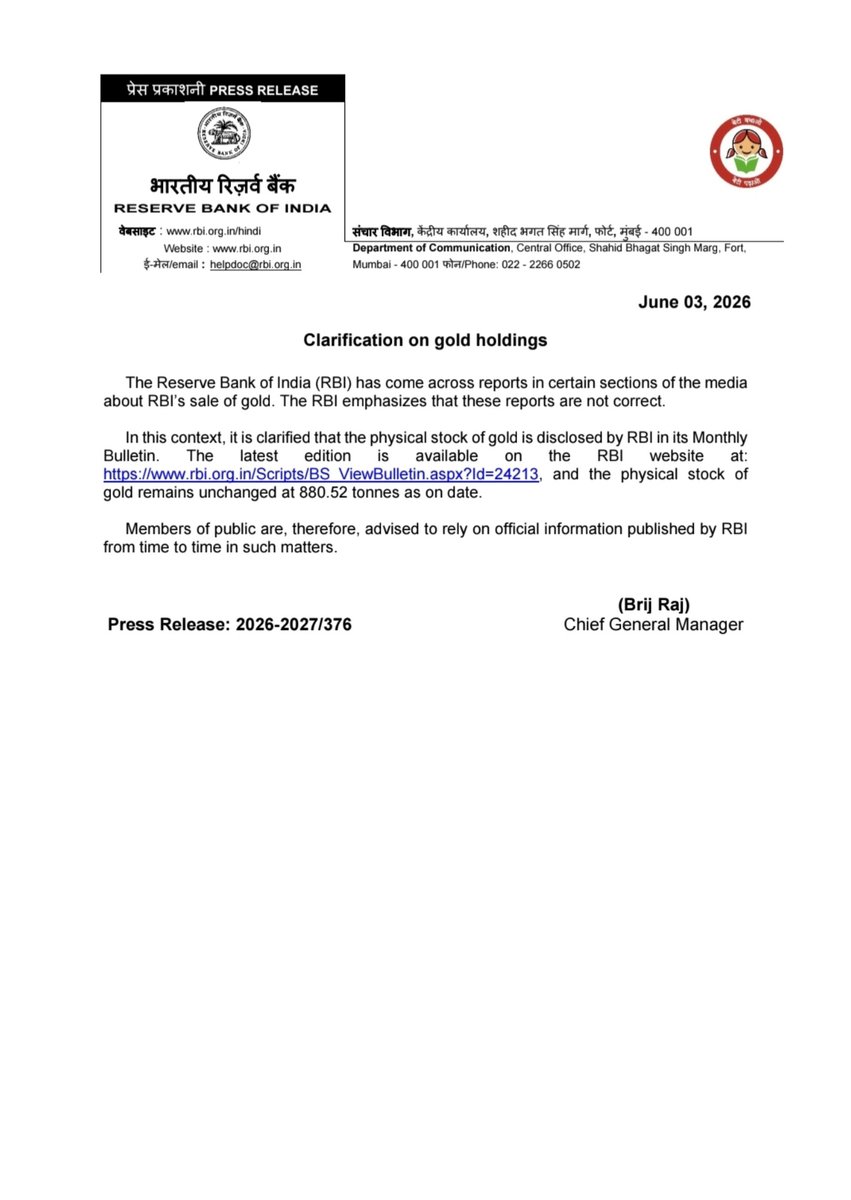
Since morning there is a buzz that Goverment India has Sold Gold in order to strengthen Indian Rupees. Even few of the 'A' listers of RWs, got caught by this 'RBI Sold Gold Bug'.
Now RBI has come forward and smashed that Big for good. https://t.co/Nb2kLCXXvb
If I may correct here, Vinod Vidhu Chopra isn't Ramanand Sagar's Half Brother but Son. I clearly remember that when Vidhu won the National award for his Murder at Monkey Bridge, it was reported he being his son from Ramanand Sagar's afair with a Kashmiri lady, while his stay in Kashmir. Ramanad Sagar was 1918 born and Vidhu is 1952 born, so I will go with version reported in late 70's.
@sushantsareen Wow!!!! That's what Snobishness reflects in some so called English Speaking RWs.... I am not surprised, it was bound to boomed one of these days.
An Indian musical project/artist named Beyond Conscious (founded by Chaitanya Sharma) composed a viral track titled "The Melodi Anthem", which celebrates the bond between Indian Prime Minister Narendra Modi and Italian Prime Minister Giorgia Meloni. The song gained major traction online as the "Melodi" hashtag trended globally during Modi's visit to Italy.
Caught on Boston Airport and The Mom reached old hand Brajesh Misra who pushed AB to bail out the family as this will reflect badly on Pandit ji family. AB personally called on US President Clinton to clear him out. This was the biggest mistake of AB and India suffered due to this.
Did you know that the U.S. defaulted on its sovereign obligations in 1971 when it unilaterally reneged on dollar-gold convertibility.
Russia defaulted in 1998 and 2022.
Argentina: 9 times since independence.
Pakistan: required IMF bailouts 23 times.
Greece defaulted in 2012.
And India? Zero defaults. Not even in 1991!
Yet Western investors classify India as "emerging risk" and call U.S. Treasuries the "risk-free rate."
This isn't risk analysis. This is cognitive bias a la Daniel Kahneman's book "Thinking, Fast and Slow". Humans systematically overweight culturally proximate information while underweighting statistical patterns that don't fit our mental models.
Western strategic planners trust Western partners not because the data supports it, but because the cultural markers feel familiar.
Three facts that challenge everything about how we assess partnership risk:
FACT 1: Across 5,000 years of recorded history, India has rarely waged wars of territorial conquest. Not in 3000 BCE when the Indus Valley Civilization had technological superiority. Not in 1000 CE when Indian mathematics and metallurgy exceeded Europe by centuries. Not in 2026 when it possesses nuclear weapons and the world's 4th-largest military. Not in 2047 when it projects to be a top-two economy.
Compare: China (annexed Tibet 1950, 14 territorial disputes, South China Sea expansion). Russia (Georgia 2008, Crimea 2014, Ukraine 2022). Europe (500 years of colonial conquest across three continents). U.S. (military interventions in 20+ countries since 1945).
This pattern is observable strategic behavior anchored in the Arthashastra, Kautilya's 2,300-year-old treatise arguing that short-term territorial expansion undermines the systemic conditions for sustained prosperity. The concept of "mandala" (circle of states) recognizes that each power's long-term interest depends on system equilibrium.
FACT 2: India has never defaulted on debt, treaties, or security guarantees since independence in 1947. The most revealing test: 1991 balance of payments crisis. Reserves fell to $1.2 billion = just three weeks of imports. Default appeared certain. Instead, India implemented painful reforms, honored every obligation. India didn't use political costs as an excuse to default. Commitments were kept.
This behavior isn't accidental. It's anchored in the Sanskrit concept of ṛṇānubandhaḥ, that obligations are metaphysically binding across time. The Mahabharata established 2,000 years ago that rulers who break commitments violate cosmic order and create systemic instability.
Philosophy became institutional architecture: investment-grade credit through multiple crises, $600B forex reserves (6th globally), zero defaults on government securities across 77 years.
FACT 3: During COVID-19, India exported 300 million vaccine doses to 110 countries while its own vaccination was incomplete. 96 countries received doses free through "Vaccine Maitri."
Meanwhile: U.S. ordered 1.2 billion doses for 330 million people (4x population). EU ordered 4.6 billion for 450 million (10x population). Canada ordered 400 million for 38 million people (10x population).
Western nations didn't begin international distribution until domestic targets were substantially met.
The distinction? India's Economic Survey 2020-21 quoted Sanskrit: "āpadā hi prāṇa rakṣā hi dharmasya prathama aṅkuraḥ" (in calamity, protecting life is the first duty). Not Indian life. Life in general.
This aligns with Vasudhaiva Kutumbakam (the world as one family), not as rhetoric but as policy. India supplies 60% of global vaccines and 20% of generic medicines normally, maintained production during its own constraints, built digital public infrastructure (UPI processes more transactions than all nations combined) and offers it open-source to developing countries.
WHY THIS MATTERS NOW:
Every CFO, sovereign wealth fund, and policymaker is asking: "Who can we depend on for the next 50 years?"
Ukraine shattered the illusion that economic integration prevents aggression. COVID exposed single-source dependencies. Taiwan reveals semiconductor concentration risk.
The global economy is re-optimizing from efficiency to trust.
But here's where Kahneman's research becomes critical: most strategic planners are making decisions using "System 1" thinking (fast, intuitive, pattern-matching based on cultural familiarity) rather than "System 2" thinking (slow, analytical, data-driven assessment of long-horizon behavioral patterns).
The result? Systematic mispricing of partnership risk.
Strategic planners face a choice:
- China: manufacturing efficiency + demonstrated willingness to weaponize interdependence (sanctions on South Korea over THAAD, Australia over COVID inquiry, Lithuania over Taiwan, Belt & Road debt traps in 60+ countries)
- Russia: resource access + repeated weaponization (invaded Ukraine despite economic integration, cut gas to freeze European cities)
- U.S.: innovation + extraterritorial enforcement (billions in fines on European banks for transactions legal in Europe, CLOUD Act overrides local privacy laws, "America First" tariffs hit Canada, Mexico, EU alongside rivals)
- India: 5,000-year track record of territorial restraint + zero defaults + systemic thinking during crises +
challenges (infrastructure gaps, bureaucratic complexity, uneven state capacity).
The question isn't perfection. It is: which risk profile aligns with 50-year partnership objectives when analyzed through System 2 rather than System 1 thinking?
THE UNCOMFORTABLE TRUTH:
If India's pattern suggests lower long-duration risk, why is trust in India still "emerging"?
Kahneman would predict exactly this outcome. Three cognitive biases at work:
1. **Availability bias:** We assess risk based on vivid, recent, culturally proximate information. NATO expansion incorporated Poland, Czech Republic, Hungary rapidly because they registered as "European." India's democracy, rule of law, English-language business environment gets discounted because cultural markers differ.
2. **Confirmation bias:** Western institutions have decades of frameworks built around current partnerships. New data contradicting established models gets filtered out rather than integrated.
3. **Status quo bias:** Existing relationships are comfortable. The U.S.-Europe alliance, U.S.-Japan partnership, Five Eyes intelligence sharing operate with established protocols. Structural change requires crisis-level disruption to overcome inertia.
The crisis arrived.
For boards evaluating long-term partnerships—semiconductors, pharmaceuticals, digital infrastructure, maritime security, critical minerals—India presents a risk profile worth systematic, System 2 analysis.
Because of demonstrated behavior across sufficient time horizons to be statistically meaningful.
In an era of fragmentation, weaponized interdependence, and trust deficits, historical patterns become predictive indicators.
Kahneman spent decades showing that intuitive judgments systematically diverge from statistical reality. Strategic partnership assessment is no exception.
The question is: Are we assessing risk based on data, or based on what feels familiar?
In the 21st century, power matters. But trust may matter more.
And trust should be measured by track record, not by cultural proximity.
PM is traveling abroad to secure investments and ensure energy security in this period of economic gloom due to various global wars. It is one thing to know that, as a contender of PM post over the last 16 years, you don't have the intellectual capacity to understand this. However, I am intrigued to see your irritation towards promoting a reputed Indian brand (Parle). Is it because you don't want Indian brands to be showcased on the global stage? Or are you disgruntled by your intelligence (or lack of it), which has kept you puzzled over why melody is chocolaty?
Rammohun Roy the so called Sati reformer, hated the fact that his widowed mother Tarini Devi was a devout Hindu who contributed money for "idol worship" in Pujas. When he refused to pay his share from the family's land for contributions to Hindu ceremonies, his mother filed a case through his nephew, which Rammohun easily won due to his links with the British administrators. After winning the case against his mother, Rammohun took over all the property and kicked her out on the streets. His mother had to seek refuge in the temple of Jagannath Puri and died there in wretched conditions in 1822. When Roy's sister in law, Durga Devi also filed a case to recover back some money from family properties - Rammohun again ensured that his influence helped him win the case. He then forced his widowed sister-in-law out on the streets.
This is the man who is touted as the savior of widows - but himself ensured that the two widows in his own family were thrown out on the streets and forced to live in wretched poverty after taking over all their property - all in the name of his hatred against "idol worship".
He wasn't the only one, who betrayed Subhash Chandra Bose. Other one was Bhosale, who was working for Miletray Intelligence, later was awarded by Nehru and made him Rehabitation Minister. Apart from him Shahnavaz Khan also betrayed him and later conived with Nehru and declared Bose's death in Aircrash. He was rewarded with Property and Ministry.
PM Modi visit to Nordic Countries is unprecedented-with a population of just 2.7Cr— they have 67 Nobel Laureates: Bluetooth, Linux, Pacemaker, Nokia, Renewable Tech, Quantum Tech and lot more.
..And they are the descendents of great Danavas & Asurs- Ragnarök . Read on ❗️
This is totally false.
Not an iota of truth in this.
There is no question of putting such restrictions on foreign travel.
We remain committed to improving ‘Ease of Doing Business’ and ‘Ease of Living’ for our people.
In the late 1800s, while the West claimed that India was a land of mysticism & snake charmers, 1 man was proving that ancient India had mastered the Atomic Theory & Calculus centuries before Europe. Brajendra Nath Seal was not just a scientist; he was a Universal Mind who encoded the logic of the past to build the lab of the future. He was the silent mentor who sat in a room filled with smoke & ancient scrolls, handing out the mathematical keys that allowed India’s greatest scientists to unlock the secrets of plants and chemicals.
Seal was a polyglot who mastered nearly every branch of human knowledge, from deep-sea biology to advanced mechanics. J.C. Bose drew on the intellectual currents of Bengal’s renaissance, including the philosophical insights of scholars like Brajendranath Seal. Seal’s deep studies of Samkhya & ancient Indian positive sciences offered frameworks of continuity b/w matter & life that resonated with Bose’s experiments on plant responses
In 1915, Seal published a masterpiece called The Positive Sciences of the Ancient Hindus. He did not just make vague claims. He used rigorous mathematics to prove that ancient Indian thinkers had calculated the size of an atom & understood the circulation of blood & nervous system long before the Renaissance.
This was not just pride; it was a scientific weapon. It gave Indian scientists the intellectual permission to compete with the British as equals, not as students.
A young P.C. Mahalanobis (the founder of ISI Kolkata) once went to Seal for advice. Mahalanobis was obsessed with the Anthropometric data of different tribes. Seal warned him that his math was too simple & introduced him to the concept of Biometry.
W/o Seal’s Hidden Hand, the Indian Statistical Institute might never have reached the level of global rigor it did.
Seal worked closely with P.C. Ray (the father of Indian Chemistry). While Ray was in the lab boiling nitrates, Seal was in the library deciphering 10th century Sanskrit texts on metallurgy. He provided the formulas for ancient chemical processes that Ray then used to manufacture world-class medicines in India.
Seal was so respected that he was asked to lead the Mysore University as Vice-Chancellor. He transformed it from a sleepy provincial college into a powerhouse of research. Despite being the Brain of Bengal, he never chased patents/fame. He gave his ideas away for free. He was a Knowledge Infra, the solid ground upon which the towers of Indian science were built.
Brajendranath Seal was the Operating System upon which the greatest Bengali minds ran their software. He proved that an Indian did not need to become Western'to be scientific; they just needed to remember who they were. He remains the Ghost of the Library, the man who knew everything so that India could become anything.
Imagine a man surrounded by 10000 books in 10 different languages, pointing a finger at a complex equation & telling a Nobel-caliber scientist, "You are looking at it wrong. The answer was written 2000 yrs ago, you just need to translate it into math."
और कितना मुंह काला करवाएंगे अपने समर्थकों का महोदय? यदि 12 वर्ष बाद भी कापड़ी ऐसे अधर्मी व्यक्ति को भारत की गौरव वा प्राण भारतीय सेना के शौर्य को प्रसारित करने के लिए, धन दिया जा रहा है, तो इसका अर्थ यही है कि आपकी केन्द्रीकृत नियंत्रण के माध्यम से शासन व्यवस्था चलाने की व्यवस्था में छिद्र हो गए है। @PMOIndia@HMOIndia@DefenceMinIndia
बड़ी ख़बर-
आखिर बीजेपी ने विनोद कापड़ी वाला ट्वीट क्यों डिलीट किया।
आखिर सेना ने भी कापड़ी वाले ट्वीट से क्यों पल्ला झाड़ा?
आखिर विनोद कापड़ी को ऑपरेशन सिंदूर पर फिल्म बनाने का ठेका किसने दिलवाया?
उसे सेना के कनेक्शन में कौन लाया?
जो आदमी टीवी इंडस्ट्री में भूत-प्रेत-नाग-नागिन-कुत्ता-बिल्ली-सांप-बिच्छू वाली स्टोरियां चलाने के लिए कुख्यात रहा हो।
जिस पर आपराधिक मुकदमे दर्ज हैं।
जो सालों तक इंडिया टीवी में नरेंद्र मोदी की जयजयकार करता रहा,
और उसके बाद जब नौकरी से बाहर हुआ तो मोदी को दिन रात गाली बककर लेफ्ट लिबरल गैंग का मसीहा बन गया,
ऐसे आदमी को सेना के संपर्क में लाने और ऑपरेशन सिंदूर पर फिल्म बनाने सरीखा मन को जीत लेने वाला 'मनजीत' काम किसने किया?
सेना को चाहिए कि पता करे कि कौन इस आदमी का पोस्टमैन बना हुआ है?
क्या डिफेंस बीट कवर करने वाले किसी रिपोर्टर की सेवाओं का उपयोग किया जा रहा है?
आखिर कौन इसकी पहुंच का सेतु बना हुआ है?
सेना हमारे देश का गौरव है।
हम सब को सेना पर नाज़ है।
सेना क��� कुछ नहीं करना है।
सिर्फ कापड़ी जैसे आदमी को मिली इस फिल्म की फाइल खोल देनी है।
किस अधिकारी को किसने फोन किया?
किसने कापड़ी को रिकमेंड किया?
ये सब एक झटके में सामने आ जाएगा।
अगर इसके पीछे डिफेंस बीट का कोई रिपोर्टर है तो वो भी खुल जाएगा!!
'ऑपरेशन सिंदूर' कर चुकी सेना के लिए अब 'ऑपरेशन दूर' शुरू ��रने का समय है ताकि अवांछित तत्वों से खुद को दूर किया जा सके।
वैसे भी अगर आपकी कमीज़ लकालक सफेद हो तो कोयले की ख़ान के संपर्क में आने से पहले सावधानी बरतनी चाहिए,
और ज़रूरी due diligence अवश्य करना चाहिए।