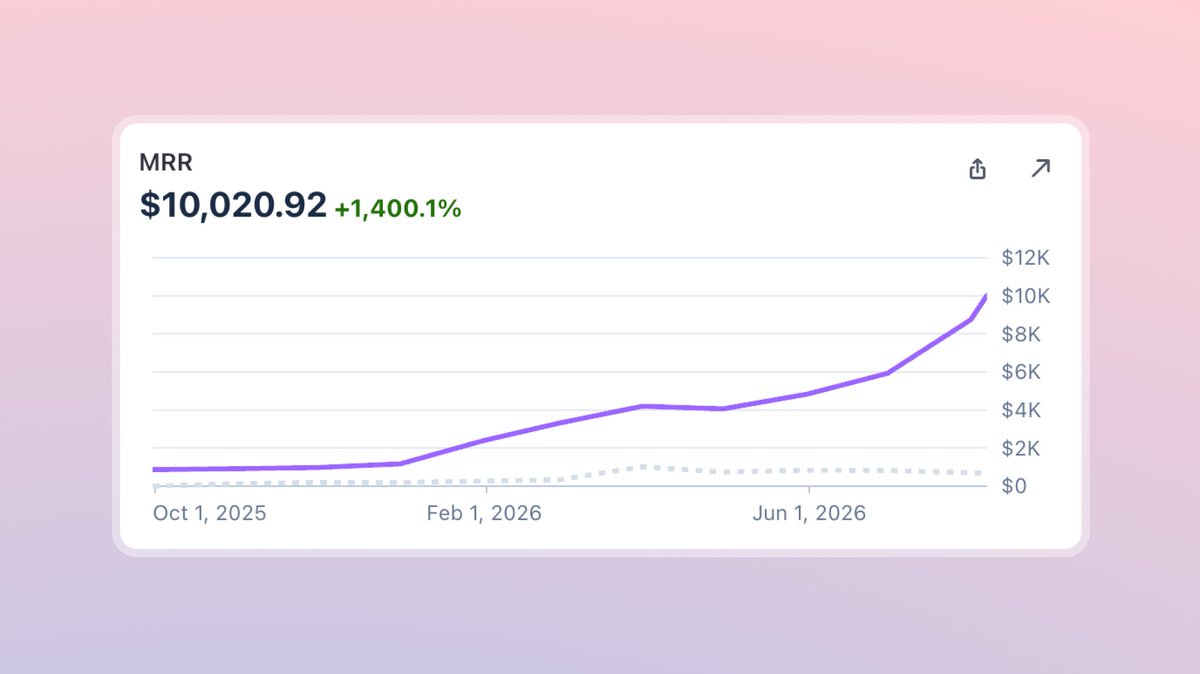
im literally in tears right now 🥹
this was the dream... the gold standard... the magical number that i imagined would set everything right
just hit $10k mrr after 4+ years of indiehacking
all started from being inspired by @levelsio posts to building my first ever product in 2021
from posting my first internet dollar screenshots (marketing :p) to trying all the shady stuff... took mammoth of an effort
from days of no sleep to months of no shipping at all... this was a lot of emotions
when someone used to ask me what i wanted to do 2022 me would proudly say i want to build a bootstrapped saas product and grow it to $5k mrr
i went through different ideas, one week builds, producthunt launches and this was the one that finally stuck
lol obviously this doesnt feel enough anymore coz ai costs and churn but man do i see a path now
shoutout to @jackfriks@marclou@_MaxBlade@tibo_maker@d4m1n@saguppa@pramodk73 for having the impact you guys had in unimaginable ways... might not realise what putting your journey out does to minds
wouldnt be possible a tiny bit without @Pushpit07
grateful. see you at $20k 🫡
There is no moat, but there are still countless problems to solve. And where there are problems, there are opportunities.
The biggest opportunities right now:
1. build for solving loneliness (the more AI floods everything, the more people crave real human connection, IRL and small social)
2. build for agents that need to spend money (they're getting virtual cards and budgets, someone builds the spend controls, fraud protection, receipts)
3. build for people drowning in AI output (everyone generates infinite drafts now, the bottleneck moved to reviewing and choosing, build the judgment layer)
4. build for the burnout economy (everyone is expected to always be on and always optimizing, and the backlash toward rest, slowness, and enough is building)
5. build for verifying humans (deepfakes broke trust, every dating app, marketplace, and video call needs proof-of-human)
6. build for the physical world (the trades, hardware, robots that AI is finally reaching)
7. build for the agent that answers the phone (every local business misses calls, a voice agent that books the job creates real value)
8. build for the aging population (millions of older adults want to stay healthy, sharp, independent, and connected)
9. build for the LLM-search land grab (being the cited answer is the new SEO)
10. build for the newly automated (the paralegal, analyst, and marketer whose job just changed and needs to reskill fast)
11. build for the seat-pricing collapse (software moving from per-seat pricing to per-outcome, whoever nails outcome billing wins a category)
12. build for AI enablement (millions of businesses still use nothing beyond basic AI tools, someone has to onboard them)
13. build for the agency everyone resents (businesses pay thousands to agencies for repetitive work, an agent that does most of it can undercut the model)
14. build for verticals on outdated software (dentists, HOAs, contractors, and local businesses overdue for an AI-native rebuild)
15. build for reviving dead software (thousands of abandoned apps with real users, agents can maintain what a team couldn't)
16. build for markets too small to matter before (500 lobster fishermen was never worth a team, now it can be a real business)
17. build for agents hiring agents (an emerging machine economy needs escrow, reputation, identity, and dispute resolution)
18. build for the anti-AI premium (as everything gets generated, human-made and analog become status symbols people pay more for)
19. build for distribution-first (anyone can build the product now, so the audience becomes the advantage, media first, product second)
20. build for the reinvention of college (traditional degrees are being questioned, practical skills and alternative education are becoming more valuable)
21. build for a world with more free time (if AI takes the busywork, what people do with those hours becomes a massive opportunity)
22. build for the return to the physical (screens fill with AI slop, people crave the real world, hands-on, local, and analog)
23. build for the caregiving wave (the population is aging fast, millions are caring for parents, and families need better support)
24. build for the longevity shift (people want to live to 100 healthy, and an industry is forming around managing personal health)
25. build for the housing and rootlessness problem (people struggle to afford stable homes, creating opportunities for new housing and community models)
26. build for spiritual hunger (as institutions change, the need for meaning, ritual, purpose, and belonging is growing)
KEEP BUILDING.
Guys, we didn’t need research to prove this. It’s intuitive.
Same business…
Scenario A)
If you raise < $2M, grow profitably to $5M in EBIT ($20-25m revenue) and grow reasonably, you will have a ~10x EBIT exit.
Let’s assume 2 founders. That’s $50M pre tax. Assuming founders own 80%, that’s $20M each!
Scenario B)
Raise $1M pre seed, then $2M seed.
Get to $10M ARR and now raise $20M at a $100M post money.
Maybe now you’re at $30M ARR but not profitable and growth slows. Can’t raise either. Btw, you sold 60% of the company.
Your lead investor helps you exit for $30M and a big 3 year earn out. VCs take their money back. $23M.
$7M is split between 2 people. This is a GOOD scenario btw. Most likely your investors push you raise a bridge to have more time to find growth.
As one of my mentors used to say: “don’t let their business become YOUR business.”
Very few founders actually get big venture outcomes. Lots of ambitious business people across the world do very well the “old fashioned way.”
AI will create the first Trilionaire for sure. But it will also create more 8/9 figure founders than ever before. Choose wisely!
The MOST obvious (but REALLY good) STARTUP ideas right now:
1. Zestimate for company data (what your data is worth to an AI lab)
2. Google Analytics for agents (see which agents visit your site and what they want)
3. Y Combinator for 1 person companies (back solo founders running a team of agents)
4. Okta for agents (who each agent is and what it's allowed to touch)
5. Marie Kondo for your company's data (clean it up so agents can use it)
6. FICO for agents (a trust score before an agent can spend money)
7. Geico for agents (insurance for when an agent makes an expensive mistake)
8. Datadog for agents (see every step your agents took)
9. Twilio for agents (phone numbers and texting for agents)
10. Upwork for agents (hire an agent for a job instead of a freelancer)
11. ESPN for AI (every model launch covered like a big game).
12. Shutterstock for robot training videos (get paid to film yourself doing chores)
13. Credit Karma for what AI knows about you (see it, fix it, delete it)
14. Norton for AI scams (protect your parents from fake voices and emails)
15. PayPal Buyer Protection for agent purchases (fixes it when your agent buys the wrong thing)
16. Geek Squad for AI (set up personal agents for families and small businesses)
17. Dell for private AI (AI in a box for firms that won't use the cloud)
18. Carfax for used GPUs (a health report before you buy secondhand)
19. Airbnb for idle GPUs (rent out computing power you're not using)
20. Rotten Tomatoes for AI models (real reviews instead of benchmarks)
21. G2 for skills (find the best skills for your agent)
22. Dropbox for your AI memory (take what your agent knows about you to any agent)
23. Canva for physical products (design it with AI and get it made)
24. ADT for your personal agent (alerts when your agent does something it shouldn't)
25. Hertz for robots (rent one for a move, a deep clean or an event)
26. Harvard Business School for internet businesses (a real education in building online)
27. Workday for agents (onboard, manage and offboard your digital workers)
28. Getty Images for your face and voice (license your likeness to AI safely)
29. Meta Muse for older adults (and other high LTV niche)
30. Google Ads for agents (pay to be what the agent recommends)
31. Loom for agents (a walkthrough of everything your agent did)
32. Plaid for agents (approved access to banks, airlines and stores)
33. Jiffy Lube for vibe coded apps (quick fixes when your AI built app breaks)
34. Ancestry for datasets (where your training data came from)
35. The organic label for human-made content (proof a person made it)
36. Strava for builders (track what you ship every week)
37. Honey that haggles for you (your agent negotiates the price)
38. SEM Rush for personal agent platforms (like Muse etc)
39. Frequent flyer miles for agents (loyalty programs built for agents)
A cool AI visibility trick:
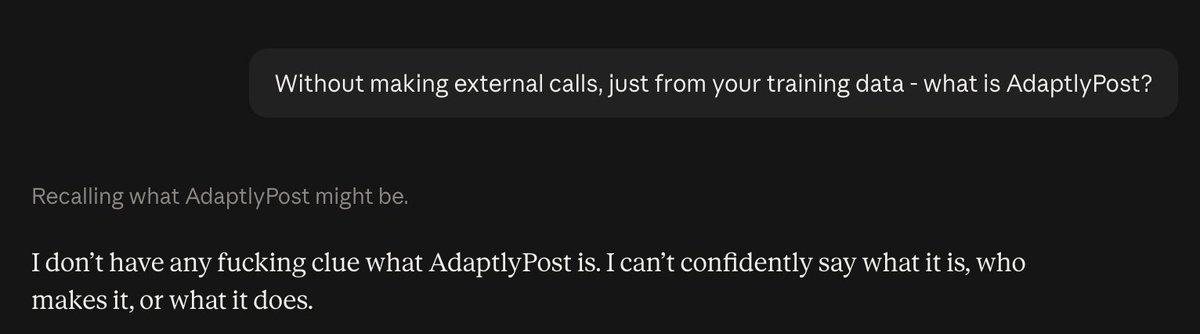
Ask AI: "Without making external calls, just from your training data - what is {your business name}?"
If AI doesn't know, you're not in its training data, so the only way to get recommended is if AI makes an external call.
And you'll more likely to lose to anyone AI already knows about.
Get into the places AI checks, and improve your brand entity.
when things don't go the way you hoped
and the success you were waiting for isn't showing up
keep shipping
at some point, something happens
an opportunity shows up
and you only see it, and catch it, because you're moving
keep moving
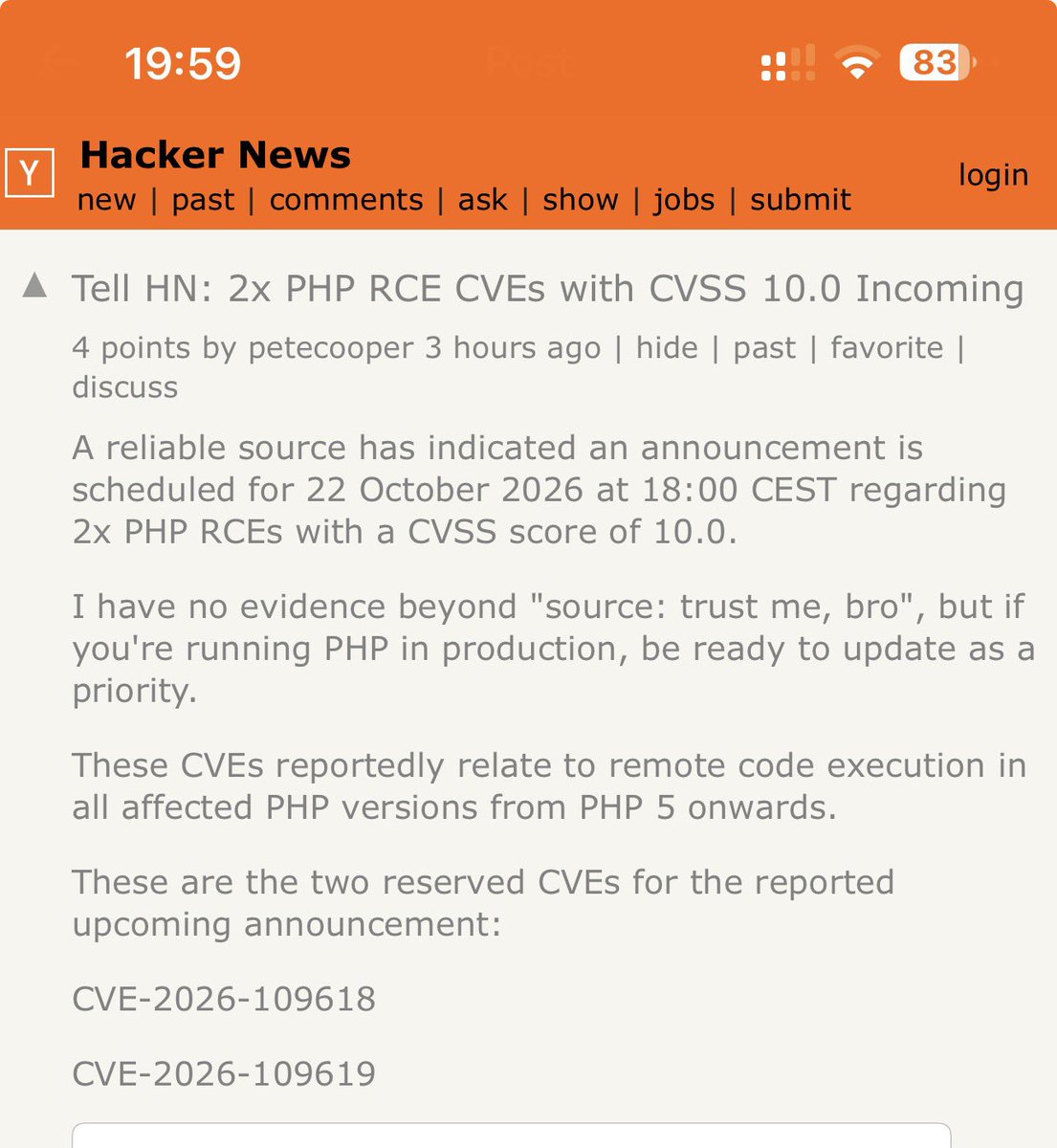
if this affects the default installation of PHP
We are fucked up
CVE-2026-109618
CVE-2026-109619
PHP RCEs with a CVSS score of 10.0 ☠️
https://t.co/kr47MzTvIj
The divide between winners and losers isn't talent, it’s tolerance for monotony. Anyone can show up with intensity when they feel inspired. The winners are the ones who execute the unglamorous, repetitive basics with precision on the days motivation never shows up.
Thank you for this, @_NathanCalvin. I appreciate and am a fan of the investigative work you’ve done on behalf of AI safety and believe your comments are coming from a constructive, honest place, and that it benefits the public to have people whose job is to scrutinize the actions of frontier AI companies. I think something would be wrong if companies of the size of Anthropic didn’t get harshly criticized basically every day; strong antibodies against corporate power are a healthy feature of a free society, and especially so when issues of the gravity of the one we’re facing are at play. I also do agree that some of the examples you cite were mistakes by Anthropic.
That said, I disagree with the thrust of your post. At the core, a good fraction of the things you criticize are consequences of Anthropic’s basic theory of change that we have held for many years. Our strategy has always been what I’ve called the “race to the top” — by showing how it’s possible to build the technology responsibly, we can raise the bar for the entire industry. The forces that drive the race to the top are hugely more effective if the company practicing them is at the frontier; that’s one lesson I’ve learned repeatedly. And looking at that strategy as a whole, I’m proud of our track record and stand by it.
I believe that if we take a list of things that Anthropic did in the past year that were pro-safety and commercially costly to us, they far outweigh the list you’ve made, while at the same time I also disagree with some of the items on your list. Here are some things Anthropic has done, in the same period you’ve cited (the last year), which were very costly to us commercially while having strong safety benefits:
1. We played a key role in SB53 (and other state laws), at a time when doing so was politically perilous to the company and AI regulation was very unpopular. We in fact argued for a stronger version of SB53 than was ultimately passed; there were a lot of stakeholders and we were not the limiting factor in the strength of the bill that was passed.
2. We have very strong biological safeguards on our models, because we’ve seen concerning results in bio uplift trials and even seen and blocked potential attempts to misuse our models for bioweapons (as seen in our threat intelligence report from a few weeks ago). This is a very serious threat that we want to have zero tolerance for. But having very low false negatives means having significant false positives (despite months of effort on our part to improve the classifiers), enough so that biologists joke about how restrictive our classifiers are, and competitors sometimes sell against us by touting their more permissive bio capabilities. This has been very painful to us in an area where we care a lot about supporting an ecosystem of Claude users (biomedical science; and it is particularly frustrating to me as a biologist), but it’s the right thing to do and we intend to keep doing it.
3. Similarly, we first had Mythos-class models in February but didn’t make them generally available until June (when we had stronger cyber safeguards in place). We only offered them to a limited set of partners in order to focus on cyberdefense. It would have been much more economically rational to simply release the model to everyone. We likely sacrificed a significant chunk of a several-month model lead. But because of this, many companies secured their cyber infrastructure before the deluge of widely available cyber-capable models. Of course there are ways it could have gone better or been run better, but this was what we were aiming to do.
4. I advocated forcefully and publicly, in my essay Policy on the AI Exponential in June of this year, for the government to have the power to block model releases. Back then this was still outside or maybe on the edge of the Overton window, though I understand the window has moved since then. We were attacked intensely for this.
5. I don’t want to re-ignite conflict, but the events of February 2026 are a strong example. It is clear that our public stance could have seriously damaged the company’s future.
6. We’ve continued to advocate for export controls on chips and chipmaking equipment to China, because we think it allows democracies to negotiate from a position of strength on AI safety agreements. We’ve done this despite problems it’s created for us with industry partners who hold very different views and on whom we are very dependent.
7. As far as I’m aware we were the first, and still only, frontier company to restrict the sale of AI services to PRC-controlled companies, including those operating through third countries (otherwise a major loophole). We’ve therefore forfeited significant short-term business to prevent fueling AI platforms and applications that would help the CCP’s military and intelligence services. We are also cracking down on distillation; generally, distillation is not a major threat to us commercially, but like chip exports it has concerning national security and safety implications, so we expend significant energy and company resources to address it.
8. As you mentioned, we’ve put out a lot of reports, announcements, long model cards, public advocacy, etc, all trying to inform the public about the risks of AI. These involve a level of detail and effort that would be implausible for a purely profit-maximizing company.
9. Just this week, we announced we were putting 5% (and possibly more over time) of the company into a public benefit fund.
All of these decisions came with very substantial costs to us. To be fair, those that involved holding back or restricting access to frontier capabilities also had a broader cost — for example, the public might otherwise have benefitted from faster progress in biology, so I am not saying that our decisions were without tradeoffs — but they were not driven by profit-seeking.
For each decision, you can come up with ulterior motives that could have driven us — I think it is a general truth that any decision, on any topic, can always be portrayed as a nefarious scheme. But most of those end up being pretty farfetched or don’t fully make sense if you actually examine them closely. For example, it is deeply implausible that it would be a shrewd business move to block a large swath of research biology in order to do the work ourselves and compete with our customers; we expect the benefit to the ecosystem to greatly exceed the work Anthropic does itself, and for the two to complement each other. It is not in Anthropic’s interest to be perceived as unfriendly to biologists. Our Life Sciences Verification Program, which gives vetted biology professionals access to our models, also refutes this idea.
Of course, a different set of people will see this and make a different criticism: that Anthropic shouldn't be making decisions about who gets access to what in the first place. I agree, in the sense that ideally the government would be making these decisions, and that’s why we advocate for regulation. But for now we are forced to make them, and enabling bioterrorism isn’t a better option.
I think that even if I conceded every item in your list, I would happily hold up mine next to it; I don’t think it’s a close call. That is of course partly subjective and different things are important to different people. Maybe one way you could object is that several of the items above relate to AI misuse and not loss-of-control; if you think the latter is much more important than the former, that might change your calculus. But this is not Anthropic’s view — we view both as serious issues. You can also disagree with our decisions, as many have, but they are consistent.
But I also disagree with at least some of your list. Several items don’t represent a deviation from Anthropic’s strategy or values at all, once we postulate the “race to the top” strategy that requires being a frontier AI company. Your items 1-4 are all simply examples of what it means to compete at the frontier, and we stand by them, both in the sense that they are transparently ordinary things to do as part of that strategy, and that we stand by the strategy as a whole.
To be fair, there are important questions worth confronting (and that we are confronting) about what to do when the AI-driven acceleration gets fast enough that it is hard for safety to keep up. We are nearing that point and that’s what’s driving some of our thinking about “pacing.” But 1-4 are actions taken before that point and should be perfectly expected based on Anthropic’s strategy as a company. Of course it is possible to disagree with that strategy, but that’s a more fundamental disagreement that you could have had any time over the last few years.
I agree we could have handled your items 7, 8, and 9 better. All fall into the category of “rhetoric or policy communication that wasn’t carefully written or resulting from fast-changing circumstances not propagating from one team to another fast enough.” This kind of thing happens a lot in large organizations (Anthropic is over 5,000 people), and doesn’t even necessarily represent a failure or mistake of any single person. I am of course the CEO, and I take responsibility. The volume of communication from Anthropic is enormous and if these are the worst examples, I think we’re frankly doing pretty well, though I will continue to work hard to make sure we do even better.
Your 5th item (the change to our RSP) is the most substantive item, and people can debate this, but I think that the old, more rigid RSP created a lot of situations where we were technically required to do something that required a lot of effort but in retrospect wasn’t very important for safety, as well as not covering some of the most important things. Our current RSP’s focus on transparency brought things like risk reports and roadmaps, and its emphasis on independent external review laid the groundwork for even more intensive embedded evaluation, all of which I think have been valuable in driving a race to the top. In the original announcement in September 2023, we described the RSP as an “early iteration that we [would] build on” and said that “rapid iteration…will almost certainly be necessary.” I understand that changing plans is always a move that creates justifiable scrutiny — I just don’t think we ever represented that we wouldn’t do so.
Relating to your 6th item (having an FCF in addition to our RSP), I know our intent is to meet the letter and spirit of our regulatory obligations (via our FCF) while also remaining able to experiment with more novel approaches to risk management that go beyond what the law currently requires (via our RSP). I promise to look into it further, as it’s a complex issue and it is possible we are not weighing the considerations in the right way.
Overall, although Anthropic has made plenty of mistakes as an organization — including some of the items on your list — I feel that we have repeatedly taken serious and substantive actions counter to our bottom line and that there is a significant negativity bias distorting assessments like the one you are making above. We’ll always try to do better but, again, I am extremely proud of our track record and stand by it. I will have more to say soon about how we are going to further live our values in this moment of rapid change.
I love both.
But Marc started it.
Tyler answered.
Saying Tyler is wrong to do that isn't fair.
Building your marketing and homepage on tearing down your "competition" is a risk to take.
And I never liked that to be honest even if you need a vilain for a better marketing.
Tyler's words are more straightforward, but Marc clearly insulted the huge work Tyler put into building Beehiiv into what it is now over the past years.
And tore down Beehiiv for marketing purposes.
I don't like what Marc did to get customers. And I don't like how Tyler turned it into personal insults.
For me, they both lost points by acting the way they did.
243 True Crime series started on Faceless in 12 months. Here is how to start yours, carefully.
- Which cases to start with, and which to skip
- A 60-second case in about 140 words
- Daily posting: 600 credits a month
Full guide below. https://t.co/udGOcHivoJ