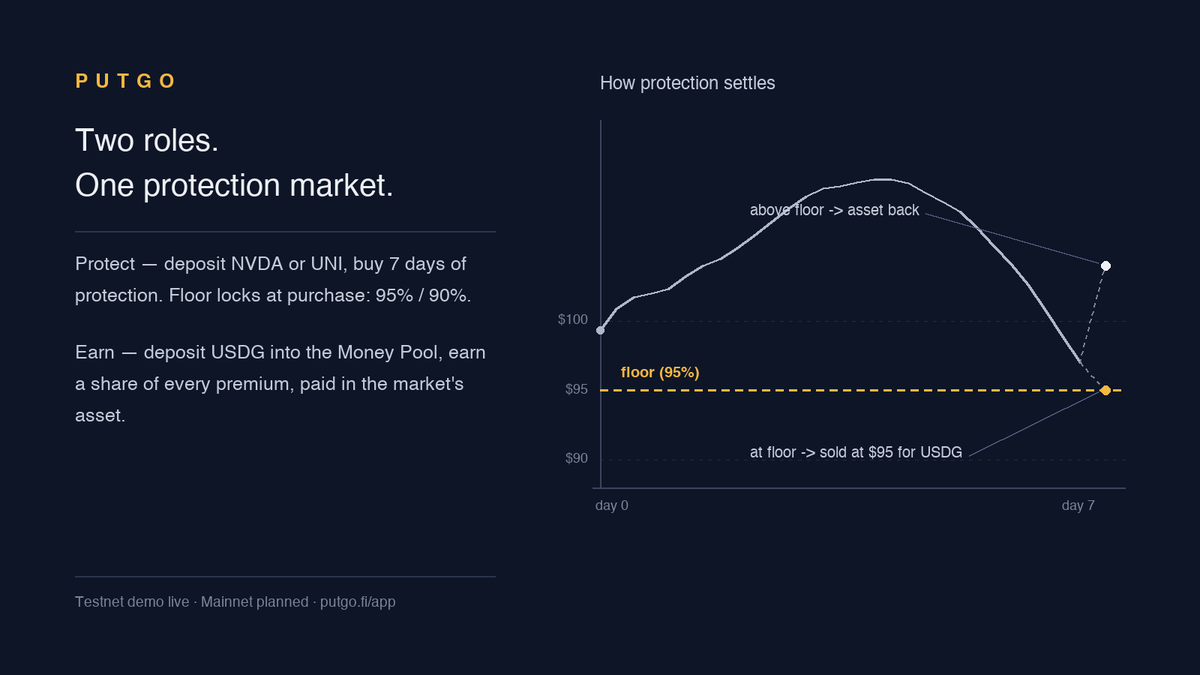
PUTGO protection ends one of two ways. At expiry, one official price at 12:00 UTC decides: above the floor — your asset comes back; at or below — it sells at the floor for USDG. No discretion. Testnet: https://t.co/6r47Xe7iqd #RobinhoodChain#StockTokens $USDG #Arbitrum@arbitrum
@arbitrum $300K into founders beats any marketing spend. Infrastructure like price protection gets built by teams that stick around — this is how an ecosystem keeps them.
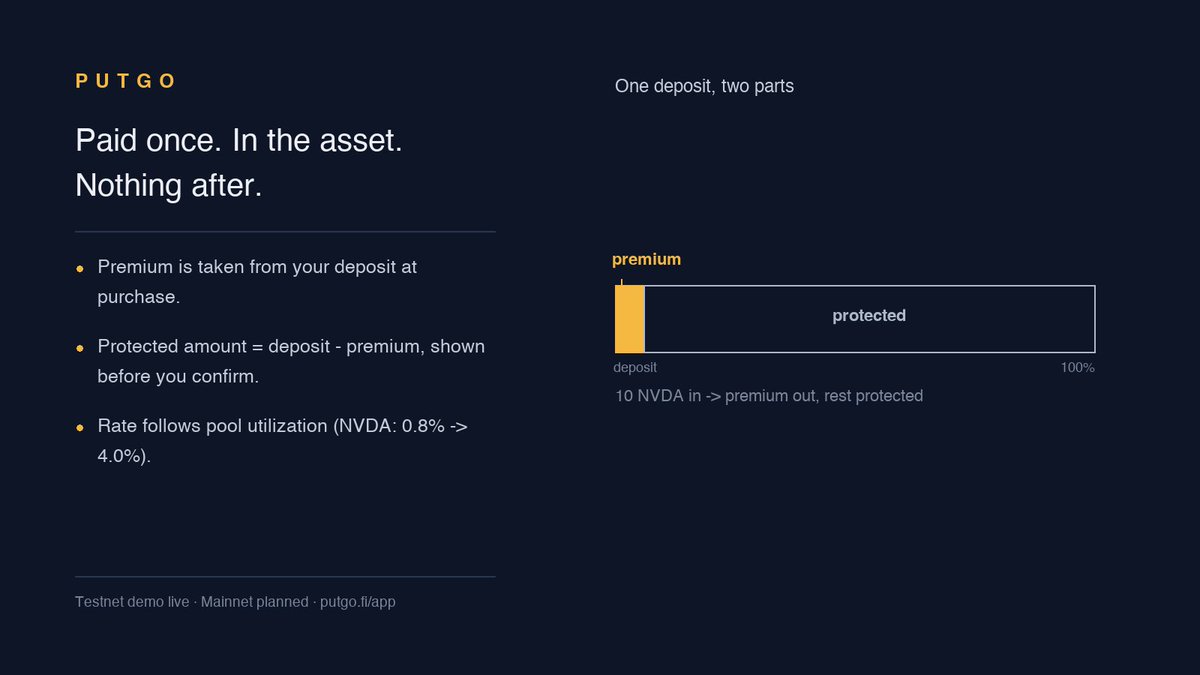
PUTGO's premium is paid once, in the asset, at purchase — nothing after. Deposit 10 NVDA: premium comes out of that amount, the rest is protected. Protected amount shown before you confirm. Testnet: https://t.co/Nv8RFJSuwh #RobinhoodChain#StockTokens $USDG #RWA#HOODSummit
@Uniswap@RobinhoodCrypto $70B through one venue is real depth. Deep liquidity is exactly what makes on-chain price protection viable — you can't build floors on thin books.
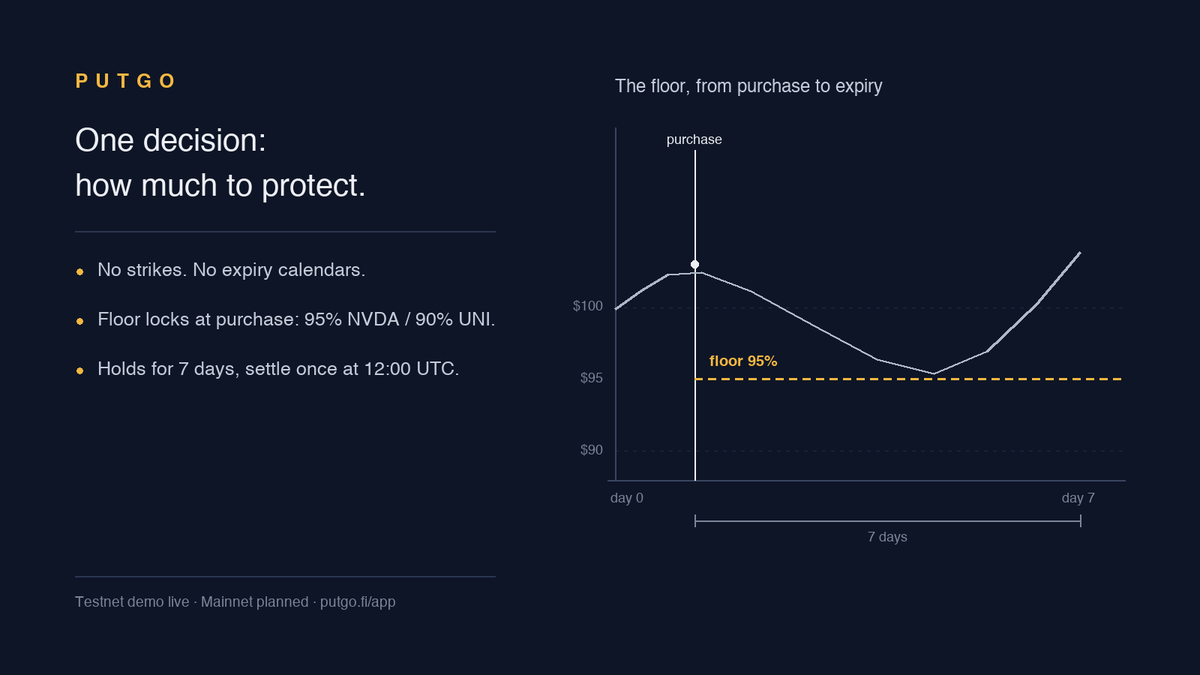
Buying protection on PUTGO takes one decision: how much. No strikes, no expiry calendars. The floor locks at purchase — 95% on NVDA, 90% on UNI — and holds for 7 days. Live on testnet: https://t.co/Nv8RFJSuwh #RobinhoodChain#StockTokens $USDG #RWA@RobinhoodCrypto
@RobinhoodCrypto Fun is what brings people onchain; confidence is what keeps them there. Price floors for the assets they hold are how confidence gets built.
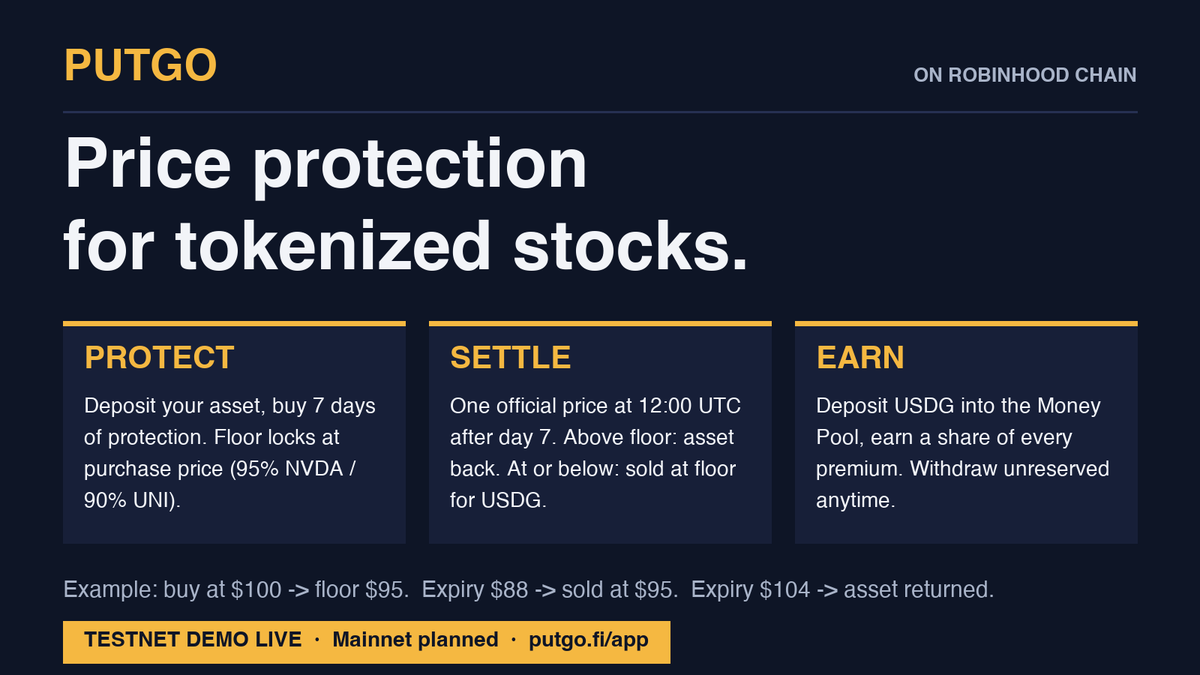
Two ways to use PUTGO on #RobinhoodChain:
Protect — own tokenized stocks? Buy a 7-day price floor.
Earn — hold $USDG? Back that protection in the Money Pool and collect your share of every premium.
Testnet demo live: https://t.co/Nv8RFJSuwh #StockTokens#RWA@RobinhoodCrypto
@RobinhoodCrypto Impressive pace — $60B to $75B in five days. As liquidity this deep arrives, so does the need for on-chain price-risk tools. Protection markets are the natural next primitive.
PUTGO is a price-protection market on #RobinhoodChain: own a tokenized stock? Buy 7 days of price insurance at a fixed floor — no strikes, no order books. Hold $USDG? Fund the pool, earn the premiums. Testnet demo live: https://t.co/Nv8RFJRWGJ #StockTokens#RWA@RobinhoodCrypto
Plans change. PUTGO's early-exit design returns your protected asset before expiry and ends protection. The premium stays paid. Mainnet not live. Explore the testnet:
https://t.co/Nv8RFJRWGJ
@RobinhoodCrypto@ponsdotfamily@Uniswap#RobinhoodChain#PONS
@RobinhoodCrypto Useful products should work across seasons. We're building PUTGO around clear price-protection rules: a floor set at purchase, explicit expiry outcomes, and an early-exit option. Testnet available; mainnet not live.
PUTGO's Money Pool design: deposit USDG to back protection and receive asset premiums. Delivery converts USDG into assets; it isn't extra income. Mainnet not live.
https://t.co/Nv8RFJRWGJ
@RobinhoodCrypto@ponsdotfamily@Uniswap#RobinhoodChain#PONS
@ponsdotfamily@Uniswap Broader market access also needs clear ways to manage exposure. PUTGO's Money Pool design lets USDG depositors back price protection and receive premiums, while keeping asset-delivery risk explicit. Testnet only today.
PUTGO's protection design: pay a premium, lock a floor. At expiry: above it, get your protected asset back; at/below it, receive USDG at the floor. Mainnet not live.
https://t.co/Nv8RFJRWGJ
#RobinhoodChain#HOOD#NVDA#PONS#STONKBROKER
@WhaleInsider Tokenized equities need clear holding outcomes alongside trading access. PUTGO's price-protection design fixes a floor at purchase and settles against the official expiry price; the testnet lets users explore both outcomes.
PUT is minted once: 1B across four fixed buckets. No mint authority follows Genesis. A burn permanently reduces supply and never refills a bucket. TGE remains TBD. https://t.co/mP2NwUHuyG #RobinhoodChain#STONKBROKER#PENGUIN#PONS#NVDA
@ClutchMarkets Burn mechanics matter most when the supply path is explicit. PUT follows a mint-once design: burned tokens permanently exit supply and never refill any allocation bucket.
@BitgetWallet One nuance for concentrated-liquidity pools: the total balance is not all active at the current price. Quotes at realistic trade sizes reveal usable depth more clearly than a headline liquidity figure.
@RobinHubHB Can the analyzer distinguish immutable pool rules from permissions that remain after launch? Knowing whether fees or controls can change matters as much as the initial configuration.
@PareStocks The credit-loop stage adds a different risk layer from simply splitting a stock token. A worked example showing debt, liquidation thresholds and unwind costs would make that trade-off tangible.