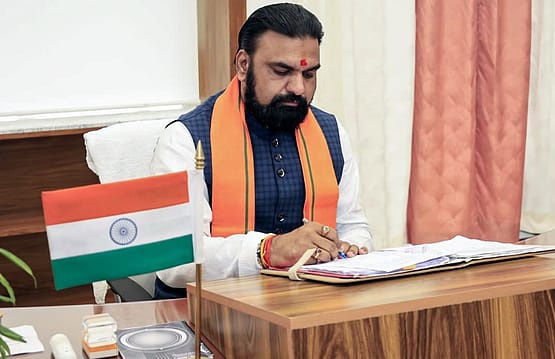
"Bihar's criminals will have to flee to Nepal. There's Yogi Baba in UP, Dada in Bengal, and here sits Emperor. No one can play with the law in Bihar."
— CM Samrat Chaudhary
खासदार संजय दिना पाटील..आम्ही तुला मतदान दिले कारण तू भाजपच्या विरोधात उभा होता..
तुझी खासदार होण्याची लायकी नव्हती तुला मतदारांनी खासदार केला... मुंबईत एवढ्या उन्हात दोन दोन तास उभ राहून मतदान केलं होत कारण आम्हाला भाजप नको हवी होती..... आणि तूच भाजपच्या मांडीवर गेला?
#लोकशाहीचाबाजा���
Dharmendra Pradhan is The Worst Education minister in Indian History...??
○ Yes, I agree
○ No, I disagree
Follow @TheCockroachIND and share your opinion clearly.
2013– US strip-searched one Indian woman diplomat.
Dr. Manmohan Singh govt retaliated by removing US Embassy barricades and curtailing US diplomat privileges.
2026– US killed 3 Indian sailors.
Modi govt did ‘kadi ninda’ and summoned the US envoy to do ‘kathor ninda.’
Ironically, Dr. Manmohan Singh was called a ‘weak PM’, while Modi is called ‘Vishwaguru.’
To all NRI Bhakts living in USA:
USA bombed 3 ships carrying Indian nationals & killed 3 Indians.
You danced when Modi came to America, you supported & voted Trump. Would you now dare to ask Trump why the USA did that?
Or Dollars are more important to you than India?
Watched this woman destroy an innocent girls life while reading her WhatsApp Messages on the news. For ratings. Had her call me anti-national on the news for speaking about women’s safety. For ratings. Now she’s ‘concerned’ about women. For ratings. Give me a break. That’s my take.
After two successful peaceful protests in Delhi and Pune, I am leaving for Lucknow.
Will join the students there tomorrow to demand resignation of Education Minister.
Gadkari is screwing your vehicles up with Ethanol
Nirmala is sucking up money via taxes
Pradhan is destroying future of students
Modi can not control inflation
Amit Shah is busy in breaking political parties
Laser minister has screwed foreign policy
The worst govt in the history of independent India.
#WATCH | Ranchi, Jharkhand | A class 12th student, Sarthak Sidhant, says, “…I have written a blog that compares the tender documents of CBSE. I have uploaded and published it… There were at least 15 discrepancies, as per my blog. I would like to highlight three or four of them. Let me give a background about Coempt. It was known as Globarena, and they have a very shady background. 23 students killed themselves because of coempt… Now, I would like to tell you about RFP (Request for Proposal). What happens is the government issues a tender and asks the bidder to bid for it. CBSE issued this tender three times… I have compared the old RFP and the new RFP, and I found some discrepancies… The first discrepancy is that there were three clauses of poor performances which was completely wiped out from the new RFP. In the earlier RFP, there was a clause called blacklisted earlier, whereas in the new RFP, it was changed to blacklisted currently. Why would the board want a service provider which was blacklisted earlier? The third thing I found out is the 50 crore limit, which you needed to qualify, and coempt qualified that by 1.7% … The time frame of corrupt practices was halved, and there were project criteria changes… It shows a pattern that the industry giant TCS was not preferred, but coempt was preferred, which works as a very fragmented group of institutions…”
The other day, I was having conversation with a friend who is an unwavering Modi supporter.
The conversation drifted to the rupee.
He immediately launched into a detailed explanation of why the rupee’s weakness has nothing to do with the government.
“Look at the global situation,” he said.
“The dollar is strong. Oil prices are volatile. There are wars. There is uncertainty in the global economy. Every currency is under pressure.”
I nodded.
Everything he said was correct.
Then I asked him, “So you’re saying a currency’s value isn’t determined only by the government in power?”
“Of course not,” he replied confidently.
“Global factors matter.”
Excellent.
I then pulled up some old speeches and headlines from 2013.
I reminded him how Narendra Modi had relentlessly attacked the UPA over the falling rupee.
Back then, every decline in the rupee was portrayed as a national embarrassment.
Every fall was presented as proof of weak leadership.
The famous line was that the Congress and the rupee were competing to see who could fall faster.
Suddenly my friend became uncomfortable.
So I continued.
“In 2013, when the rupee was around ₹60 to the dollar, India was still one of the fastest-growing major economies in the world. Even during difficult global conditions after the 2008 financial crisis, India managed years of strong GDP growth. Infrastructure expanded, telecom exploded, the IT sector flourished, foreign exchange reserves were far stronger than in the crisis years, and India remained one of the world’s most attractive emerging markets.”
He interrupted.
“But there were problems too.”
“Of course there were,” I replied.
“No government is perfect. But that’s not the point.”
The point is consistency.
If today’s rupee weakness is due to global factors, then the UPA was unfairly blamed.
If the UPA was responsible for every fall in the rupee, then today’s government must also accept responsibility.
You cannot blame Manmohan Singh for a rupee at ₹60 and then discover international economics when the rupee is much weaker.
You cannot spend a decade telling people that a falling rupee is proof of failed governance and then suddenly explain that exchange rates are influenced by global markets, capital flows, oil prices, interest rates and geopolitics.
My friend looked at me and said:
“Politics is different.”
And there it was.
Not economics.
Not GDP.
Not exchange rates.
Not global factors.
Just politics.
I smiled and replied:
“Exactly. The rupee remained a currency. It was the explanation that got demonetised.”
He laughed.
I laughed.
Then I told him:
“What’s truly remarkable is that when the rupee was around ₹60, everyone was apparently a currency expert. Today, to discuss the rupee, you need a doctorate in global economics, a specialization in geopolitics, a thesis on crude oil, and a fellowship from the US Federal Reserve.”
By this point, my friend had quietly stopped defending the rupee and started defending the argument.
And that’s when I realised something.
The economics never changed.
The rules never changed.
The global factors were always there.
Only the political interpretation changed.
In 2013, a falling rupee was a slogan.
In 2026, a falling rupee is a seminar.
The rupee’s exchange rate changed over the years.
The exchange rate of excuses changed even faster.