Haven't tweeted in a long time, but just thought I'd share that our paper on engineering cell-free biosensors came out in @NatureComms last Friday: https://t.co/DMftvjkPE5
Also, I wrote a companion blog piece for the Nature Bioengineering site: https://t.co/jH8G0wz7AM
How can we make medicines more accessible? Cell-free manufacturing offers a way.
New work from @PardeeLab shows multi-site implementation of cell-free systems across continents, countries, and labs...
https://t.co/QfOTRxAzwh
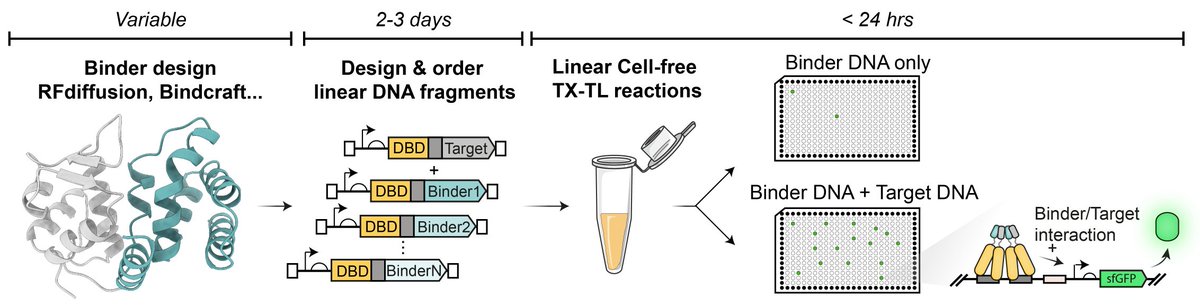
You designed binders for your favourite protein and wish there was a way to experimentally screen them within 24h w/ only a set of pipettes and a plate reader?
Check out our Cell-Free 2-Hybrid approach (CF2H)
Full post: https://t.co/KTSNnA4dsS
Preprint: https://t.co/J6X9htyAzl
🚨🚨🚨This is exactly how I feel. 🚨🚨🚨
CHARLES PIERCE WRITES:
“In my life, I have watched John Kennedy talk on television about missiles in Cuba. I saw Lyndon Johnson look Richard Russell squarely in the eye and say, "And we shall overcome."
I saw Richard Nixon resign and Gerald Ford tell the Congress that our long national nightmare was over.
I saw Jimmy Carter talk about malaise and Ronald Reagan talk about a shining city on a hill. I saw George H.W. Bush deliver the eulogy for the Soviet bloc, and Bill Clinton comfort the survivors of Timothy McVeigh's madness in Oklahoma City.
I saw George W. Bush struggle to make sense of it all on September 11, 2001, and I saw Barack Obama sing 'Amazing Grace' in the wounded sanctuary of Mother Emanuel Church in Charleston, South Carolina.
"These were the presidents of my lifetime. These were not perfect men. They were not perfect presidents, god knows. Not one of them was that. But they approached the job, and they took to the podium, with all the gravitas they could muster as appropriate to the job.
They tried, at least, to reach for something in the presidency that was beyond their grasp as ordinary human beings. They were not all ennobled by the attempt, but they tried nonetheless.
"And comes now this hopeless, vicious buffoon, and the audience of equally hopeless and vicious buffoons who laughed and cheered when he made sport of a woman whose lasting memory of the trauma she suffered is the laughter of the perpetrators.
Now he comes, a man swathed in scandal, with no interest beyond what he can put in his pocket and what he can put over on a universe of suckers, and he does something like this while occupying an office that we gave him, and while endowed with a public trust that he dishonors every day he wakes up in the White House.
"The scion of a multigenerational criminal enterprise, the parameters of which we are only now beginning to comprehend. A vessel for all the worst elements of the American condition. And a cheap, soulless bully besides.
We never have had such a cheap counterfeit of a president* as currently occupies the office. We never have had a president* so completely deserving of scorn and yet so small in the office that it almost seems a waste of time and energy to summon up the requisite contempt.
"Watch how a republic dies in the empty eyes of an empty man who feels nothing but his own imaginary greatness, and who cannot find in himself the decency simply to shut up even when it is in his best interest to do so. Presidents don't have to be heroes to be good presidents.
The only rule in biology is that there are exceptions to every rule. This is what makes biology infinitely exciting; even when you think you’ve got the complete view, the floor can drop out from underneath you at any given moment.
Case-in-point: The nucleus is the thing that makes eukaryotes...well, eukaryotes. It's the part of the cell that stores the genome, separating DNA from the cytoplasm and other organelles. (Bacteria do not have nuclei.) For decades, scientists thought that each nucleus contains one or more haploid sets of chromosomes.
But there are exceptions. Red blood cells, for example, don’t have nuclei at all. (They expel their nuclei during maturation to maximize hemoglobin concentrations.) Cells in the eye lens, too, lose their nuclei and organelles during differentiation, thus becoming transparent. And so on.
But now there is yet ANOTHER exception to this rule, and it’s one I hadn’t seen before. For a study in Science, researchers discovered that two types of pathogenic fungi that infect plants, called Sclerotinia sclerotiorum and Botrytis cinerea, have two different nuclei. And instead of storing a full set of chromosomes in each nuclei, they instead “distribute their chromosomes such that each of their nuclei contains only a subset of the haploid chromosomes.” The authors confirmed this by throwing a kitchen sink of methods at these cells; chromosome counting, DNA measurements using flow cytometry, single-nucleus PCR, and more.
Nobody knows why the fungi do this, but the scientists claim (in their discussion) that it could enable them "to respond and adapt more effectively to local environmental stresses within their extensive mycelial networks. Nuclear shuffling may facilitate the rapid generation of new genotypes, enhancing adaptability to changing environments.” There is also evidence that the chromosomes within each nucleus may briefly collide during cell division, before going back into their separate nuclei.
This is a great paper. It is simple, to the point, and challenges the status quo. It has serious potential to become a “classic” of the genre.
Link: https://t.co/AtsN5Kufpl
World's first floating 3D printed protein
I chose GFP because of it's amazing beta barrel structure and how we can make it glow with the LED like it does in nature
Really happy with how this turned out, I'm going to keep this spinning 24/7 on my desk
kit from @BambulabGlobal
This brilliant cartoon clearly explains Trump’s current position on Ukraine. It is in Ukrainian with English subtitles. Share it with anyone who keeps repeating russian propaganda.
I am hiring 2 postdocs to work on parasitic and endosymbiotic fungi associated with Hemiptera insects!
Ideal candidates will have experience working with symbionts, dissecting insects, meta/phylogenomics and confocal/FISH techniques (or some of these). Info below.
Please RT.
We just published a big report at @AsimovPress about the dangers from mirrored life.
It accompanies an article that just came out in @ScienceMagazine. I hope you'll check it out!
@benchling Thanks for the help. Changing the parameters viewed (1 & 2) didn't help me view things that were cut off, but reducing the number of bases viewed worked. I just wish there were a way that I could manually adjust the viewing height of each sequence to better see all the info.
Hey #sciencetwitter, whenever I try doing sequence alignment in @benchling, certain information gets blocked and I can't find out how to resize things vertically. Forum searching hasn't helped. Any thoughts?
Our mini review on Microbial Biosensors is out ! 🦠
We talk about recent achievements, discuss challenges and how the use of AI will be key in discovering and engineering new sensing modules.
https://t.co/bvWnAiK1Fg