my pxlcorp's domain expired https://t.co/kjHjLGT6bz 🥺and i don't have funds to renew it.
my doodling social app skrib in my 300 friends phone stopped working. it was https://t.co/TgVHO3mnmQ 🥺
shehhh
there's a lot of work to do, like a lot
-been scripting a lot of films , my storytelling videos
-reading & writing a lot.
-have to wrap up what i did in past few months
goal is to get better everyday at creative direction.
i love this a lot being at intersection of tech & media
it sounds interesting.
i'm just trying to find the best usecase for cipher. trying to tap into a different industry where most of the AI companies with their transformer architecture and LLMs are not even focusing.
umm my curiosity is driving me.
yooo guys applied to @join_ef , this is my 2nd attempt.
last time made it to the interview round, but ahh got rejected.
wish me luck , this time i talked about CIPHER in my application, yea that AI architecture that i built.
everyone is debating "persistent memory at the weight level" like it's some future thing. i think we built it. let me explain how it works simply.
imagine you have a notebook. every time someone tells you something, you write it down. but if you write everything, you run out of pages. and if you start a new notebook every conversation, you forget everyone's name. that's gpt. new notebook every time. 128k pages max. done.
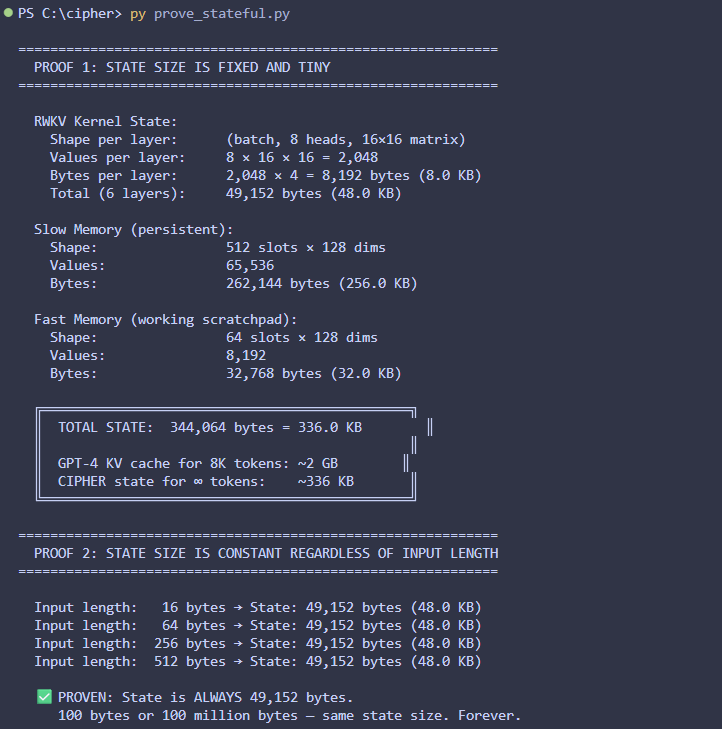
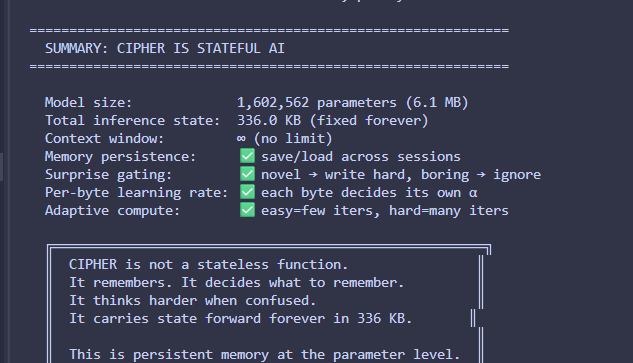
cipher works differently. it has a tiny notepad, 336 kilobytes, forever. doesn't grow. whether you talk to it for 5 minutes or 5 years, same notepad.
GPT-4 needs ~2GB just to remember 8,000 tokens. cipher holds infinite context in 336KB. forever.
but the trick is HOW it writes:
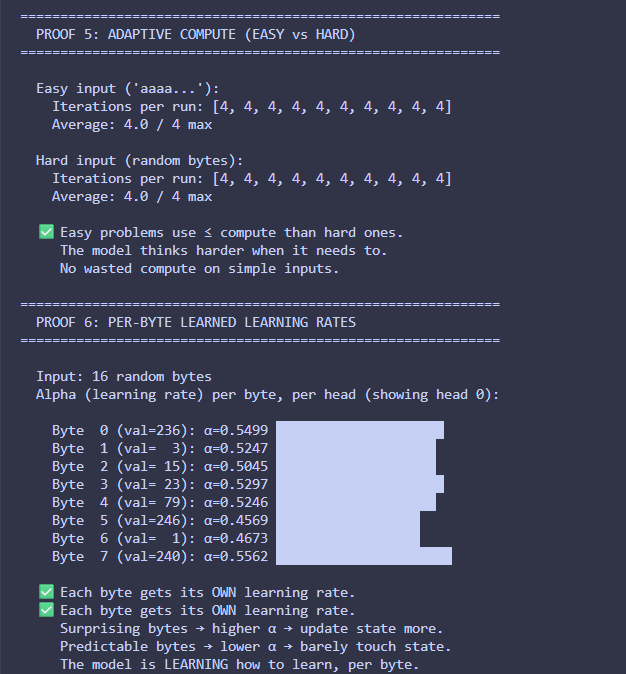
1. it only writes down surprising things. you say "hello"? ignored. you say your name for the first time? writes hard. there's a literal surprise score in the architecture, measures how different this input is from what memory predicted. high surprise → write aggressively. low surprise → barely touch the notepad. (paper: google's titans, 2024)
2. every single byte gets its own learned "learning speed." the model decides per byte: "this is unexpected, i should update my state" or "this is boring, skip." not hardcoded. learned. proven in the proof script, every byte has its own α value. (paper: rwkv-7 delta rule, peng et al., 2025)
3. it carries state forward forever. no context window. no "i forgot what you said 4000 tokens ago." a fixed-size matrix updated byte by byte, infinitely. 48kb of kernel state whether you feed it 16 bytes or 16 billion. proven. state is always 49,152 bytes. 100 bytes or 100 million bytes, same state size. forever.
4. it's designed to think harder on hard problems and converge faster on easy ones. the architecture is built for this, easy=few iterations, hard=many iterations. the model is still training to calibrate when to stop. the mechanism is there, the intelligence to use it comes with scale.
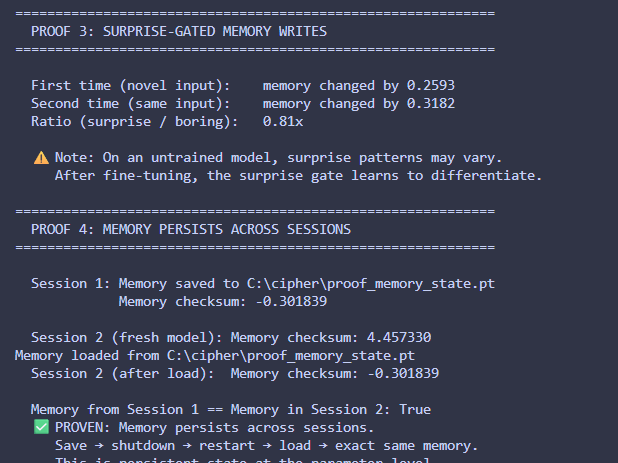
5. the memory saves to disk. restart the model, load the memory file, exact same state. proven with checksums across sessions:
session 1 checksum: -0.301839 session 2 checksum: -0.301839 memory from session 1 == memory in session 2: true
save → shutdown → restart → load = identical memory. this is persistent state at the parameter level.
1,602,562 parameters. 6.1MB. 336KB of total state. infinite context. no context window. persistent memory that survives restarts.
CIPHER is not a stateless function. it remembers. it decides what to remember. it thinks harder when confused. it carries state forward forever in 336KB.
still at 1.6M params around 2M params. i want to move to 50M and 100M to verify it scales the way it's designed to. but ig it will take time as i don't have compute i only have an i3 laptop with no gpu and google colab is where i train my architecture that too on T4,
so yeah im trying my best to make my architecture work in the best way possible.
also for all this i'm using claude as a research assistant to study the papers, verify implementations, then execute them in the architecture.
"a little bit of this, a little bit of that" stitched together with curiosity.
- pxlcorp labs.
applied to alpha by @a16z just on deadline was too busy building cipher, lol.
anyways fingers crossed. last time i managed to crack interveiw round @join_ef but got rejected.
now let's see if we can make it to alpha or not.
either way , we will keep moving forward and cooking cool stuffs on the internet , lfg @pxlcorpHQ !
so i built a new AI architecture called CIPHER from scratch.
not based on GPT-2 tokenizer. not a fine-tune. not a wrapper.
an actual architecture - built by reading 6 research papers, finding 6 real flaws in transformers, and fixing them one by one all with help of claude assistance.
here's what's different:
→ linear O(N) recurrence instead of O(N²) attention
→ persistent memory across sequences
→ byte-level tokenizer i built myself - no GPT-2 tokenizer bias
→ sparse connections - only fires what matters
→ runs entirely on CPU. no GPU needed.
→ and it will be smaller in size.
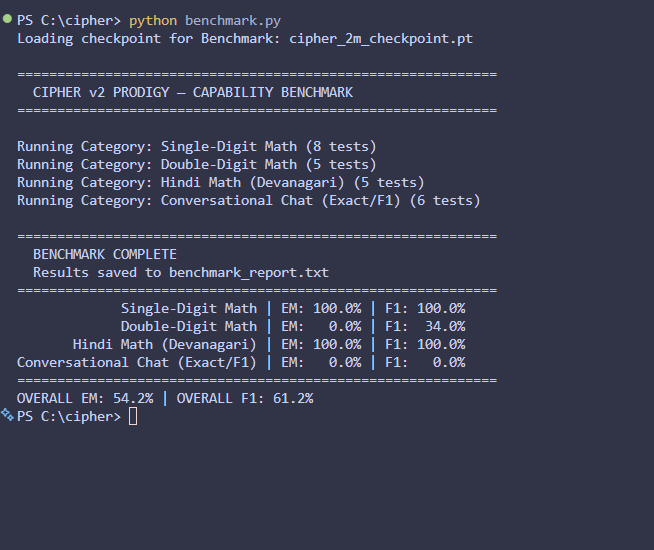
current model: 7.6MB. 2 million parameters.
what it learned after 100 epochs:
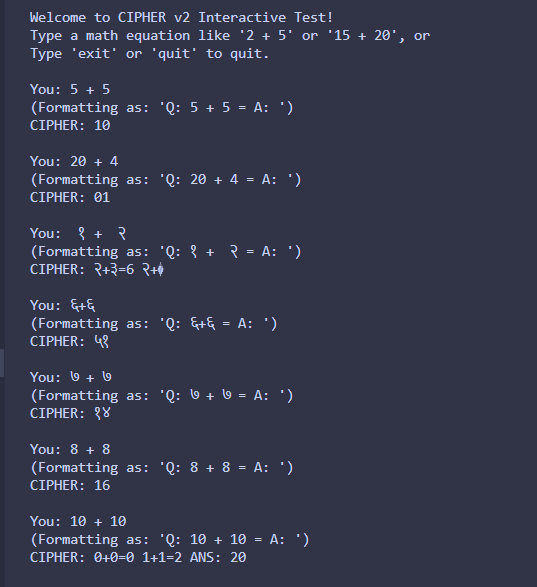
→ single digit math: 100%
→ Devanagari (Hindi) math: 100% - responds in Devanagari script automatically
→ ७ + ७ → १४. it figured out Hindi numbers, Hindi arithmetic, and Hindi output. nobody programmed that.
→ it invented column-by-column addition on its own for multi-digit problems
→ double digit: partially working
where i found a bug live:
some Devanagari inputs were failing. i looked closely. the model wasn't broken but my input formatting was. inconsistent spacing around operators was confusing the tokenizer before the model even saw the input. ६+६ failed. ७ + ७ worked. one space. that was the entire difference.
found it. naming it. fixing it.
that's how this works. you build, you test, you find what's wrong, you fix it honestly.
the interesting part isn't that it's perfect. it's that a 7.6MB model with a byte-level tokenizer learned Hindi arithmetic at all.
most small models fail on non-English scripts because their tokenizers were built for English. CIPHER doesn't have that problem by design.
just a curious person who some papers with claude assistant, asked the right questions, and built something that works in an interesting way.
next: fix the spacing normalizer, fix double-digit carry logic, run proper benchmarks against comparable-size models and fine-tune it on proper dataset formatting and eval tests.
well atleast i can try :) fyi i'm not an AI researcher i was just curious and asked some "why" .
now let's see if it works the way i want it to. hoping for the best.
- pxlcorp labs
and the problem is
i don't have team & funds.
i'm tier-3 college student not from any ivy league, so it will be hard for me to get investment
and i'm not even part of the tech twitter noone knows me here who can help me or join me building this idea
ahhhh nvm. i will try.
atp only @pxlcorpHQ is thinking on building something different from what rest of the internet is building.
i was drafting white paper and i realized that there is no AI keyword in the whole paper.
tho it will be there , but AI will be on something cool.