Backend engineer building AI systems for real-world use. LLMs, agents & async Python.
I care about
– structured outputs
– strong typing
– observability
– clean architecture
Architecting AI-native systems & ML-backed products
Exploring AI-native SaaS in public
Follow for more
Introducing the Science One Framework, an experimental autonomous research prototype that builds verifiable evidence chains. We demonstrate how natively maintaining these chains eliminates hallucinated citations and enables reproducible AI science. Read the blog to learn more: https://t.co/sRchtF605B
It’s funny how we’re in the middle of this mess where, ultimately, engineers don’t know what to do with AI, yet companies demand that they understand it and expect them to solve every problem, forgetting that AI and its applications are, first and foremost, matters of technology and engineering
Everyone's arguing about whether Uncle Bob should read his agents' code. Wrong argument. He said he doesn't review code written by agents anymore. Instead he tracks test coverage, dependency structure, cyclomatic complexity, module size, mutation testing. People are calling that either genius or negligence, and both camps are missing the point.
Not reading the code isn't the risky part. Not replacing that reading with something real is.
If you stop reviewing line by line and you don't have an actual verification layer underneath, you're just hoping. That's the failure mode blowing up half of tech Twitter right now, not Bob's method itself. His approach is a bet that the right constraints and metrics catch more than a human skimming a diff ever would. That's a defensible bet if the constraints are real.
Most people piling on don't have that layer. They ship fast with agents, skip the review, and call it velocity. That's not what Bob is doing, and lumping the two together is why this debate keeps talking past itself.
This is the exact problem I've been heads down on with Invariant: how do you build the infrastructure that makes "I don't need to read every line" a true statement instead of a hope. Fuzzing agents before they ship. Catching regressions before they hit prod. Governing what they're allowed to do at runtime. Constraints, not trust.
@unclebobmartin your method is directionally right. The industry just needs the tooling that makes it safe by default instead of by discipline.
I’m building this in the open. If you're working on the same problem, I'd love to compare notes
I’m significantly older than you. I started coding in the late 60s. My current strategy is to not read any of the code written by my agents. That’s the only way I can take advantage of their productivity. What I do instead is to surround the agents with extreme constraints. Unit tests, gherkin tests, QA procedures, quality metrics, mutation testing, test coverage, and a plethora of others. In the end, I have very high confidence in the code they produce because they’ve had to run the gauntlet of all of my constraints and tests.
Announcing OpenWorker! An open-source agent that doesn't just chat with you, but delivers finished work -- like hand you a polished document, send a slack message, or update a calendar entry.
Ask it to prepare a customer brief, untangle your calendar, draft a report, or triage a Slack alert. It works across your files and everyday tools, produces the deliverable, and checks in before doing anything consequential.
OpenWorker runs on your Mac, with Windows support coming soon. It does not lock you into any one model. Bring your own API key and run it with GPT 5.6 Sol, Claude Fable, Gemini 3.6, an open weight model (like Kimi, GLM, DeepSeek, Inkling), or Ollama to keep your data local. Your data does not leave your machine except through an LLM provider and integrations that you choose.
@rohitcprasad and I are building OpenWorker because AI coworkers are an important way to get work done, and we want there to be an open, privacy-preserving, model-independent option. Check it out and let us know what you think!
Try it out: https://t.co/P0mGnI1o31 (requires your own API key)
Source code: https://t.co/NYCiTD6hSq
ty now ships with first-class support for Pydantic
For example: we now distinguish between lax and strict mode in Pydantic fields, and follow Pydantic's coercion rules
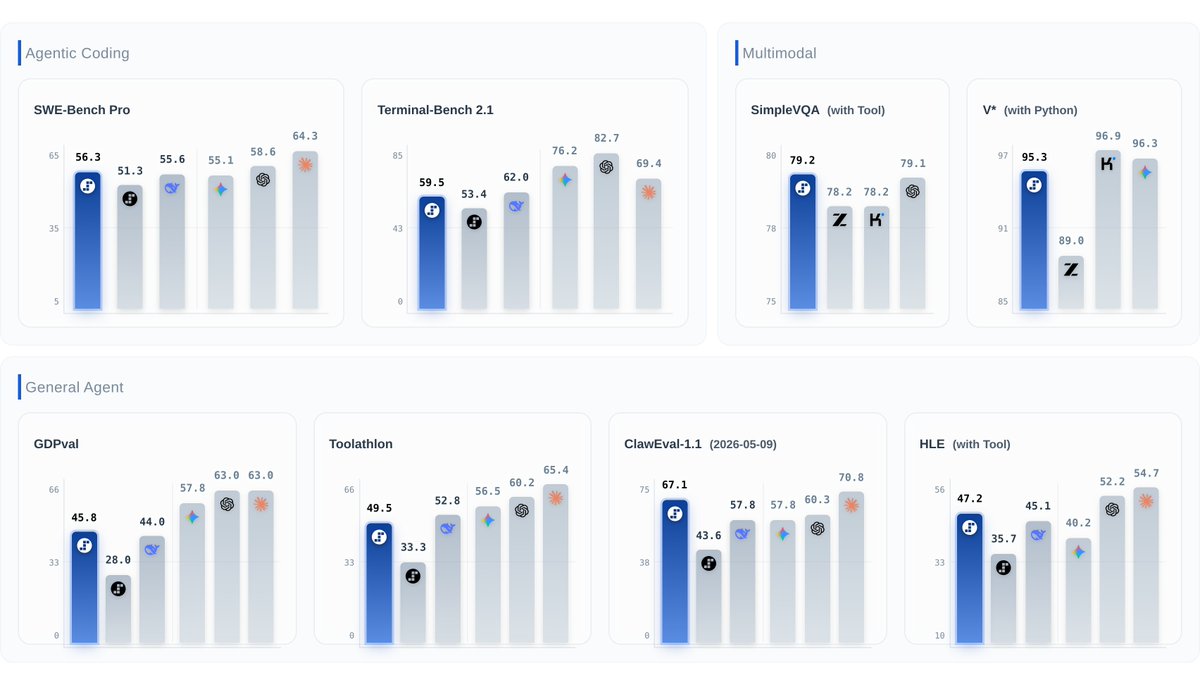
⚡️ Step 3.7 Flash is here: The new frontier is agent efficiency.
#1 ClawEval-1.1 (67.1), #1 SimpleVQA Search (79.2), #2 SWE-PRO (56.3), 95.3 on V* Python. Open weights under Apache 2.0.
Built for agentic, coding, search, and multimodal workflows — balancing speed, cost, and reliable execution.
- 400 TPS. 198B sparse MoE, ~11B active. 256K context, 3 reasoning levels.
- Understands UIs, charts, docs, images — then writes code or calls tools to act on what it sees.
- Web + visual search reaches further: more sources, deeper follow-up.
- Reliable tool use — less drift, fewer broken toolcalls. 98%+ on τ²-bench across all difficulty levels.
- Works with Claude Code, KiloCode, Hermes Agent, OpenClaw, and protocols like MCP.
- Runs locally on Mac Studio M4 Max, DGX Spark, AMD AI Max+ 395.
GitHub: https://t.co/kqlZkVIRHv
HuggingFace: https://t.co/qqceCrgPiw
GGUF: https://t.co/rR6XrnymWG
ModelScope: https://t.co/wney6Tzvqy
API: https://t.co/RvHWzRG7Fu
Blog: https://t.co/BxDiajiQ5G
What if you could take three completely different model families… and distill them into one tiny model? 🤯
📜 Paper: https://t.co/K2iKD4xFvp
MOPD (Multi-Teacher On-Policy Distillation) has become a standard procedure in post-training. We already distill multiple specialized variants of the same model into a single set of weights.
But what if we could go further - and distill models from entirely different families? Turns out, it is possible.
Today we’re releasing a paper on cross-tokenizer distillation - our first steps in this exciting direction. 📄
We distilled Qwen3-4B, Phi-4-Mini, and Llama-3B into Llama-3.2-1B.
MMLU jumped from 32.05 → 46.32 when using multiple teachers. 📈
The team is now working on Nemo-RL integration so the community can try this method in their own settings. Plus, we are scaling experiments up. 🚀
Personal update: I've joined Anthropic. I think the next few years at the frontier of LLMs will be especially formative. I am very excited to join the team here and get back to R&D. I remain deeply passionate about education and plan to resume my work on it in time.
People talk, listen, watch, think, and collaborate at the same time, in real time. We've designed an AI that works with people the same way.
We share our approach, early results, and a quick look at our model in action.
https://t.co/AFJZ5kH7Ku
🚀 DeepSeek-V4 Preview is officially live & open-sourced! Welcome to the era of cost-effective 1M context length.
🔹 DeepSeek-V4-Pro: 1.6T total / 49B active params. Performance rivaling the world's top closed-source models.
🔹 DeepSeek-V4-Flash: 284B total / 13B active params. Your fast, efficient, and economical choice.
Try it now at https://t.co/GCdiMzk1Dl via Expert Mode / Instant Mode. API is updated & available today!
📄 Tech Report: https://t.co/drlDrxkYtp
🤗 Open Weights: https://t.co/T13Y8i7SDM
1/n
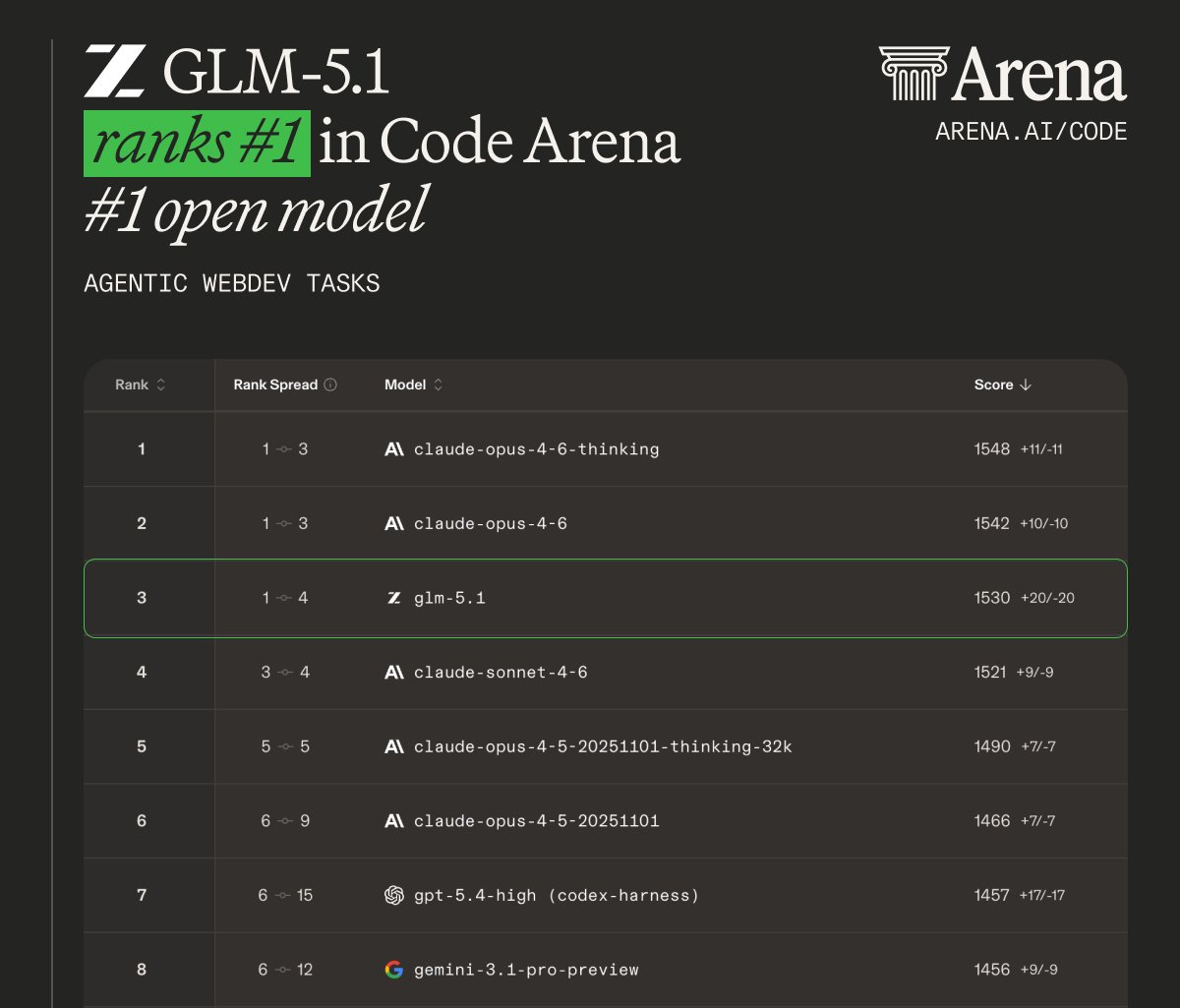
GLM-5.1 by @Zai_org is now #3 in Code Arena - surpassing Gemini 3.1 and GPT-5.4, and now on par with Claude Sonnet 4.6.
The first frontier level open model to break into the top 3. It’s a major +90 point jump over GLM-5, and +100 over Kimi K2.5 Thinking.
Huge congrats to @Zai_org on pushing open model progress forward 🚀
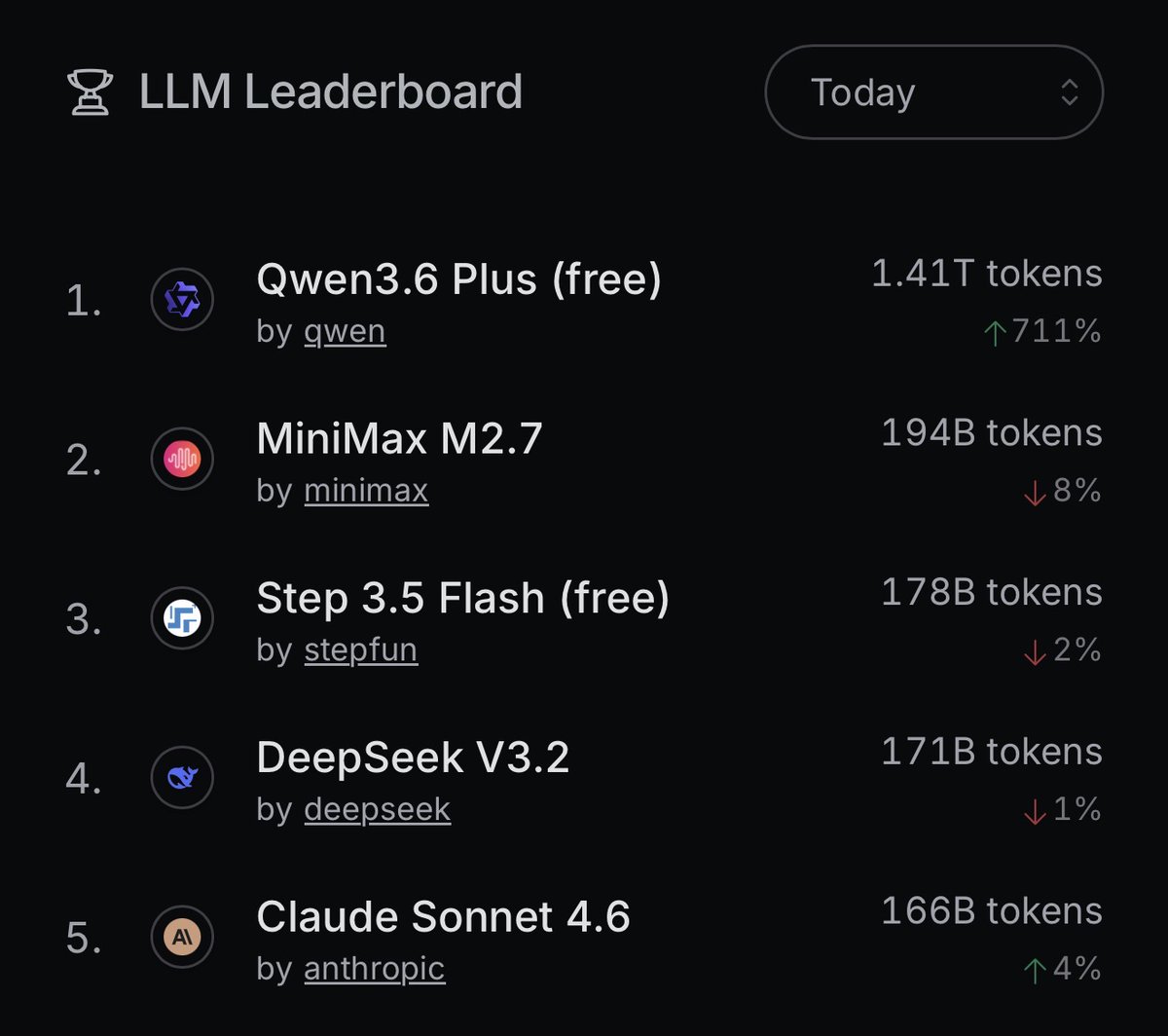
Qwen 3.6 Plus from @Alibaba_Qwen is officially the first model on OpenRouter to break 1 Trillion tokens processed in a single day!
At ~1,400,000,000,000 tokens, it’s the strongest full day performance of any new model dropped this year. Congrats to the Qwen team!
@ClementDelangue Local is the Present, running @liquidai on @lmstudio is a game changer without having to rely on the internet or giving your information to third-party providers
New Anthropic research: Emotion concepts and their function in a large language model.
All LLMs sometimes act like they have emotions. But why? We found internal representations of emotion concepts that can drive Claude’s behavior, sometimes in surprising ways.