1/n
A physical book is a real object, anchored. If you read a particular edition, you remember not only the contents but the object itself: its cover, typography, smell, even where a passage sat on the page.
Books organize themselves in memory by place --the ancient method of loci.
Digital text does not exist.
Liftoff.
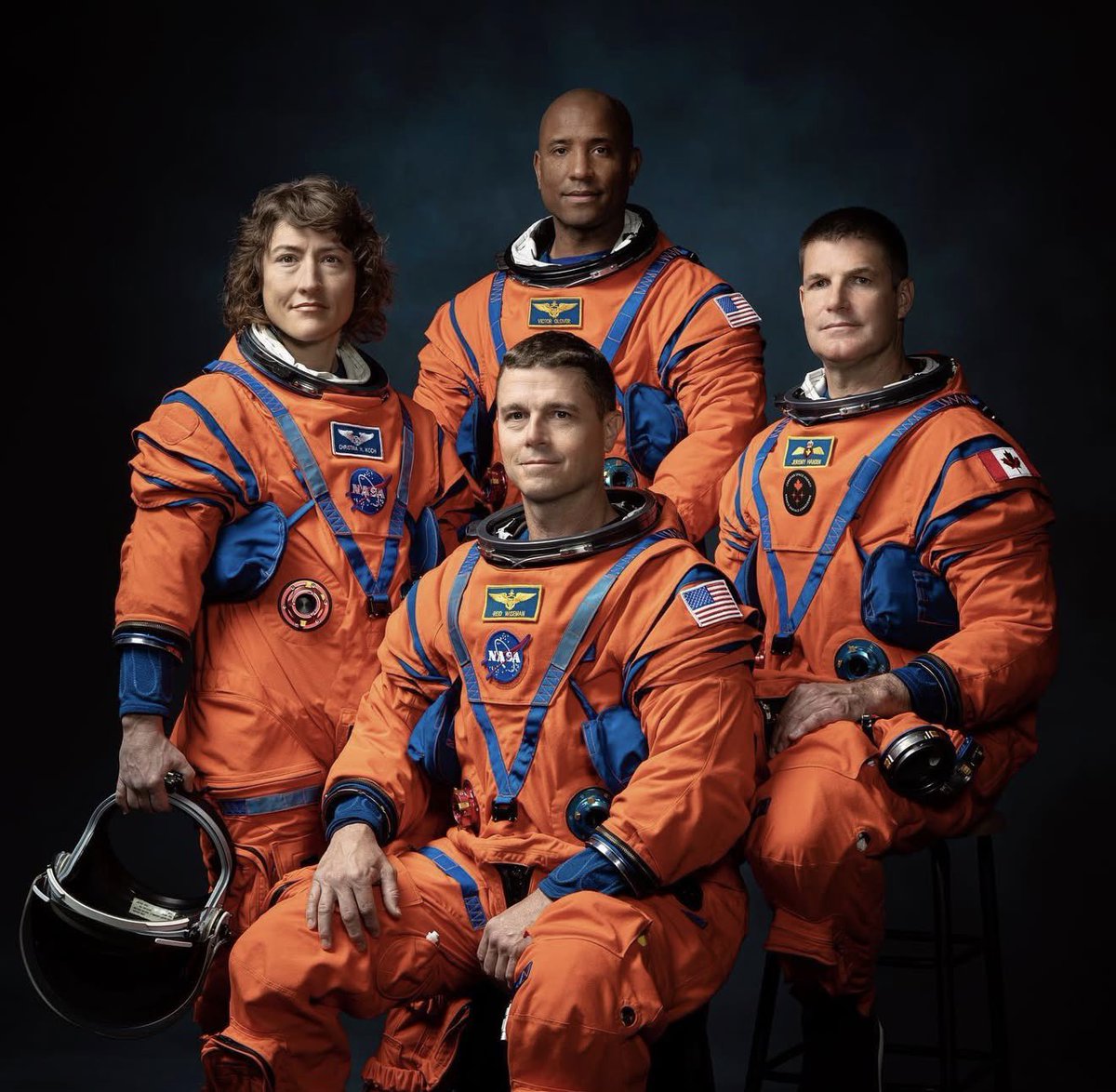
The Artemis II mission launched from @NASAKennedy at 6:35pm ET (2235 UTC), propelling four astronauts on a journey around the Moon.
Artemis II will pave the way for future Moon landings, as well as the next giant leap — astronauts on Mars.
Action. Wonder. Adventure. Artemis II has got it all. Don't miss the moment. Our crewed Moon mission will launch as early as April 1.
Learn how to watch: https://t.co/fAg0bGAqEc
11 months after his release from the concentration camps, Viktor Frankl gave a set of lectures on moving beyond optimism and pessimism to find life's deepest source of meaning. They were lost for decades, never before published in English—and now they are: https://t.co/3ZkFb3gs0f
THE BIG REGRESSION
My folks are in town visiting us for a couple months so we rented them a house nearby.
It’s new construction. No one has lived in it yet. It’s amped up with state of the art systems. The ones with touchscreens of various sizes, IoT appliances, and interfaces that try too hard.
And it’s terrible. What a regression.
The lights are powered by Control4. And require a demo to understand how to use the switches, understand which ones control what, and to be sure not to hit THAT ONE because it’ll turn off all the lights in the house when you didn’t mean to. Worse.
The TV is the latest Samsung which has a baffling UI just to watch CNN. My parents aren’t idiots, but definitely feel like they’re missing something obvious. They aren’t — TVs have simply gotten worse. You don’t turn them on anymore, you boot them up.
The Miele dishwasher is hidden flush with the counters. That part is fine, but here’s what isn’t: It wouldn’t even operate the first time without connecting it to an app. This meant another call to the house manager to have them install an app they didn’t know they needed either. An app to clean some peanut butter off a plate? For serious? Worse.
Thermostats... Nest would have been an upgrade, but these other propriety ones from some other company trying to be nest-like are baffling. Round touchscreens that take you into a dark labyrinth of options just to be sure it’s set at 68. Or is it 68 now? Or is that what we want it at, but it’s at 72? Wait... What? Which number is this? Worse.
The alarm system is essentially a 10” iPad bolted to the wall that has the fucking weather forecast on it. And it’s bright! I’m sure there’s a way to turn that off, but then the screen would be so barren that it would be filled with the news instead. Why can’t the alarm panel just be an alarm panel? Worse.
And the lag. Lag everywhere. Everything feels a beat or two behind. Everything. Lag is the giveaway that the system is working too hard for too little. Real-time must be the hardest problem.
Now look... I’m no luddite. But this experience is close to conversion therapy. Tech can make things better, but I simply can’t see in these cases. I’ve heard the pitches too — you can set up scenes and one button can change EVERYTHING. Not buying it. It actually feels primitive, like we haven’t figured out how to make things easy yet. That some breakthrough will eventually come when you can simply knock a switch up or down and it’ll all makes sense. But that's at least 20 years down the road.
It’s really the contrast that makes it alarming. We just got back from a vacation in Montana. Rented a house there. They did have a fancy TV — seems those can’t be avoided these days — but everything else was old school and clear. Physical up/down light switches in the right places. Appliances without the internet. Buttons with depth and physically-confirmed state change rather than surfaces that don’t obviously register your choice. More traditional round rotating Honeywell thermostats that are just clear and obvious. No tours, no instructions, no questions, no fearing you’re going to do something wrong, no wondering how something works. Useful and universally clear. That’s human, that’s modern.
New newsletter: THE END OF THINKING
Doomsday predictions about AI taking our jobs in the future shift focus away from where it belongs: in present reality, the age of screened tech has coincided with declines in literacy, reading, and writing.
We are deskilling ourselves.
DEBUNKING BS DU JOUR
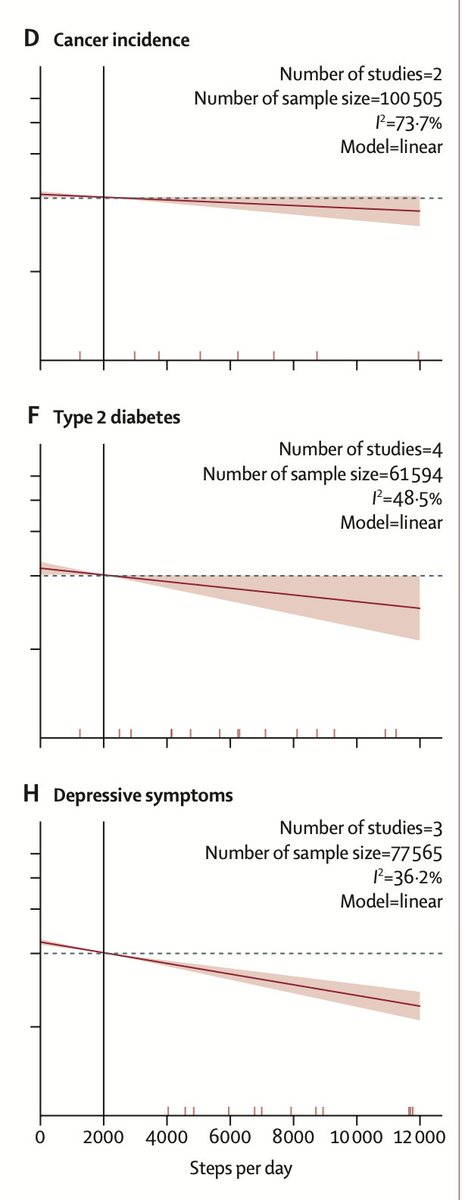
Article discussing a new study (metanalaysis) "debunking 10k steps/day" does not understand the paper!
It DOES NOT say to stop at 7k: drops in Hazard R continue beyond 12k steps but hard to see on graph when HR becomes low.
For metabolic syndrome & depression, even 12K not sufficient!
Today I had an experience I've not had in 10 years -- or more, all things considered.
I was chatting with an old friend of ours outside her apartment, on the lawn. A boy across the street was fooling around with a soccer ball. He's 16, and built like a middle linebacker. She waved to him and said hello.
We were talking for a while, and he must have overheard part of the conversation, which had to do with when I was going to retire already, and I mentioned I was memorizing Paradise Lost of all things (almost halfway into Book 10), and the boy came over.
He was polite and a bit reserved, but obviously smart, as you could tell from his eyes. He was LISTENING. I then asked him whether he was at the local English high school (we are in a partly Francophone part of Nova Scotia), and he said he was at the French school down the street. So I asked him whether for his French literature class he had read Victor Hugo -- I mentioned Les Miserables. (My friend was boasting about me and languages). He said that it was on the list for the coming year, but that they weren't going to assign it as a book; they'd be reading it on line. I said that that was a bad idea, because the computer is mostly a distraction; he agreed.
It was altogether pleasant. He WANTED to meet me, because something we were talking about stirred his interest. I'm not going to let this one drop. Now then, this is the sort of thing that boys used to do all the time. Girls too, for that matter, but the dynamic is a little different. In either case, though, young people liked to hang around the old people, to learn by listening, and occasionally to contribute something of their own. They did so without being invited. It's a kind of gravitation at work.
The business about the computer is, I think, germane. There's another boy, a couple of years younger, whom I've known since he was born. He's the grandson of very close friends here. He used to be open, wide-eyed, interested in everything, very friendly. No more. School and computer games have taken over his mind. I'll go to his house to see his grandparents, and he won't greet me or look at me, not anymore. It's sad, actually. The other day one of his school friends was there, and the friend, sitting at a table with his back to me, did not even turn around.
This is not good. It hurts everybody... us oldsters, too.
Some personal news.
Today, I’m leaving The Atlantic after almost 17 years and moving my writing to Substack.
It would be convenient, for the purposes of crafting an exciting departure announcement, to have a dramatic exit story: a fight, a grievance, a shouting match with an editor that ended with me hurling a bunch of leather-backed Thoreau volumes across the open-plan office. That is not the case here.
I love The Atlantic, and I'll remain a contributing writer there. But after almost two decades at one publication, I wanted to write for myself. The things I've published that I'm most proud of—whether it was the original abundance agenda essay, or my piece on workism—emerged from a very personal expression of frustration, or confusion, or curiosity. I want to know what my thinking and writing is like if I lean into a more independent and personal writing life.
That's brought me to Substack, which is already home to an astonishing share of my overall reading. I'm excited to join their community and excited to build my own. The name of the newsletter should be easy to remember: Derek Thompson.
The newsletter will have three main pillars
1. Abundance
2. The frontier of science and technology—GLP1s, AI, biotech, energy breakthroughs—covered in a way that’s both curious and skeptical
3. The anti-social century & the social crises of anxiety and aloneness
Thanks to The Atlantic for 16.8 incredible years and thanks to everybody who follows me across the river.
- dt
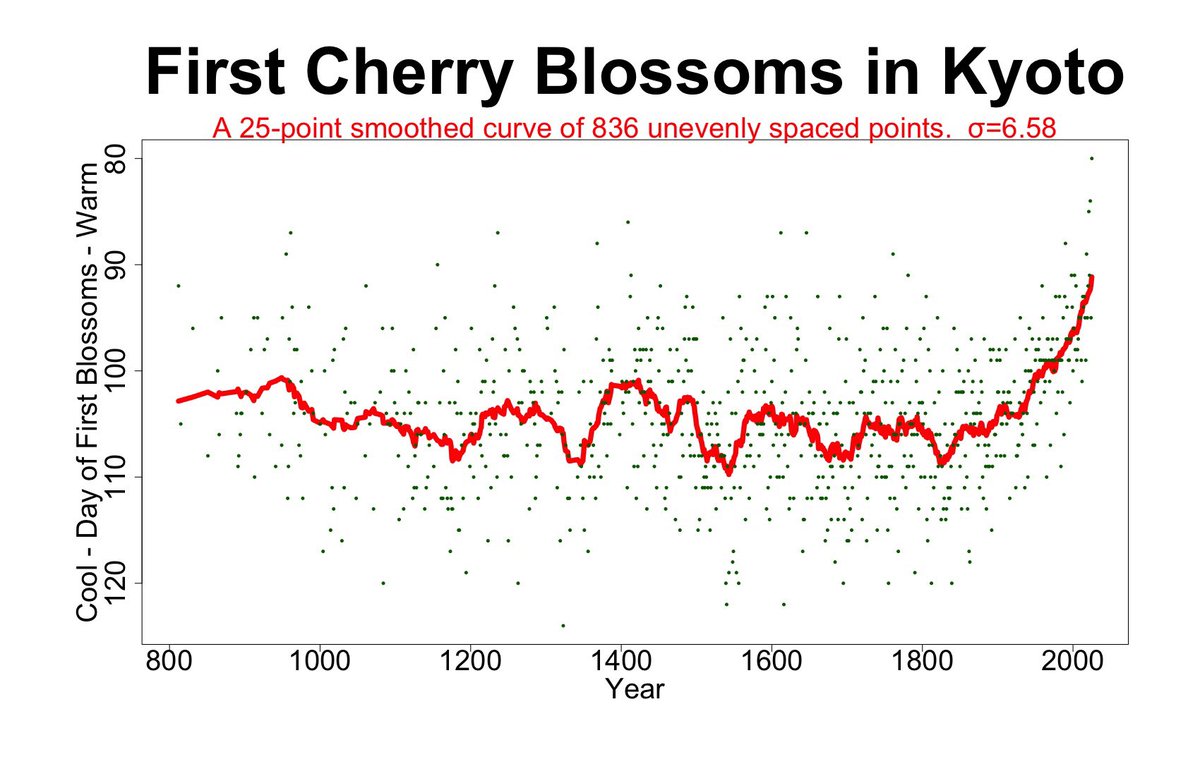
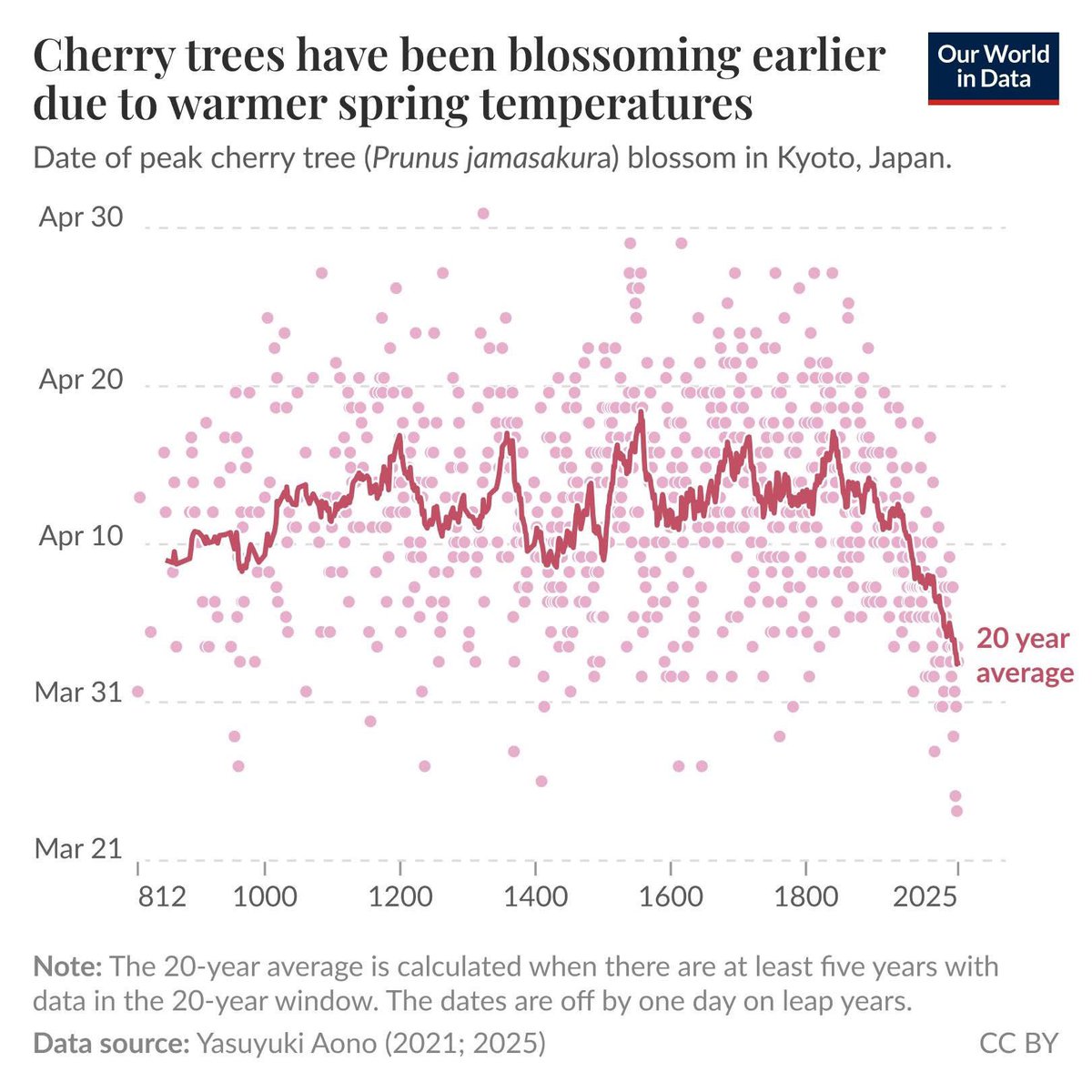
A 1,200-year-old data series offers no room for conspiracy theorists and science deniers. For all those who claim that the climate has changed much more dramatically in recent centuries than it does today:
For 1,200 years, the date of the first cherry blossom has been meticulously recorded in Japan. One can see a millennium of natural fluctuation and then the significant earliness in recent years.
The cause of the change has been known for 150 years, the topic has been on the agenda of the global scientific community for 50 years, and there has been an international agreement on it for nine years. And CO2 emissions around the world are reaching new record levels every year.
And since at least one day ago, it has been clear that the #Kleiko may have money to spare, but ideas to spare – and not just when it comes to man-made climate change.
https://t.co/jycjXQwNhF via Michael Kipp
Did you hear about that recent Florida study that found that the 78% of kids with smartphones are happier than the 22% without?
The op-ed about it, which suggested that smartphones are "beneficial" to 8 year olds, is contradicted by the study itself:
https://t.co/e3tgzVaevU
Denmark will ban phones in schools. “And if we find out in five years that it was better with the phones, we can reintroduce them. But I don’t think that will be the case.”
https://t.co/5o0by7ot5e