Qbyte Network is building decentralized infrastructure for large-scale AI simulation and distributed compute.
By aggregating global GPU resources and coordinating them through a blockchain layer, Qbyte enables AI systems and future humanoids to train, simulate, and deploy without relying on centralized cloud monopolies.
Community-owned. Permissionless. Built for long-term infrastructure.
#QBYT #AIInfrastructure #DePIN #Simulation #DAO #DecentralizedCompute #Ethereum
Qbyte Network is building decentralized infrastructure for large-scale AI simulation and distributed compute.
By aggregating global GPU resources and coordinating them through a blockchain layer, Qbyte enables AI systems and future humanoids to train, simulate, and deploy without relying on centralized cloud monopolies.
Community-owned. Permissionless. Built for long-term infrastructure.
#QBYT #AIInfrastructure #DePIN #Simulation #DAO #DecentralizedCompute #Ethereum
Qbyte Network is building decentralized infrastructure for large-scale AI simulation and distributed compute.
By aggregating global GPU resources and coordinating them through a blockchain layer, Qbyte enables AI systems and future humanoids to train, simulate, and deploy without relying on centralized cloud monopolies.
Community-owned. Permissionless. Built for long-term infrastructure.
#QBYT #AIInfrastructure #DePIN #Simulation #DAO #DecentralizedCompute #Ethereum
Introducing the Qbyte Box ⚡️
Plug. Deploy. Train.
A plug-and-play node for AI agents to run simulations, learn collaboratively, and scale on decentralized compute.
With ERC-8004, validation and DAO coordination become native — securing access, governance, and execution on Ethereum.
This is the next layer of AI infrastructure.
More coming soon. 👀
#QBYT #AI #Simulation #Ethereum #ERC8004 #DePIN #DAO
@ethereum is becoming the settlement layer for the world.
Qbyte is building the intelligence layer on top of it.
With ERC-8004 enabling next-gen DAO coordination, Qbyte turns decentralized compute + simulation into real infrastructure — not theory.
AI needs scale.
Humanoids need simulation.
Qbyte supplies both.
This is early.
#QBYT #Ethereum #ERC8004 #AIInfrastructure #DePIN #Simulation #DAO
Qbyte Network is built on Ethereum — leveraging its security, decentralization, and developer ecosystem.
With ERC-8004, DAO coordination and on-chain governance become native primitives, not afterthoughts.
Ethereum provides the trust layer.
Qbyte builds the simulation + compute layer on top.
Together, they enable community-owned AI infrastructure.
#QBYT #Ethereum #ERC8004 #DAO #AIInfrastructure #DePIN
Qbyte Network is built on @ethereum leveraging its security, decentralization, and developer ecosystem.
With ERC-8004, DAO coordination and on-chain governance become native primitives, not afterthoughts.
Ethereum provides the trust layer.
Qbyte builds the simulation + compute layer on top.
Together, they enable community-owned AI infrastructure.
#QBYT #Ethereum #ERC8004 #DAO #AIInfrastructure #DePIN
Simulation demand is exploding — AI models, robotics, and autonomous systems all need continuous environments to train, test, and evolve.
Centralized clouds can’t scale this efficiently.
Qbyte Network provides decentralized compute and simulation coordination — making large-scale training cheaper, open, and resilient.
#QBYT #Simulation #AIInfrastructure #HumanoidAI #DePIN #DecentralizedCompute
Something big is forming behind the scenes at Qbyte Network.
Simulation engine upgrades.
Distributed compute coordination.
DAO groundwork.
Humanoid & AI training pipelines.
This isn’t a fast launch — it’s a foundation build.
The next phase is about to unfold. 👀⚙️
#QBYT #AIInfrastructure #DePIN #Simulation #HumanoidAI #DecentralizedCompute
Crypto never ment to be easy
I held projects for 3-5 years to get insane roi.
Talking about x 100 x 400 x 1000s
I aint intrested in 5% moves.
Play the long game. Hold the right projects and take profit in time
Thats how you do it.
WIZZZ
2026 is the year that we take back lost ground in terms of self-sovereignty and trustlessness.
Some of what this practically means:
Full nodes: thanks to ZK-EVM and BAL, it will once again become easier to locally run a node and verify the Ethereum chain on your own computer.
Helios: actually verify the data you're receiving from RPCs instead of blindly trusting it.
ORAM, PIR: ask for data from RPCs without revealing which data you're asking, so you can access dapps without your access patterns being sold off to dozens of third parties all around the world.
Social recovery wallets and timelocks: wallets that don't make you lose all your money if you misplace your seedphrase, or if an online or offline attacker extracts your seedphrase, and *also* don't make all your money backdoored by Google.
Privacy UX: make private payments from your wallet, with the same user experience as making public payments.
Privacy censorship resistance: private payments with the ERC-4337 mempool, and soon native AA + FOCIL, without relying on the public broadcaster ecosystem.
Application UIs: use more dapps from an onchain UI with IPFS, without relying on trusted servers that would lock you our of practical recovery of your assets if they went offline, and would give you a hijacked UI that steals your funds if they get hacked for even a millisecond.
In many of these areas, over the last ten years we have seen serious backsliding in Ethereum. Nodes went from easy to run to hard to run. Dapps went from static pages to complicated behemoths that leak all your data to a dozen servers. Wallets went from routing everything through the RPC, which could be any node of your choice including on your own computer, to leaking your data to a dozen servers of their choice. Block building became more centralized, putting Ethereum transaction inclusion guarantees under the whims of a very small number of builders.
In 2026, no longer. Every compromise of values that Ethereum has made up to this point - every moment where you might have been thinking, is it really worth diluting ourselves so much in the name of mainstream adoption - we are making that compromise no longer.
It will be a long road. We will not get everything we want in the next Kohaku release, or the next hard fork, or the hard fork after that. But it will make Ethereum into an ecosystem that deserves not only its current place in the universe, but a much greater one.
In the world computer, there is no centralized overlord.
There is no single point of failure.
There is only love.
Milady.
Humanoid robots are already working 7-hour shifts.
This time-lapse shows HMND 01 completing hours of uninterrupted bin picking of metallic bearing rings, compressed into just a few minutes.
And if you’re in the mood for a calming background video, the full version is available here: https://t.co/HCO5Tri0E3.
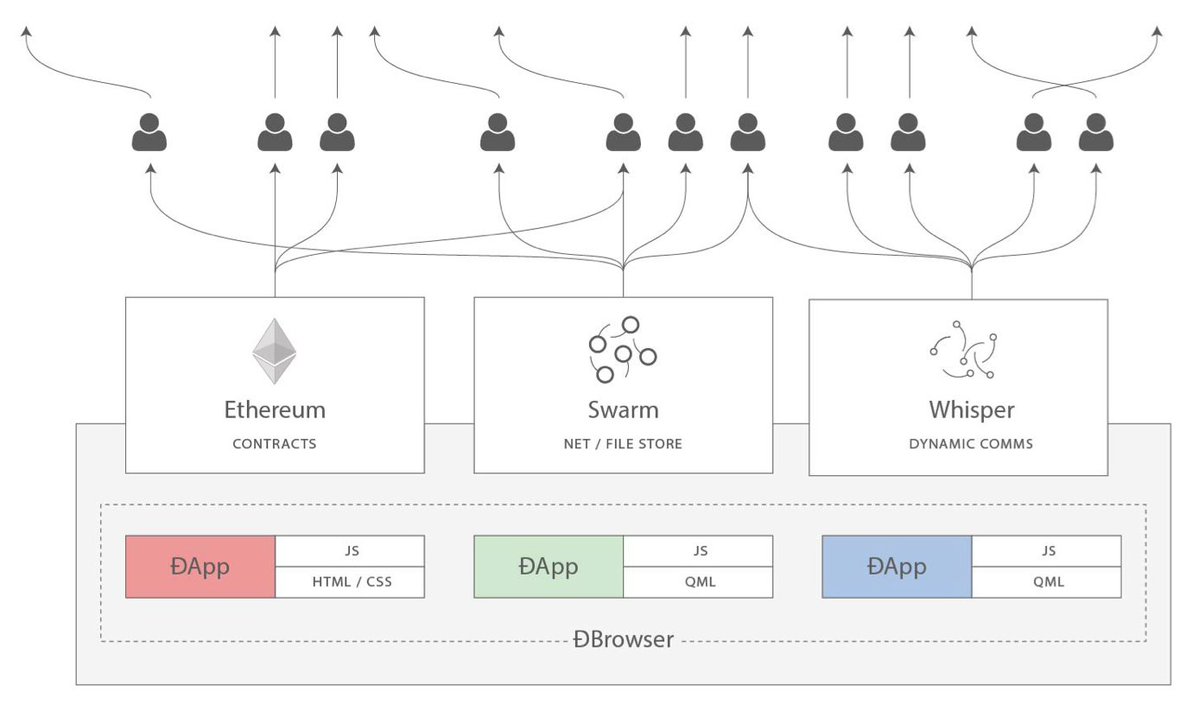
In 2014, there was a vision: you can have permissionless, decentralized applications that could support finance, social media, ride sharing, governing organizations, crowdfunding, potentially create an entire alternative web, all on the backs of a suite of technologies.
Ethereum: the blockchain. The world computer that could give any application its shared memory.
Whisper: the data layer. Messages too expensive for a blockchain, that do no need consensus.
Swarm: the storage layer. Store files for long-term access.
Over the last five years, this core vision has at times become obscured, with various "metas" and "narratives" at various times taking center stage. But the core vision has never died. And in fact, the core technologies behind it are only growing stronger.
Ethereum is now proof of stake. Ethereum is now scaling, it is now cheap, and it is on track to get more scalable and cheaper thanks to the power of ZK-EVMs. Thanks to ZK-EVM + PeerDAS, the "sharding" vision is effectively being realized. And L2s can give additional and different kinds of gains in speed on top.
Whisper is now Waku ( https://t.co/uj5h9iSpIL ), and already powers many applications (eg. https://t.co/owlo5yoS68, https://t.co/hDizYCFjuq just to name two I use). Even outside of Waku, the quality of decentralized messaging has increased. Fileverse (decentralized Google Docs and Sheets alternative: https://t.co/ZIKj4U5pQe ) has seen massive gains in usability over the past year.
IPFS is now highly performant and robust as a decentralized way of retrieving files, though IPFS alone does not solve the storage problem. Hence, there is still room to improve there.
All of the prerequisites for the original web3 vision are here, in full force, and are continuing to get stronger over the next few years. Hence, it's time to buidl, and buidl decentralized.
Fileverse is an excellent example of the right way to do things:
* It uses Ethereum and Gnosis Chain for what they are good for: names, accounts and permissioning, document registration
* It uses decentralized messaging and file storage to store documents and propagate changes to documents
* The application passes the walkaway test: https://t.co/xO1dNLlnhf (even if Fileverse disappears, you can still retrieve them and even keep editing them with the open source UI)
This is what we mean by "build a hammer that is a tool you buy once and it's yours, not a corposlop AI dishwasher that requires you to register for a google account and charges a subscription fee per month for extra washing modes, and probably spies on you and stops working if you get politically disfavored by a foreign country".
If you think this criticism of corposlop is hyperbolic, well turns out, it's literally a concatenation of these three:
* https://t.co/GBNaXOa454
* https://t.co/saD3cNp4Ae
* https://t.co/skoJ58vbqz
In 2014, decentralized applications were toys, hundreds of times more difficult to use in web2. In 2026, fileverse is now usable enough that I regularly write documents in it and send them to other people to collaborate. The decentralized renaissance is coming, and you can be part of making it happen.
Nvidia $NVDA posted this today:
“Alphabet and NVIDIA are expanding their decade-long partnership to advance agentic AI, robotics, drug discovery, and more.”
xAI locked in five more 380 MW natural gas turbines.
Enough power to support hundreds of thousands of next-gen AI systems.
That’s not planning capacity – that’s claiming it.
Power first, excuses never.
@xAI, @elonmusk
Ethereum itself must pass the walkaway test.
Ethereum is meant to be a home for trustless and trust-minimized applications, whether in finance, governance or elsewhere. It must support applications that are more like tools - the hammer that once you buy it's yours - than like services that lose all functionality once the vendor loses interest in maintaining them (or worse, gets hacked or becomes value-extractive). Even when applications do have functionality that depends on a vendor, Ethereum can help reduce those dependencies as much as possible, and protect the user as much as possible in those cases where the dependencies fail.
But building such applications is not possible on a base layer which itself depends on ongoing updates from a vendor in order to continue being usable - even if that "vendor" is the all core devs process. Ethereum the blockchain must have the traits that we strive for in Ethereum's applications. Hence, Ethereum itself must pass the walkaway test.
This means that Ethereum must get to a place where we _can ossify if we want to_. We do not have to stop making changes to the protocol, but we must get to a place where Ethereum's value proposition does not strictly depend on any features that are not in the protocol already.
This includes the following:
* Full quantum-resistance. We should resist the trap of saying "let's delay quantum-resistance until the last possible moment in the name of ekeing out more efficiencies for a while longer". Individual users have that right, but the protocol should not. Being able to say "Ethereum's protocol, as it stands today, is cryptographically safe for a hundred years" is something we should strive to get to as soon as possible, and insist on as a point of pride.
* An architecture that can expand to sufficient scalability. The protocol needs to have the properties that allow it to expand to many thousands of TPS over time, most notably ZK-EVM validation and data sampling through PeerDAS. Ideally, we get to a point where further scaling is done through "parameter only" changes - and ideally _those_ changes are not BPO-style forks, but rather are made with the same validator voting mechanism we use for the gas limit.
* A state architecture that can last decades. This means deciding, and implementing, whatever form of partial statelessness and state expiry will let us feel comfortable letting Ethereum run with thousands of TPS for decades, without breaking sync or hard disk or I/O requirements. It also means future-proofing the tree and storage types to work well with this long-term environment.
* An account model that is general-purpose (this is "full account abstraction": move away from enshrined ECDSA for signature validation)
* A gas schedule that we are confident is free of DoS vulnerabilities, both for execution and for ZK-proving
* A PoS economic model that, with all we have learned over the past half decade of proof of stake in Ethereum and full decade beyond, we are confident can last and remain decentralized for decades, and supports the usefulness of ETH as trustless collateral (eg. in governance-minimized ETH-backed stablecoins)
* A block building model that we are confident will resist centralization pressure and guarantee censorship resistance even in unknown future environments
Ideally, we do the hard work over the next few years, to get to a point where in the future almost all future innovation can happen through client optimization, and get reflected in the protocol through parameter changes. Every year, we should tick off at least one of these boxes, and ideally multiple. Do the right thing once, based on knowledge of what is truly the right thing (and not compromise halfway fixes), and maximize Ethereum's technological and social robustness for the long term.
Ethereum goes hard.
This is the gwei.