📣 FUNDING OPPORTUNITY: Are you a researcher exploring the underground? 🍄
Apply to become an Underground Explorer. Gain funding and support from our thriving community of myconauts.
Help us spread the word.
🗓️ Deadline: 21 March
👉 https://t.co/qG7qPJ8ngB
Going to ICOM? Want a SPUN t-shirt?
Opportunity for scientists attending @ICOM_12!
48 hours only!
Apply to be a Science Associate at the link below before 5PM EST July 5 and we will send you a form to pre-order your free shirt once you are approved.
https://t.co/f7TKZlsxM0
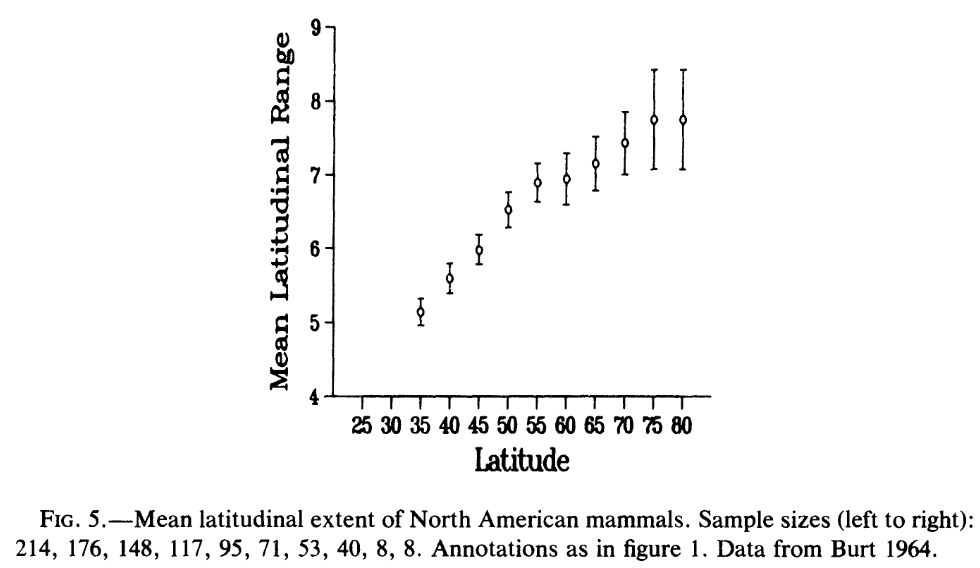
*Side note: I think the use of the term "mean latitudinal range" in site-centric interpretations had been throwing me off. There it's really more akin to a community-weighted mean. May I suggest "community latitudinal range index"?
But I think the species-centric and site-centric interpretations give consistent interpretations if and only if species fill their latitudinal ranges (no gaps), sites represent completely sampled latitudinal bands, and species are given equal weight in site-level calculations.
I'm working on a dataset now where species do not follow the species-centric Rapoport's rule, but the "mean latitudinal range"* of communities follows the site-centric Rapoport's rule. Which doesn't seem possible at first.
When I (mis)understood Rapoport's rule to refer to a pattern in species ranges, it led me to believe that we should generally not expect there to be high-latitude endemic species, since all species that thrive at higher latitudes should also thrive in lower ones. Not always true.
This is not to say that species-centric interpretations of Rapoport's rule are illegitimate. Those are worthy of investigation too. It's just that I'm realizing for the first time that there is a species-centric and a site-centric way to "do" Rapoport's rule.
Rapoport's rule, as coined by Stevens (1989) based on the work of Rapoport (1975), refers to a pattern in which sites are the sampling units. The pattern involves the (sometimes abundance-weighted) mean latitudinal range of the species present at a site.
Rapoport's rule states that species found farther from the equator tend to have larger latitudinal ranges, right? No! Not always! I just learned that it typically refers to a pattern of SITES, not SPECIES. This has been a persistent source of confusion for me. Anyone else?
Our new paper out today on climate risks to ECM symbioses and tree migration lags across North American forests: https://t.co/Rfu1Yo8vY3
@qin_clara@mykophile@KaiZhuPhD
@mykophile 💯 It often feels like the CMN debate has higher stakes for those interested in looking for a model of what ethical more-than-human relations might look like than for those interested in understanding the organisms with whom one could be in relation — a necessary first step.
Do you want to work with a science team dedicated to exploring underground ecosystems?
Now is your chance! We are hiring three science positions.
Apply on our Careers Page (linked below). Applications will be reviewed on a rolling basis.
Are you a researcher who is interested in helping the world understand underground fungal biodiversity?
Apply to join our fourth cohort of Underground Explorers by March 17.
Please share with your networks!
https://t.co/N7pQuvElKe
I've joined @spununderground as a postdoctoral data scientist! I'll be developing quantitative methods to evaluate threats to mycorrhizal fungal biodiversity, using eDNA from soils around the globe. Excited to be part of the mission to #ProtectTheUnderground
RT/ I am looking for TWO postdoctoral researchers to join the Conservation Ecology Research group @ucsc in @UCSC_ENVS in topics related to spatial ecology and conservation (one in CA and one in 🇨🇴/🌎) see details: https://t.co/FPKzuHuHB3 Deadline: Oct 31! #postdocposition 1/3
Are there any well-written critiques of the notion that process-based/mechanistic models are inherently more "causal" than statistical (i.e. linear regression-based) models? Esp. in macroecology and other fields modeling large-scale phenomena?
Our lab is looking to hire a new postdoc working on ectomycorrhizal fungi, climate change, and genomics. More details on the position and how to apply in the attached flyer!
Thanks @NEON_sci for letting me share reflections on making ecology not only more inclusive but also more meaningful for minoritized scientists. For me, that came from understanding the specialized role of ecology in approaching fundamentally *social*-ecological problems.
In our latest Women in Ecology interview, we hear from @qin_clara, a Ph.D. candidate who highlights the importance of embracing diverse perspectives and their significant impact on ecological research.
Read her interview here: https://t.co/Oxyf2gl0Mx
#womeninSTEM