Qlicket is an anonymous platform that diagnoses the drivers of avoidable employee turnover and gets employees bought in to the best solutions to reduce it.
Great companies understand they have two product:
The one they build for customers and the one they build for employees
If you can, work for companies that builds their employee product (culture) with the same focus, dedication and craft as their customer product
11/25: Bad managers tell employees what to do all the time. Good managers explain why employees need to follow their plans. Great managers involve employees in critical decisions.
True leaders define goals and surround themselves by people capable of hitting targets.
Your job isn't to sell software.
Your job is to make sure those that buy your software win against those that don't.
See so many SaaS companies that don't comprehend what should be obvious.
Question I get from leaders in other cities: “Why can’t we replicate Silicon Valley in our region? We have the money, education, office space, and government support”
The main difference is that Silicon Valley enables founders to try multiple times, Pivot, and Punt until they Progress to product-market fit.
Other cultures Shame, Shun, and Snub founders who fail.
Naval Ravikant: “You only have to be right once”
In the clip below, Naval reflects on how it took 13 years after starting his first startup when he was 23 before founding AngelList.
“Entrepreneurial ventures fail all the time. Most of my companies failed. I actually started seven companies, and I’ve launched about 40 or 50 projects over my career. And AngelList is the first one that I would truly say is product, market, entrepreneur fit for me that might succeed down the road.”
He tells the audience:
“It’s a low hit rate over your career, but you only have to be right once… So just keep trying, just keep iterating… a lot of it is market timing and you learn a lot of lessons.”
In his essay How To Be Successful, Sam Altman writes:
“’I will fail many times, and I will be really right once’ is the entrepreneurs’ way. You have to give yourself a lot of chances to get lucky.”
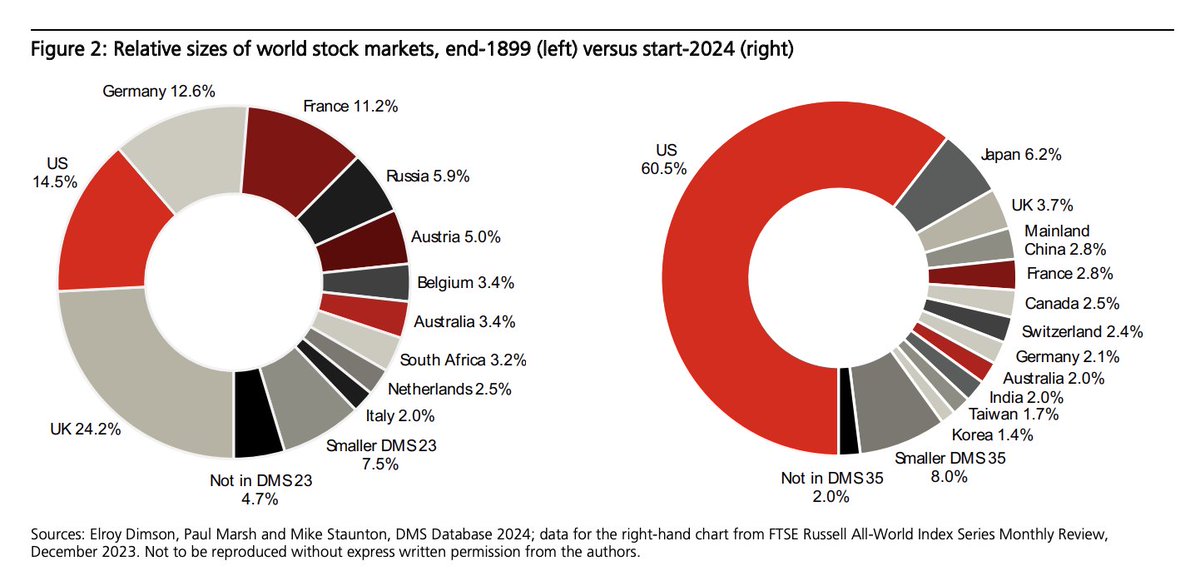
The dominant rise of US public markets over the last 120 years is difficult to comprehend until you see a comparison like this.
1899 on the left vs 2024 on the right.
AI's true gold isn't in the UI or model—they're both commodities. What breathes life into AI is the data & metadata that describes the data to the model—just like oxygen for us. The future's fortune lies in our data. Yes, Data is the new gold! 💖
Friends and family on your startup journey:
$0/mo: "Wtf are you doing?"
$1k/mo: "That's cute!"
$3k/mo: "Why u quit your six-figure stable paycheck to make $3k/mo?"
$10k/mo: "Businesses grow?"
$50k/mo: "Is this legal?"
$100k/mo: "You are a genius, I knew it all along"
$250k/mo: "Can I pick your brain on this idea I have?"
Balaji Srinivasan: “If you have runway, you’re not dead. You iterate until you survive.”
In the clip below, Balaji is asked for his thoughts on pivots, and he lists several examples of massive companies that pivoted from their initial idea:
• YouTube started as a dating site
• PayPal was originally built for beaming money between PalmPilots
• Slack started as a gaming company called Tiny Speck
• Opsware (sold for $1.6B) started as LoudCloud
He continues:
“Even Google initially thought it was going to make its money from enterprise search and that was a non-starter. Overture came up with the concept of auctioning ads and Google basically just copied them and executed it better.”
Balaji tells the audience:
“Basically you iterate until you achieve product/market fit, and then you accelerate… If you have the runway, you’re not dead. You iterate until you survive and thrive. And then you become big.”
Source: @StartupGrind
People won't respect you because you did what they expected from you, people respect you once you do your own thing and go way beyond what they thought you could achieve, at which point, you will also realize that you no longer really care about their validation.
Most business owners look at their expenses as expenses.
Every dollar they spend means a dollar less in their pocket.
So they under-invest in growth and they try to nickel and dime everyone.
Great business owners do the exact opposite.
They look at their expenses as compounding investments.
Every dollar they spend today on great people, equipment, or services might be a $1.20 or $1.50 in their pocket at the end of this year, and then $3 or $4 dollars more at the end of next year.
Meanwhile, they’re getting $2-10 in equity value appreciation too if done right over time.
Once you understand this, your whole world opens up and you'll take a very different approach to spending to grow your firm.
Cerebral Valley is real and all the best people in AI are coming here.
The smart nerds are here. The capital is here. We are turning the doom loop into the boom loop in San Francisco.
https://t.co/lLWi9EKfoe
Sam Altman (@sama): "The most underrated quality is being really determined. This is more important than being smart, having a network or a great idea.
So much about being a successful entrepreneur is just not giving up."
Feedback is the breakfast of champions. Feast on it. Starve your ego, and nourish your product with the insights and critiques of your customers. You needn't take action on all of it, but digest it all.
Always surround yourself with people who see potential in you. It could be a mentor, co-worker, supportive manager, an ambitious group of friends, or a life partner. Words to live by, @bchesky 🫶
I miss SF
I’d rather be at a hacker house than a bar on a Friday night
I stay up until 4 AM working on a hackathon project in NY and my friends here look at me like I’m crazy
Builder culture just not the same (I’m sure there are pockets of it but you really have to seek it)