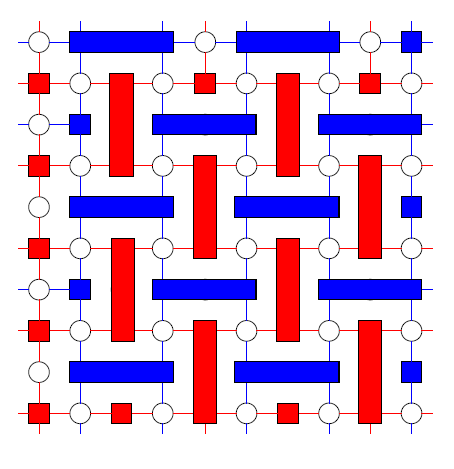
Tanner graph for well known [[5,1,3]] code. Smallest error correcting code; not a CSS code it is also a member of "rotated toric code" family. Concatenating it with itself gives best known code on 25 qubits [[25,1,9]] #QuantumErrorCorrection (2/2)
Tanner graph for [[25,1,7]] "rotated toric code". This is not a CSS code but it has better distance than [[25,1,5]] (CSS) surface code. All stabilizers are of weight 4 and have form XZXZ. #QuantumErrorCorrection (1/2)
@letonyo@CVuillot @QuantumGizmos This does seem to fix it and the diagram does look like the rotated surface code. Also the number of stabilizers (12+12) is what's expected for a [[n=25,k=1]] code.
@letonyo@CVuillot @QuantumGizmos Until I see it and the number of qubits and stabilisers are right this is only a conjecture (with some pretty pictures)
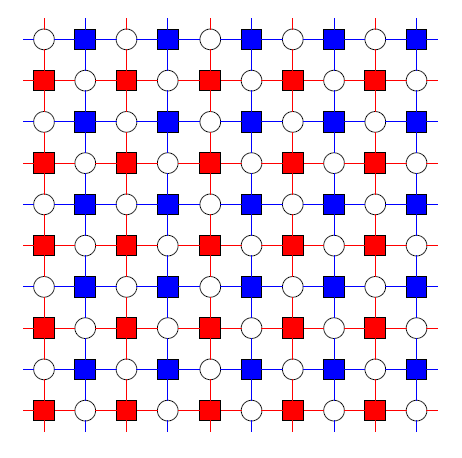
@CVuillot@letonyo @QuantumGizmos Here's the tanner graph for the original toric code (red square = Z stabilizer, blue square = X stabilizer, circle = qubit)
@CVuillot@letonyo @QuantumGizmos I made an attempt at duplicating this for 5x5 toric code. Something odd happens at the top and left edges. There are 7 extra nodes (circles). So there are 32 circles instead of expected 25.
@CVuillot@letonyo @QuantumGizmos Thanks, the connections make sense now. In that case, is the "quanum tanner transform" unique? or can you get different codes by different partitions? For example take one pair of X-O-X's and join them by including a purple edge between them...
@CVuillot@letonyo @QuantumGizmos I can follow part of this but not all. Do the edges/vertices correspond to the usual toric code construction? In lines on the left and bottom each edge connects to two vertices; that makes sense. "Inside", each edge connects two X and two Z stabilizers; that also makes sense 1/2
@CraigGidney This paper https://t.co/MyX1j83Ubv starts with [[6,0,4]] code (also an AME) and derives the the [[5,1,3]] and [[4,2,2]] from it in a systematic way. Might be related to what you're doing here
Computation and communication are unreliable without error correction! @theeczoo provides a place to collect info about any error-correcting code, classical or quantum; develops a taxonomy of relations between codes; and indexes features like decoders, thresholds, rates, FT, etc.
Full paper is open access… unfortunately they don’t tell you enough about codes to try to duplicate their results…surprised their referees didn’t catch that


![qodesign's tweet photo. @letonyo @CVuillot @QuantumGizmos This does seem to fix it and the diagram does look like the rotated surface code. Also the number of stabilizers (12+12) is what's expected for a [[n=25,k=1]] code. https://t.co/SoRJNFfqwJ](https://pbs.twimg.com/media/FZSSdNaUsAAs93w.png)






![qodesign's tweet photo. Tanner graph for well known [[5,1,3]] code. Smallest error correcting code; not a CSS code it is also a member of "rotated toric code" family. Concatenating it with itself gives best known code on 25 qubits [[25,1,9]] #QuantumErrorCorrection (2/2) https://t.co/Mxw6Fk4hhP](https://pbs.twimg.com/media/FaSqeTnVEAEs1s3.png)
![qodesign's tweet photo. Tanner graph for [[25,1,7]] "rotated toric code". This is not a CSS code but it has better distance than [[25,1,5]] (CSS) surface code. All stabilizers are of weight 4 and have form XZXZ. #QuantumErrorCorrection (1/2) https://t.co/7W90bbg2As](https://pbs.twimg.com/media/FaSpqRPUYAEAhqW.png)
![qodesign's tweet photo. Two views (Tanner graphs) of [[25,1,5]] surface code (2/2) #QuantumErrorCorrection https://t.co/bq3U5qslhp](https://pbs.twimg.com/media/FZ5reTrUUAAetdX.png)
![qodesign's tweet photo. Two views (Tanner graphs) of [[25,1,5]] surface code (1/2) #QuantumErrorCorrection https://t.co/TebbwA1wHx](https://pbs.twimg.com/media/FZ5rXi3UUAEDj9E.png)


