About me: I'm Chinese. I like European history, art and culture. I like Marie Antoinette. I refuse to discuss any subject related to politics. My English is not very good, if there are improper wording and grammatical errors, please correct, thank you very much.
A contemporary critic on the Queen's 'chemise' portrait, exhibited then removed at the Salon: "Many people have found it offensive to see these august persons revealed to the public wearing clothes reserved for the privacy of the palace."
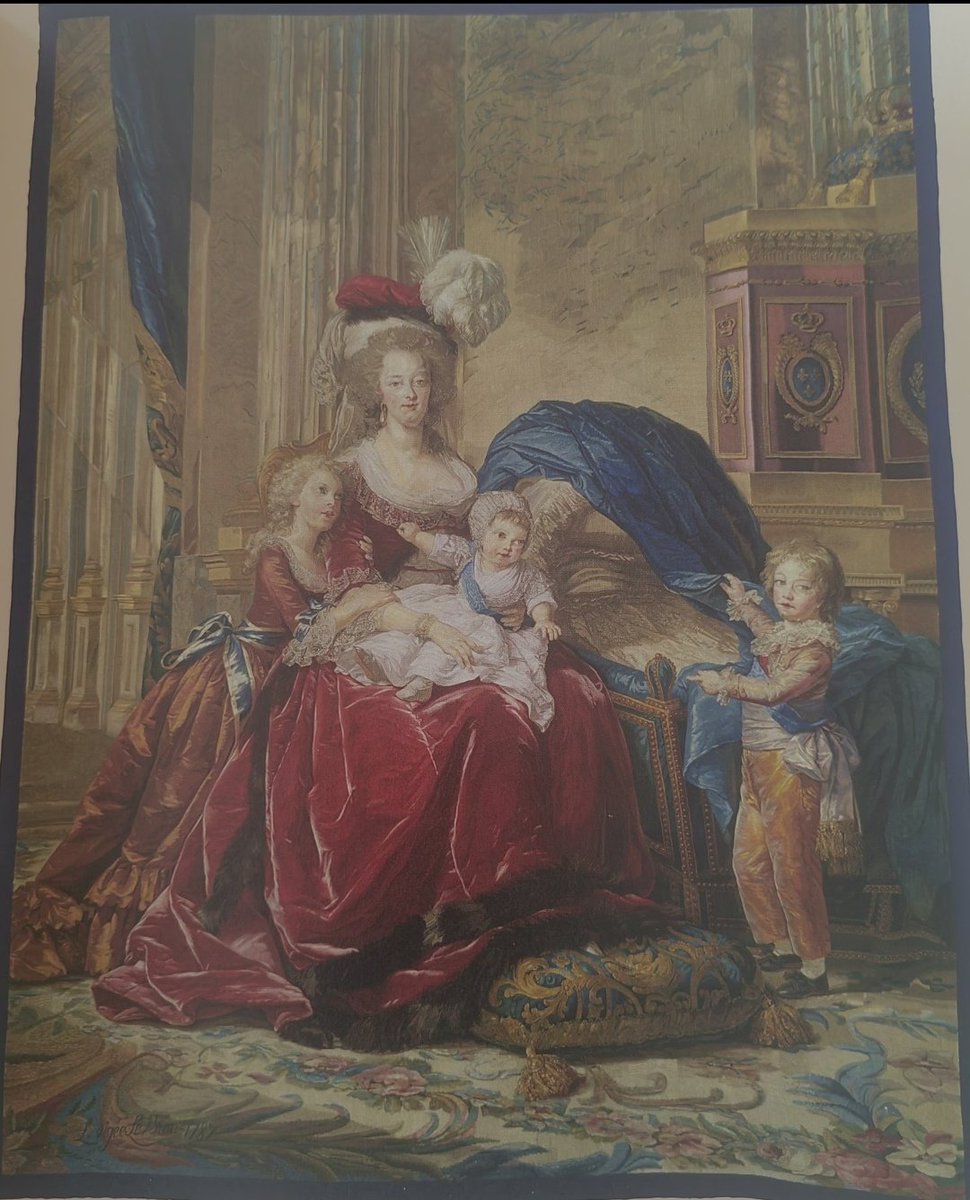
@invitinghistory A tapestry of Marie Antoinette created by the Gobelins manufactory, the third version of which was exhibited at the Paris World's Fair before being gifted to Alexandra Feodorovna of Russia.
My Irish pen pal Karen sent me several articles about Marie Antoinette. After reading them, I feel that people still focus primarily on her image as the "Fashion Queen."
I think this is no different from the 19th century tendency to reduce her image to that of a saint—except now she's been one-dimensionally portrayed as a frivolous fashion queen.
There's an exhibit about Marie Antoinette at the V&A museum and they're displaying the guillotine blade I wrote a chapter about in my book.
And I think the sign is a bit too vague, it should be clearer about this likely NOT being the blade that decapitated Marie-Antoinette. 🧵
"She had read all the newspapers" from "The Snow Queen" in Stories from Hans Christian Andersen, London, Hodder & Stoughton, Ltd., 1911, by French magazine illustrator, book illustrator and stamp designer Edmund Dulac.
In 1767, Maria Josepha of Austria wrote this message in a devotional book of a lady in waiting: "Always remember... the one who has always loved you and who will never cease to cherish you and will never forget you."
Josepha caught smallpox and died in October of that year.