New episode with John Hempton (@John_Hempton), legendary Australian hedge fund manager and short seller.
I wanted to get John’s thoughts on the likelihood of an overbuild / bust in AI compute, and what implications that has for the Australian government’s data centre push.
John talks me through why he thinks the global compute build-out is “fibre optics Mark II” - i.e. why AI is “the most amazing technology of your lifetime”, yet compute looks like “the worst business in the world”.
John’s recipe for the worst business in the world is: “high capital cost, low marginal cost, competition, and technical improvement”. With these ingredients, new entrants push prices down to marginal cost, businesses can't recover their capital costs, and they go bust.
To get an adequate return on the $7 trillion of capex expected to be poured into compute by 2030, John estimates you’d need $2 trillion per year in revenue.
That would most likely have to come from businesses replacing workers (or not hiring new ones), as consumers won’t get you there. But companies typically don’t fire people for a 10% saving. So to pay $2 trillion a year, they’d need to save at least twice as much, or $4 trillion in wages.
The OECD wage bill is about $40 trillion per year. So you’d need to save, for argument's sake, 10% of the wage bill across the entire OECD.
But that kind of saving seems politically and practically implausible in such a short timeframe.
So expect excess supply and bankruptcies. (Again, none of that is to say the underlying tech is useless - far from it.)
John also shares the thing that shocked him most about Anthropic's S-1: namely, how compute-efficient it is. By his estimates, Anthropic has spent only about $12 billion on training compute over the lifetime of the firm. Which makes the $7 trillion build-out look even worse.
There's so much more of interest in this conversation, but let me share one last thing. There's an interesting question as to exactly what the productive infrastructure left over from any overbuild will be. It might not be the GPUs, but the fabs and/or energy generation. John tells a great story about how old chip fabs he thought were worthless ended up finding an application making the tiny sensors in car air conditioners and Tesla batteries.
After all this, the policy implication for Aus govt is to happily facilitate the compute build-out, but just don’t subsidise the world’s compute the way China subsidised the world’s solar panels (another example of a bad business).
Watch below, or wherever you get your podcasts!
0:00:00 – The most amazing technology of your lifetime
00:03:10 – A short seller discovers jaggedness (from first principles)
00:19:40 – The Situational Awareness blow-up
00:24:46 – The worst business in the world
00:31:02 – Fibre optics, Mark II
00:42:41 – The best model was shockingly cheap to train
01:01:26 – Why the $7 trillion build-out can't earn its return
01:11:13 – What survives a compute bust?
01:22:59 – A data centre is a better neighbour than a prison
01:27:30 – A bad business is not a bubble
A U Sydney exchange student touted the superiority of “chalk and talk” with no lecture recordings at Penn.
Here’s an open secret in academia: chalk and talk is better because it requires a lot of effort on the part of the lecturer, slows instruction to an appropriate rate and forces the lecturer to organise and express their material properly. Simply put, better teaching is sometimes avoided because requires more effort.
“What differed was the delivery. My professors wrote everything by hand on a blackboard, working through each problem in real time. At home, lecturers often display pre-typed solutions and narrate over them, which is efficient but, I find, ultimately detrimental to the learning experience. Penn’s lectures weren’t compulsory, but they weren’t recorded either.”
https://t.co/goZk3FXrD7
What would the writing of superintelligent AI sound like? You might expect it to have the characteristics of good human writing — figurative language, high information density, coining new terms, and punchiness — but dialed up to 11. Well, that’s what Claude did, until Anthropic dialed it back recently because of user complaints. It didn’t sound superintelligent to most of us. Instead, the neuralese writing style sounds like a “stupid person’s idea of a smart person”.
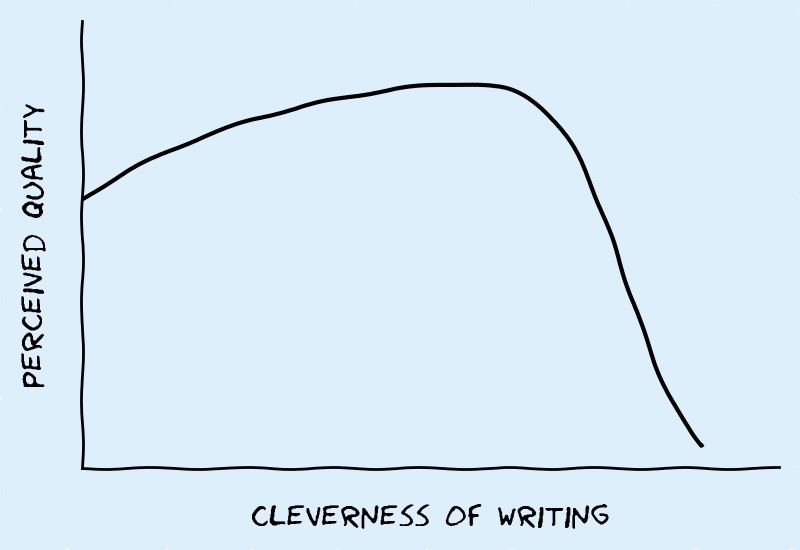
Our response to information density and metaphor-laden writing looks something like the cartoon graph I've drawn. Beyond a point, it completely backfires. The reason human writers don’t overdo it isn’t because they aren’t capable, but because they are aware of the reader’s cognitive burden. One of the hardest skills to learn as a writer is to simulate the reader’s experience.
It’s easy to train AI to mimic mediocre human writing. But optimizing it to be (perceived as) good is really hard, and made much harder by the fact that when everyone uses the same few AI models we get tired of their tics very quickly. Most Claudeisms are individually pretty good. I hate that I can’t use “load bearing” in my writing any more. If it weren’t for AI overuse it would be a neat metaphor.
A broader question is whether most tasks in the economy are like chess, where there is a clear performance metric that can be optimized, or whether they’re like writing, where quality is a multidimensional balancing act without clear training signals beyond human mimicry.
Partially agree: useful in limited domains but overclaimed for complex systems.
1. Valuable in economics (Nobels for Nash et al.), evolutionary biology (ESS, cooperation models), computer science (auctions, multi-agent AI). These fields apply and refine it rigorously.
2. Wolfram's automata and FSM enumerations show tit-for-tat underperforms richer strategies like grim trigger in exhaustive path-dependent competitions; computational irreducibility makes simple dominants fail in larger strategy spaces.
"stochastic parrot" was a mimetically-fit cognitive virus that spread from 2021-2025; it temporarily blinded many gifted people to the nature of AI progress, burning up crucial years in which they could have helped think through the response to the situation.
After I wrote my essay about self-sovereign agents doing various odd jobs on the internet for small nominal fees, multiple agents with no obvious responsible human on the other end reached out to me and pitched me on paying them small nominal fees to do various odd jobs
Jack Roche once told me he visited the Twin Towers with Hambali prior to 9/11 and Hambali said "Most people when they come into a place like this look at how it was constructed. But I look at how to take it down." Ideas like this were in the air among people close to al-Qaeda
@pstanpolitics This is what I have been saying but I’m well aware hardly anyone agrees. Also teaching, because of tacit knowledge and creative error correction that we might not even be aware of.