🤓#mdpilife New article from Kathleen E. Adair et al.
@NickvonWaaden@Baylor
Metabolic Phenotypes and Chronic Kidney Disease: A Cross-Sectional Assessment of Patients from a Large Federally Qualified Health Center
https://t.co/iOby2ihiXo
#obesity#chronic kidney disease
@Baylor_GSA 10/10 This study demonstrates the first use of strictly defined metabolic phenotypes in the analysis of CKD prevalence. While our sample was large, we were limited by its cross-sectional nature, and we recommend that more research is done in this area. #BUGSTC
@Baylor_GSA 9/10 Interestingly, the MHO phenotype demonstrated a slight protective effect in terms of renal health. This could be due to a transient increase in eGFR prior to the development of widespread glomerulosclerosis. #BUGSTC
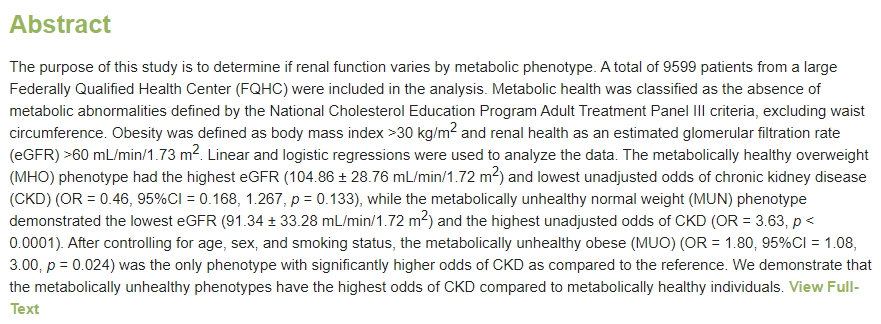
@Baylor_GSA 8/10 Our analysis indicated that chronic kidney disease is most prevalent in the MUN phenotype, and that the presence of at least one metabolic abnormality is associated with lower eGFR. #BUGSTC
@Baylor_GSA 7/10 After controlling for age, sex, and smoking status, the MUO phenotype (OR=1.80, 95%CI=1.08, 3.00, p=0.024 was the only group with significantly higher odds of CKD as compared to the reference group, MHN. #BUGSTC
@Baylor_GSA 6/10 The MUN phenotype demonstrated the lowest average GFR (91.34±33.28 ml/min/1.72m2) and the highest odds of CKD (OR=3.63, p<0.0001). #BUGSTC
@Baylor_GSA 5/10 Linear and logistic regressions were used to analyze the data. The MHO phenotype had the highest GFR (104.86±28.76 ml/min/1.72m^2) and lowest odds of chronic kidney disease (CKD) (OR=0.46, 95%CI=0.168, 1.267, p=0.133). #BUGSTC
@Baylor_GSA 4/10 As modeled by Kouvari et al (2019), metabolic health was strictly defined and required the absence of metabolic abnormalities, obesity was defined as body mass index >30kg/m2, and renal health was defined as a glomerular filtration rate (GFR) >60 mL/min/1.732. #BUGSTC
@Baylor_GSA 3/10 The purpose of this study was to determine if kidney function varies by metabolic phenotype in a large sample of 9,599 patients from a Federally Qualified Health Center (FQHC). #BUGSTC
@Baylor_GSA 2/10 The metabolic phenotypes consist of four categories: the metabolically healthy normal-weight (MHN), the metabolically healthy obese (MHO), the metabolically unhealthy normal-weight (MUN), and the metabolically unhealthy obese (MHO). #BUGSTC
@Baylor_GSA 1/10 Chronic kidney disease (CKD) is one of the top ten causes of death in the United States (U.S.) Recent research studies have analyzed the impact of metabolic phenotypes in the assessment and prediction of CKD. #BUGSTC
@Baylor_GSA@teachtinymites 10/10 High intakes of protein, sodium, and fat and low intake of fiber are of particular concern in this population, and therefore should be the target of future dietary intervention strategies. #BUGSTC