Trondheim based Socialist. Teacher. "The shallowest of communist platitudes contains more of a hierarchy of meaning than contemporary bourgeois profundity"
The situation is very interesting. In the past years, the all-encompassing rectionary aura of Orbánism has pushed me towards Marxism so much that I have a very conforming understanding of what "revolution" constitutes, and in this sense, Hungary is far from it, and indeed stuck in a long counter-revolution.
However I have just started to skim through Paweł Ukielski's 2024 grand study of 1989 in the Eastern Bloc and the literature review made me realize that bourgeois liberal theories of revolution are as much a living tradition as my own - and in that theoretical framework any rapid grab of power that aims not only to govern but to completely overhaul basic institutions - also qualifies as a revolution or counter-revolution, based on primarily fighting for or against an idea. That is, even if the power grab was not bottom-up and not violent.
This kind of "counterrevolution" or the adherence to that understanding of it, is clearly evidenced in what is happening in Budapest now. It is not that Orbánism was a revolution, but that the new power struggles against it, AS IF it was
@iamjourjean What serious anti-imperialist would argue against the need to understand their oppressor. It's a good indicator that their verbal "anti-colonialism" is mostly a front for national chauvinism.
@tothcsabatibor Interesting how Munich - which was responsible for destroying any prospects for a popular front, and for decades was accepted as the moment that enabled WWII - has been put in the shadow of Molotov-Ribbentrop, just as the generations that lived through it has disappeared.
Ernst Bloch in The Heritage of Our Times has an incredible essay on how the Nazis appropriated May Day shortly after coming to power in 1933. First, they stole the color red and placed it on all their posters in honor of the workers' holiday. On May Day they erected the maypole, the old Jacobin symbol of liberty, and danced around it like members of the White Guard. Even Hindenburg celebrated the world holiday of the proletariat but they had re-named the holiday to Day of National Labor.
Bloch writes that Hitler's concept of proletarian consciousness was proclaimed during the celebrations: "We are determined not only to eliminate Marxism externally but also to deprive it of its prerequisites."
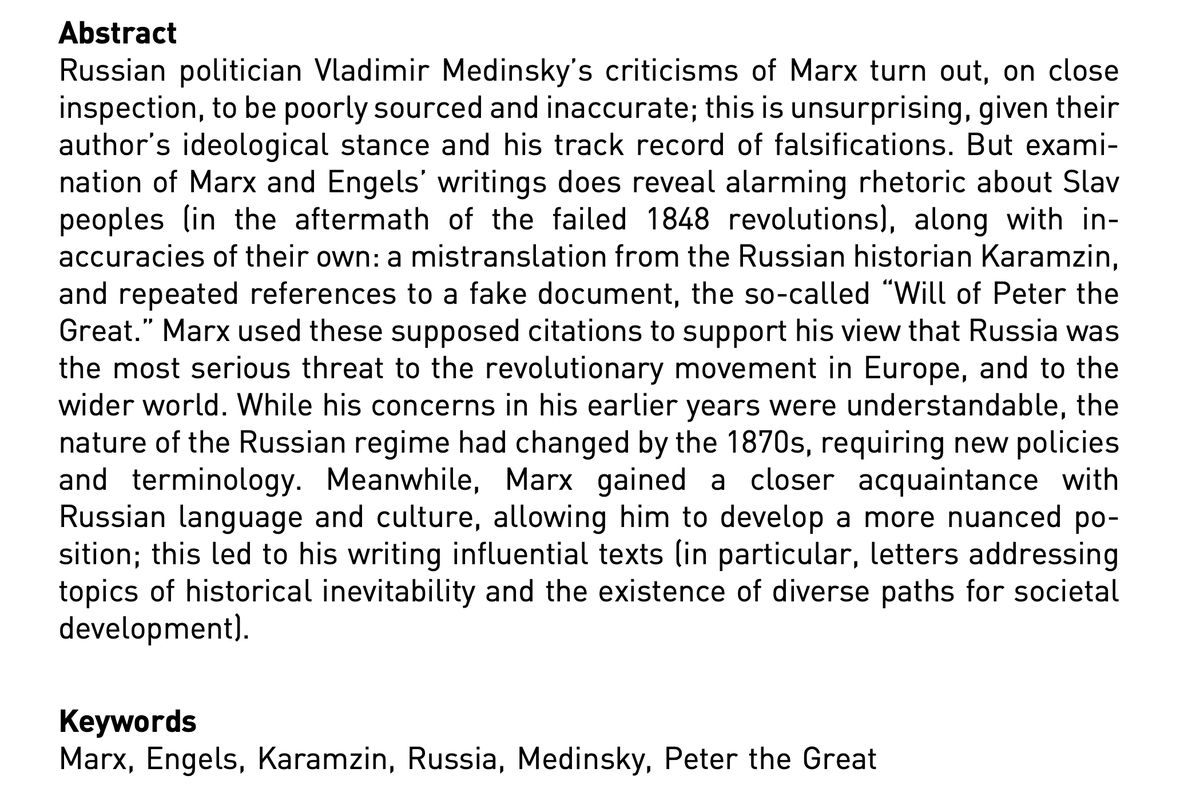
Open access article from the S&S April issue: Tim Budd challenges common conceptions about Karl Marx's supposed "Russophobia" and sheds light on the evolution of Marx's views on Russia:
https://t.co/TCPMPOMR5F
@TerezaHendl Why are you all so keen to portray someone who is essentially a left labourite, with post-war social democracy as their closest ideal, as subscribing to an idea of "Soviet utopia"? Seems pointless and very bad faith.
@stoltonaut Disse tingene går i bølger. SV var en tydelig utenrikspolitisk opposisjon i sin tid, men denne rollen ble gradvis svekket, spesielt etter 2005.
Tør påstå at dette ikke ville vært mulig uten palestinabevegelsen, som har skapt et rom for kritikk mot vestlig utenrikspolitikk som ikke fantes for 2-3 år siden.
@GustafssonEinar Ingen av oss kan forutsi framtida. Jeg ser på hvilke krefter som står bak MCM, og på bakgrunn av det jeg har lært om dynamikken i slike situasjoner så er det uaktuelt for meg å støtte henne. Det er ikke sikker kunnskap, for det finnes ikke i politikk.
Å gi prisen til MAGA sin forbundsfelle i det landet de vil føre krig mot, er litt av en finte når det blir for vulgært å gi den direkte til keiseren selv.
@GustafssonEinar Det finnes neppe reelle alternativer i dag, men for meg er ikke det noen grunn til å velge det ene eller det andre. Da må vi heller begynne med grunnleggende prinsipper, med støtte til de gode kreftene, uansett hvor små og svake de er, og uansett om veien fram er vanskelig å se.
@GustafssonEinar Det er ikke noe jeg er fristet til å finne ut, men trolig angrep på faglige rettigheter, uavhengige fagforeninger og urfolksorganisjoner. Fjerning av det som er igjen av støtteordninger for fattige. Er det noen grunn til at det skal være annerledes enn før?