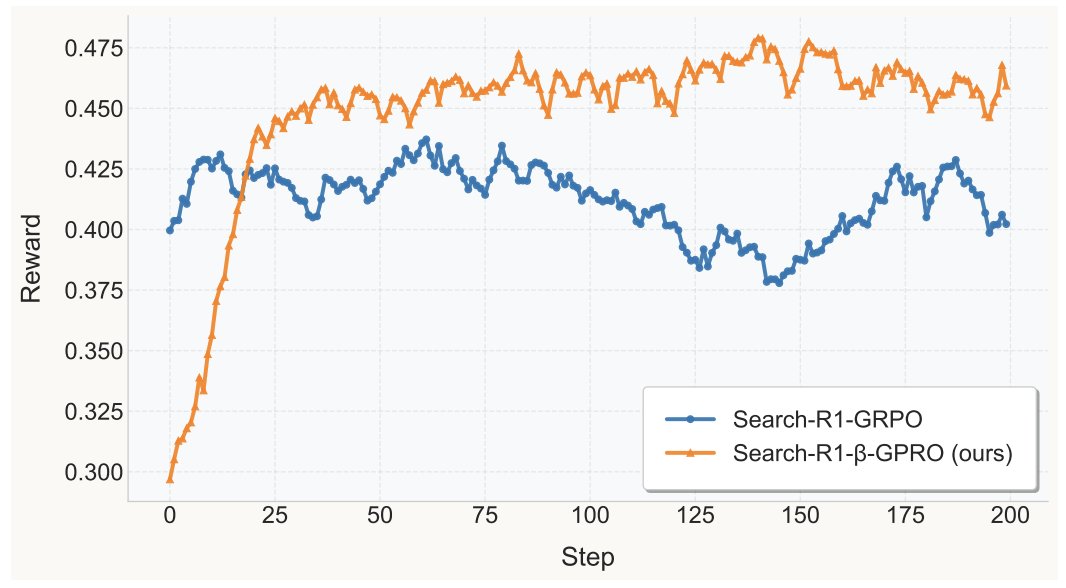
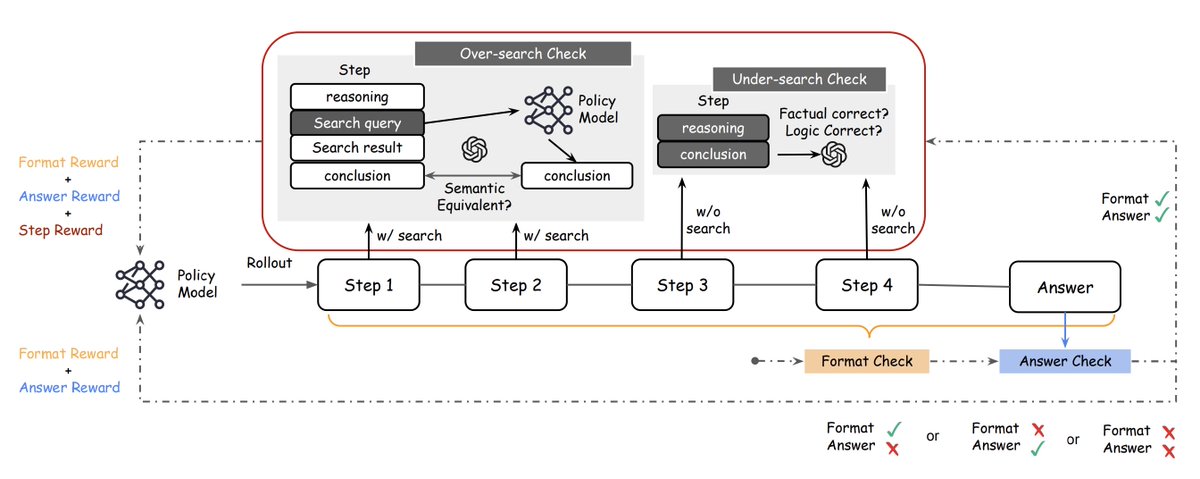
Is your agentic RAG system searching too much or too little? 🤔 We tackle this problem in our new paper, "HiPRAG: Hierarchical Process Rewards for Efficient Agentic Retrieval Augmented Generation”. We introduce a novel training method that teaches search agents how to reason efficiently, not just get the right answer. The result? We boosted the accuracy and slashed the over-search rate from over 27% in baselines to just 2.3%! 🚀
📄 Paper: https://t.co/cOIlIFVxS5
💻 Code & Models: https://t.co/VLkWWBQlRT
(1/5)
#LLM #AI #RAG #AgenticAI #DeepLearning
📢 How do LLMs behave under different user instructions about using retrieved info vs. internal memory? Our work, "Do Retrieval-Augmented Language Models Adapt to Varying User Needs?", introduces a new framework to test just that! We systematically evaluate RALM adaptability across diverse user needs (e.g., "only use context" vs. "use memory first") & tricky context scenarios (matching, conflicting, irrelevant), revealing various model behaviors and trade-offs between context reliance and internal memory usage.
📄 [Link to paper: https://t.co/qqMdERszGu]
🤯 This means choosing the right model & strategy for specific user needs is crucial! Our work highlights that we need more user-centric evaluations for RALMs. We can't just optimize for a single "correctness" by just focusing on either truthfulness or faithfulness. Our framework comprehensively evaluate RAG instruction following in more complex situation.
🙌 Huge thanks to co‑authors @_Guuuuuuuu_ , @XZ1023_ , @Xinya16 , and my advisor @ZhiyuChen4 for late‑night debugging & brilliant ideas! Code + data soon — let’s build agents that search wisely and save GPUs together. 🚀
📢Excited to share our new paper on building agentic RAG with efficient search behaviors!
Agentic RAGs often over- or under-search, hurting performance and reliability. We analyze these failure modes and propose a simple RL algorithm that rewards high-certainty search decisions, achieving improvements over strong baselines.
📄 Paper: https://t.co/fpympNpdAm




![qualidea1217's tweet photo. 📢 How do LLMs behave under different user instructions about using retrieved info vs. internal memory? Our work, "Do Retrieval-Augmented Language Models Adapt to Varying User Needs?", introduces a new framework to test just that! We systematically evaluate RALM adaptability across diverse user needs (e.g., "only use context" vs. "use memory first") & tricky context scenarios (matching, conflicting, irrelevant), revealing various model behaviors and trade-offs between context reliance and internal memory usage.
📄 [Link to paper: https://t.co/qqMdERszGu]](https://pbs.twimg.com/media/Gsd0BAUb0AITERo.jpg)


