If you believe, you will find a way ~ It’s better together. Many hands make light work. Organic experiences. Listen ~ Appreciate those you love most. Trust and support ~ Love and cherish. It starts with you. Plant the seed. Lead by example 🥰🌈🌍☮️ #empathy#Love#life#smile
AURORA ALERT!!!
BOOM!
Aurora activity extremely high with a good possibly of seeing the Northern Lights from most of the UK!
Look north and you your best to avoid bright lights
Abu Simbel Temples built by the Egyptian king Ramses II, between 1274 BC to 1244 BC, located in ancient times at pharaonic Egypt's southern frontier facing Nubia.
Well, it's a marvelous night for a moondance 🎶
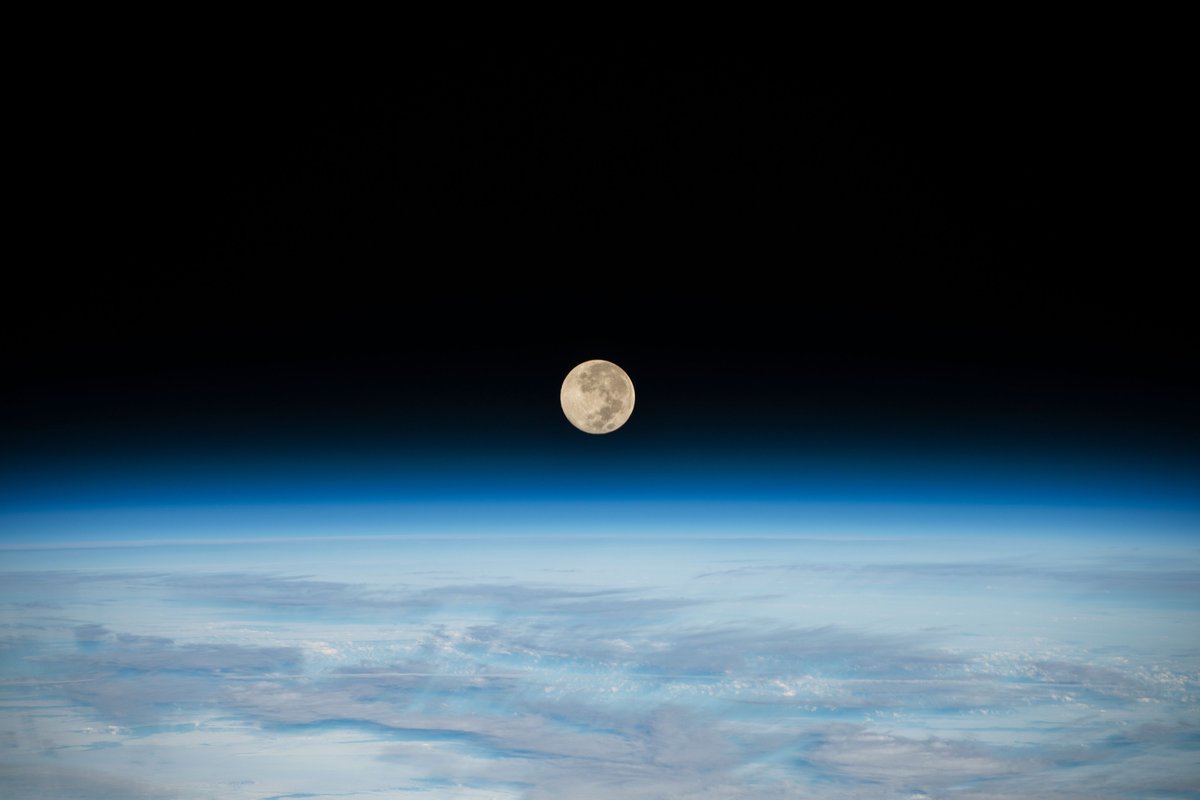
October's full moon – the Hunter's Moon – will peak at 4:24pm ET (2024 UTC) on Saturday, Oct. 28. Look out for cosmic companion Jupiter, which will appear at lower left of the Moon. https://t.co/gVOZsUNWzp
Earth at night seen from space.
That orange line you can see over the Earth is called airglow and shows how thin is our atmosphere, the extremely delicate and narrow volume we live in, protected from the harsh conditions of space.
Clear skies, full moon, can’t lose. 🌕
The Harvest Moon peaks Sept. 29. In the days before electricity, farmers welcomed the sight since it gave them more time to bring in their crops before the first frost of the season. Don't forget to look up.
When does the line between day and night become vertical?
#Today, September 23 at 06.50 UTC, there's an #equinox on planet Earth
Equinox comes from the Latin aequus (equal) and nox (night): days and nights are equal in length for everyone on Earth
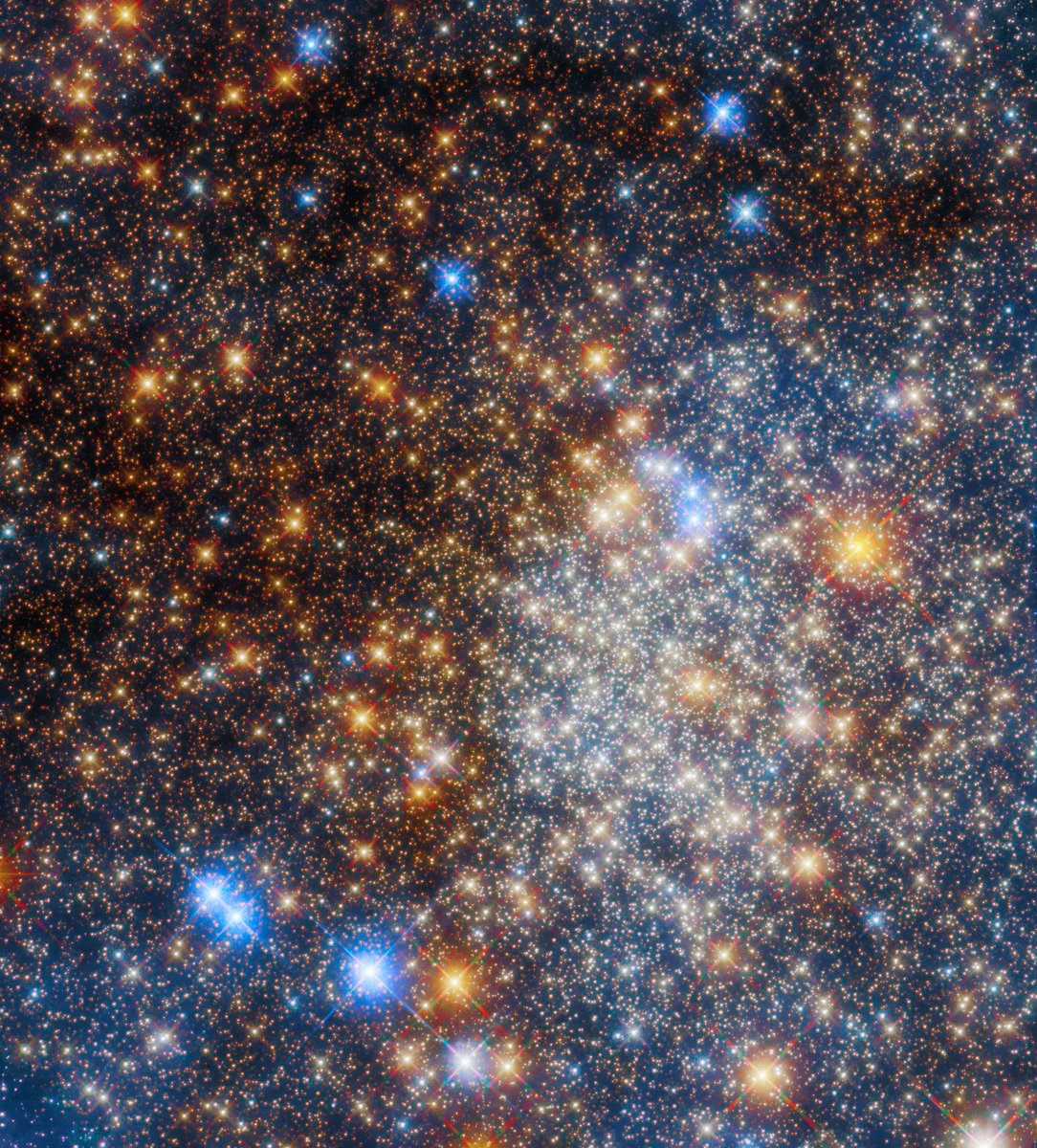
Prepare to be starstruck!
This new Hubble image shows Terzan 12, which is a globular cluster – a roughly spherical group of stars bound together by gravity.
Terzan 12 is about 15,000 light-years away, nestled in our home galaxy of the Milky Way: https://t.co/9DOouni3D9
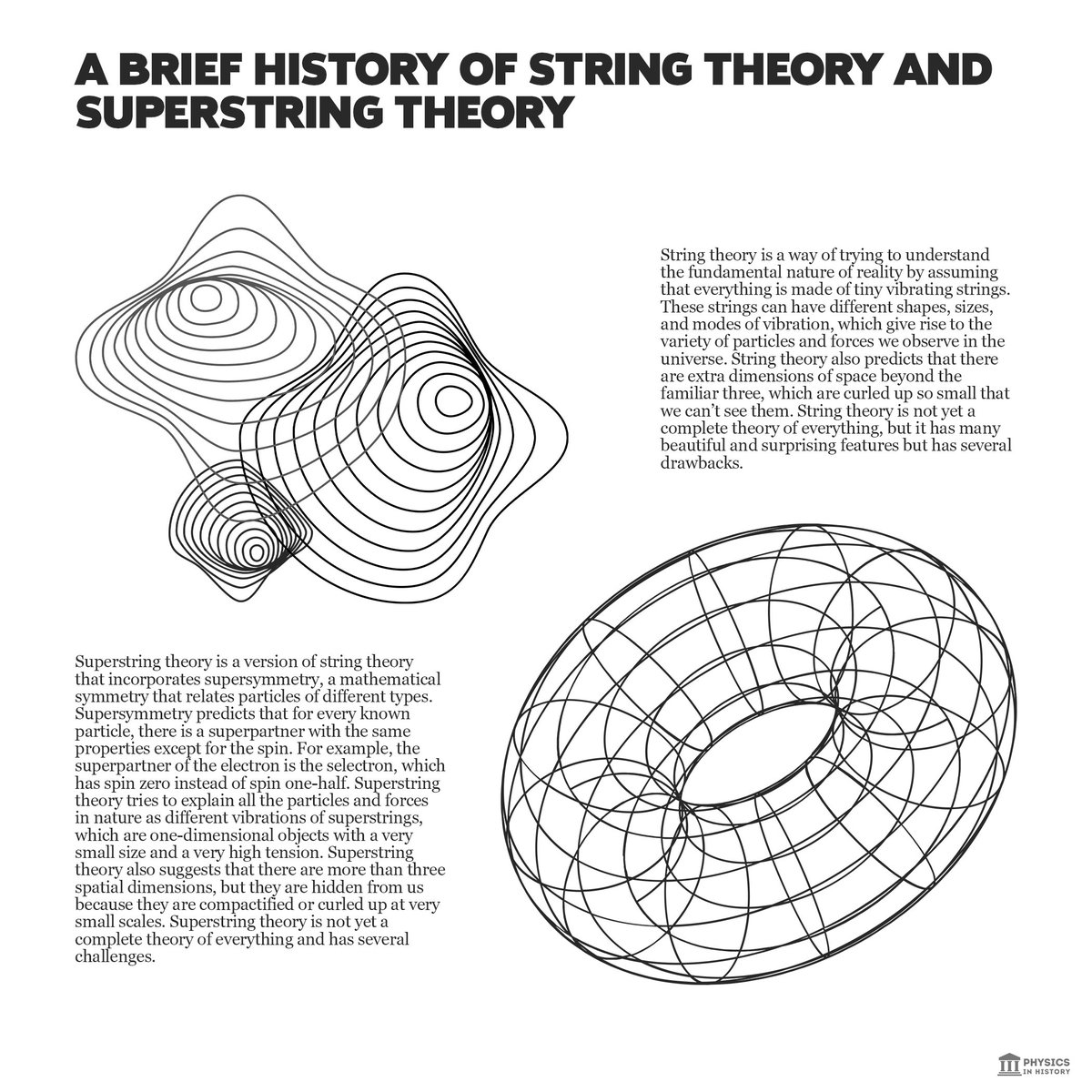
A brief history of String theory, superstring theory, and M-theory explained✍️
Imagine that you are a scientist who wants to understand the secrets of the universe. You have a powerful microscope that can zoom in on the smallest things you can think of: atoms, electrons, quarks, etc. You also have a powerful telescope that can zoom out on the largest things you can think of: stars, galaxies, black holes, etc. You want to find a simple and elegant theory that can describe everything you see, from the tiniest particles to the vast cosmos.
You start by studying the four fundamental forces of nature: gravity, electromagnetism, strong nuclear force, and weak nuclear force. You discover that each force has its own set of rules and equations, and they don’t seem to agree with each other. For example, gravity is very weak compared to the other forces, and it doesn’t work well with quantum mechanics, the theory of the microscopic world. You wonder if there is a way to unify these forces into one single force that can explain everything. You also study the different types of particles that make up matter. You discover that there are two main classes of particles: bosons and fermions. Bosons are particles that carry forces, such as photons (light), gluons (strong nuclear force), and gravitons (gravity). Fermions are particles that make up matter, such as electrons, protons, neutrons, quarks, etc. You wonder if there is a way to connect these particles into one single entity that can create everything.
You then have a brilliant idea: what if everything in the universe is made of tiny strings? Strings are one-dimensional objects that can vibrate in different ways. Depending on how they vibrate, they can produce different types of particles and forces. For example, a string vibrating in one way can be an electron, while a string vibrating in another way can be a photon. This way, you can unify all the forces and particles into one simple concept: strings.
You call your idea string theory, and you start working on it with enthusiasm. You find out that string theory has many advantages over the previous theories. For example, string theory can avoid the problem of infinities that plague quantum gravity, because strings are not point-like but have a finite size. String theory can also incorporate the idea of extra dimensions beyond the usual three dimensions of space and one dimension of time. These extra dimensions can be curled up into tiny shapes called Calabi-Yau manifolds, which can explain why we don’t see them in our everyday life.
However, you also encounter many challenges and difficulties with string theory. For example, string theory requires a very high energy scale to test its predictions experimentally, much higher than what we can achieve with our current technology. String theory also has many different versions and variations, which make it hard to choose the right one among them. String theory also has many mathematical complexities and subtleties, which make it hard to solve and understand. One of the biggest problems you face with string theory is that it only works with bosons, not fermions. This means that string theory cannot describe matter properly, only forces. You realize that you need to include fermions in your theory somehow, otherwise it will be incomplete and inconsistent. You then have another brilliant idea: what if there is a symmetry between bosons and fermions? A symmetry is a property that does not change when you transform something in a certain way. For example, a circle is symmetric under rotation: it looks the same no matter how you rotate it. You propose that there is a symmetry between bosons and fermions: they can transform into each other under certain conditions. You call this symmetry supersymmetry.
You find out that supersymmetry has many benefits for string theory. For example, supersymmetry can cancel out some unwanted terms in the equations of string theory that would otherwise make it inconsistent. Supersymmetry can also explain why gravity is so weak compared to the other forces: it could be balanced by another hidden force called supergravity. Supersymmetry can also provide a candidate for dark matter: it could be a stable particle called neutralino that does not interact with ordinary matter. You call your new idea superstring theory, and you start working on it with more enthusiasm. You discover that superstring theory has several types: Type I, Type II (A and B), Heterotic (E8 x E8 and SO(32)), etc. Each type has its own features and properties, such as the number of dimensions (10 or 26), the type of strings (open or closed), the type of interactions (oriented or unoriented), etc.
You also discover that superstring theory has many connections and relations with other fields of physics and mathematics. For example, superstring theory can be related to quantum field theory by a duality called AdS/CFT correspondence, which maps a theory of gravity in a higher-dimensional space to a theory of particles in a lower-dimensional space. Superstring theory can also be related to geometry by a duality called mirror symmetry, which maps a Calabi-Yau manifold to another one with opposite properties. Superstring theory can also be related to number theory by a phenomenon called monstrous moonshine, which links a group of symmetries called the monster group to a function called the j-invariant.
You are amazed by the beauty and richness of superstring theory, and you hope that it is the ultimate theory of everything. However, you also realize that superstring theory is not the final answer, but rather a step towards a deeper and more fundamental theory. You wonder what this theory could be, and how to find it. You then have a final brilliant idea: what if there is a higher-dimensional object that contains strings as its boundaries? An object that can have different shapes and sizes, such as membranes, tubes, cones, etc. An object that can unify all the types of superstring theory into one single framework. You call this object a brane, and you call your ultimate idea M-theory.
You are excited by the prospect of M-theory, and you start working on it with the utmost enthusiasm. You hope that M-theory will reveal the true nature of reality, and answer all the questions you have about the universe.
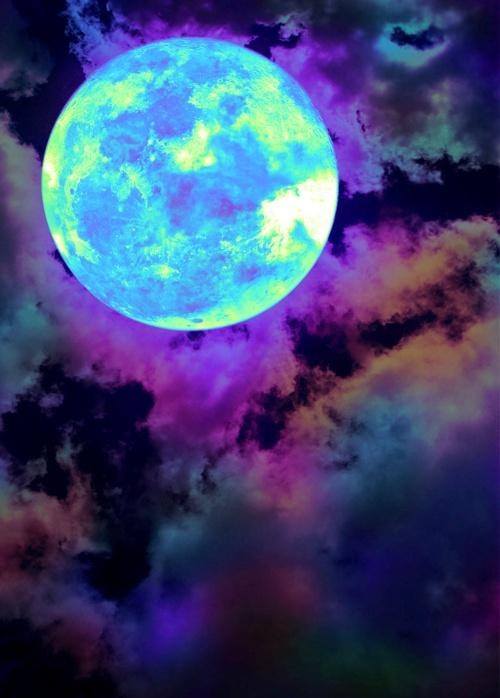
2023’s only enchanting Super Full Blue Moon in Pisces rises on August 30 at 7°. The rare “Blue Moon” in Pisces, the second Super Full Moon in August, is the biggest, brightest, and most healing Full Moon of the year! Your dreams are manifesting. #BlueMoon
The Moon is doing the most: It's a Super Blue Moon!
So-called "super" because it's slightly closer to Earth and "blue" because it's the second full moon in a month. It peaks at 9:36pm ET on Aug. 30 (0136 UTC on Aug. 31).
Details & other sky highlights: https://t.co/MLYxQ9lSKH
The ‘God’ Particle, also known as the Higgs-Boson is a subatomic particle that is believed to be responsible for giving mass to other particles. It was first theorised in 1964 by Peter Higgs and other physicists at the University of Edinburgh. However, it took almost 50 years to confirm its existence experimentally.
The discovery of the Higgs-Boson was announced on July 4th, 2012 by the ATLAS and CMS collaborations at CERN, the European Organization for Nuclear Research. They used the Large Hadron Collider (LHC), the most powerful particle accelerator in the world, to smash protons together at very high energies and look for traces of the Higgs-Boson in the resulting debris.
The problem was that the Higgs-Boson is very heavy and very unstable, so it decays into other particles almost instantly after being created. Moreover, the particles that it decays into are also produced by many other processes in the collisions, making it hard to distinguish the signal from the background noise. To solve this challenge, the scientists had to analyse billions of collisions and look for subtle patterns in the data that indicated the presence of the Higgs-Boson. One way to do this was to calculate a quantity called invariant mass from the measurements of the decay products. This quantity is conserved in a collision and gives an estimate of the mass of the original particle. The scientists expected to see a peak or a bump in the distribution of invariant masses corresponding to the mass of the Higgs-Boson, which was predicted to be around 125 GeV/c2 (about 133 times heavier than a proton).
After combining data from different decay channels and different experiments, the scientists found a clear excess of events around this mass range, with a statistical significance of 5 sigma. This means that there is only a one in 3.5 million chance that the observed signal was due to a random fluctuation. This was enough evidence to claim the discovery of a new particle consistent with the properties of the Higgs-Boson. The discovery of the Higgs-Boson was a landmark achievement in particle physics and a confirmation of the Standard Model, which describes how matter and forces interact at the smallest scales. It also provided crucial evidence for a process known as spontaneous electroweak symmetry breaking, which explains how some particles acquire mass and why there are different types of forces in nature.
The discovery of the Higgs-Boson was celebrated by scientists and media around the world as one of the most important scientific breakthroughs of the 21st century. It also earned Peter Higgs and François Englert, two of the original theorists, the Nobel Prize in Physics in 2013.
📷 Peter Higgs, credits: Claudia Marcelloni/CERN
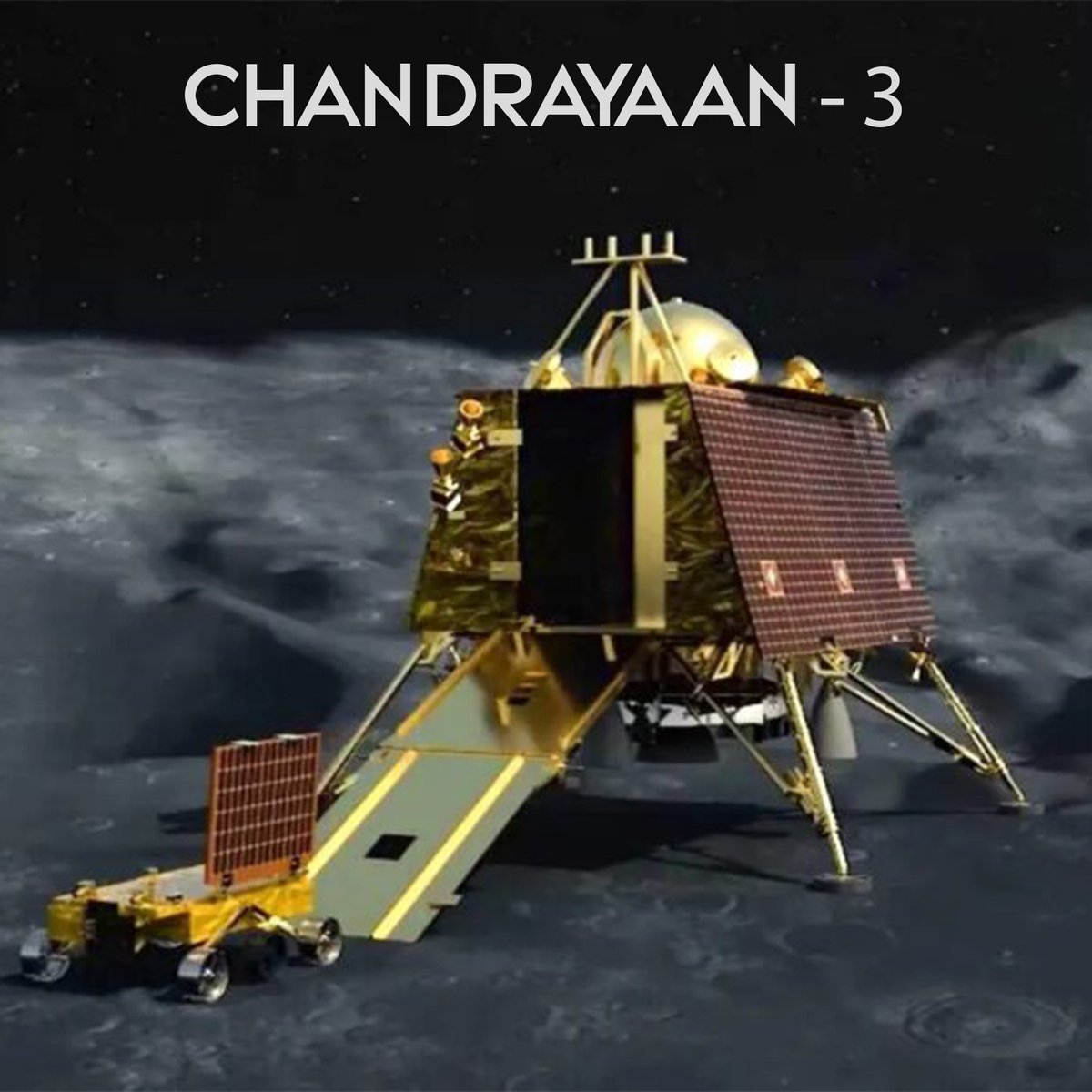
Historic: 🌖🇮🇳
India becomes the first ever country to successfully land a space probe near the lunar South Pole and the fourth country to soft-land the probe on the lunar surface.
The LM successfully touched down on a flat plain near the south pole of the moon at around 6:02 pm IST (12:32 pm UTC) on 23 August 2023, making India the first country in history to achieve a soft landing on this region of the moon. The LM will deploy its ramp and release the RM soon which will begin its exploration of the lunar terrain.
The mission’s main objective is to explore the south polar region of the moon, which is believed to contain water ice and other resources that could be useful for future human settlements. The mission also aims to conduct various scientific experiments on the lunar surface using its instruments. After orbiting the moon for about a month, the LM separated from the orbiter on 23 August 2023 and began its descent towards the lunar surface. The LM performed a series of automatic maneuvers to reduce its speed and align itself vertically to the landing site.
The LM and the RM communicated with each other and with the orbiter, which relayed their data and images to the ground station in India. The mission’s scientists and engineers celebrated this remarkable feat, which was also witnessed by millions of people around the world through live telecast and streaming.
A proud moment for @isro, India, and all of humanity!





![CuriosityonX's tweet photo. Meet BOSS, the largest discovered structure in the universe so far, a wall of galaxies at over a billion light-years across.
[illustration] https://t.co/hbQcecpWCo](https://pbs.twimg.com/media/GZuyA6sXUBQn0O4.jpg)