Bittensor mints roughly 246 to 269 million dollars of new bittensor:native a year at current prices. The best public tracker of what outside customers actually pay its subnets shows 2.34 million dollars over 90 days, spread across seven subnets. Annualized, external revenue covers about 4 cents of every dollar of new token created.
Bittensor's own FAQ states that validating the blockchain is performed by the Opentensor Foundation on a Proof-of-Authority model, and that mining inside subnets has nothing to do with adding blocks to the chain. Grayscale's filing describes the same structure, with nodes requiring Foundation admission.
So the AI work does not secure the ledger. The Foundation does. The subsidy is not buying network security the way Bitcoin's block reward buys hash power. It is buying output, and output is worth something only if somebody wants it.
The number needs guardrails. Issuance is not a cash expense. Not every recipient sells. The tracker is incomplete, uses mixed standards, and carries self-reported figures. Emissions also fund experimentation, benchmarking, liquidity and open research that no revenue line captures.
The ratio still describes the phase. Bittensor is subsidy-led, not customer-led. That is not fraud. It is early.
The engineering is real. Covenant-72B showed permissionless peers coordinating a 72 billion parameter training run over ordinary internet connections, on roughly 1.1 trillion tokens. Chutes sells genuine inference and takes dollars or TAO. Nobody is faking the technology.
The reward data is harder to explain away. A study of 6.66 million events across 121,567 wallets and all 64 subnets then active found validator stake predicted rewards at a correlation around 0.80 to 0.95, while miner performance predicted rewards at only 0.10 to 0.30. The median subnet had about 90 percent of its stake held by the top 1 percent of wallets. That dataset ends on 12 February 2025, one day before dTAO launched, so it cannot describe the current mechanism, and nobody has replicated it since. The missing replication is itself one of the largest open risks in the asset.
The bigger issue is where the money lands if Bittensor works.
There is no network-wide rule requiring a successful subnet's external revenue to buy TAO, buy its alpha token, fund buybacks, or stay inside the network at all. Some teams choose to. Nothing compels it.
The success case runs like this. TAO holders absorb the dilution. Emissions pay the miners, validators and teams. A genuinely valuable AI product gets discovered. Customers pay the operating company in dollars. The company keeps the cash. TAO financed the discovery and holds no automatic claim on the business.
Bittensor can socialise discovery and privatise the rent.
TAO's greatest risk is not that Bittensor fails. It is that Bittensor succeeds, funds the next serious AI companies through token dilution, and watches their cash flows settle somewhere else. Venture capital gets equity for taking that risk. TAO holders get a scarce token and a hope.
That turns every halving into something sharper than a supply event. It becomes a deadline for customers to arrive.
Bittensor has already proved it can coordinate intelligence. It has not yet proved that the value that intelligence creates can be made to settle back into TAO.
My Twitter account was banned for nearly all of 2022 for telling the truth about COVID.
I’m proud to be in the small percent of people, you know the conspiracy theorists, that refused to comply with the horrific lies we were told by Fauci and the “experts.”
So much of what the public is constantly told is organized and planned propaganda.
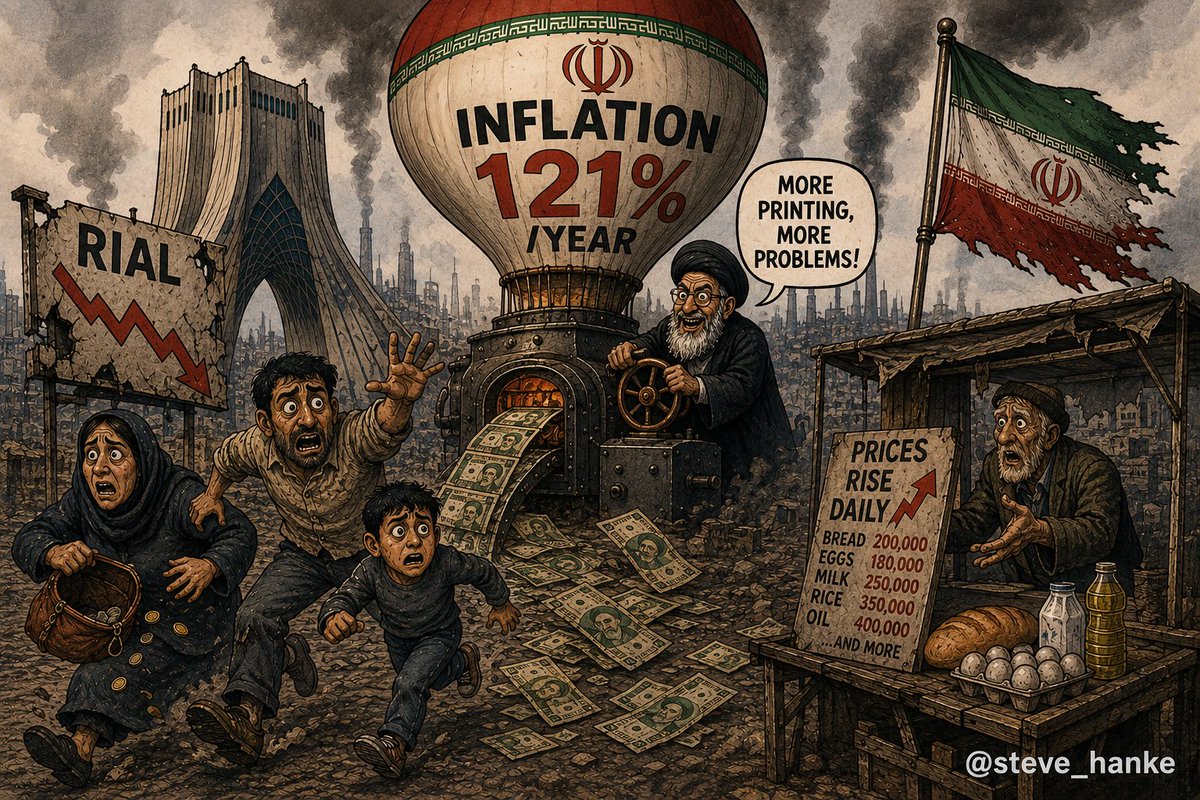
#IranWatch🇮🇷: Today, I measure Iran’s inflation at a PUNISHING 121%/yr.
That is the WORLD’S 2ND HIGHEST rate, only behind Venezuela.
I REMAIN THE ONLY ACCURATE SOURCE FOR INFLATION MEASUREMENTS IN IRAN AND VENEZUELA.