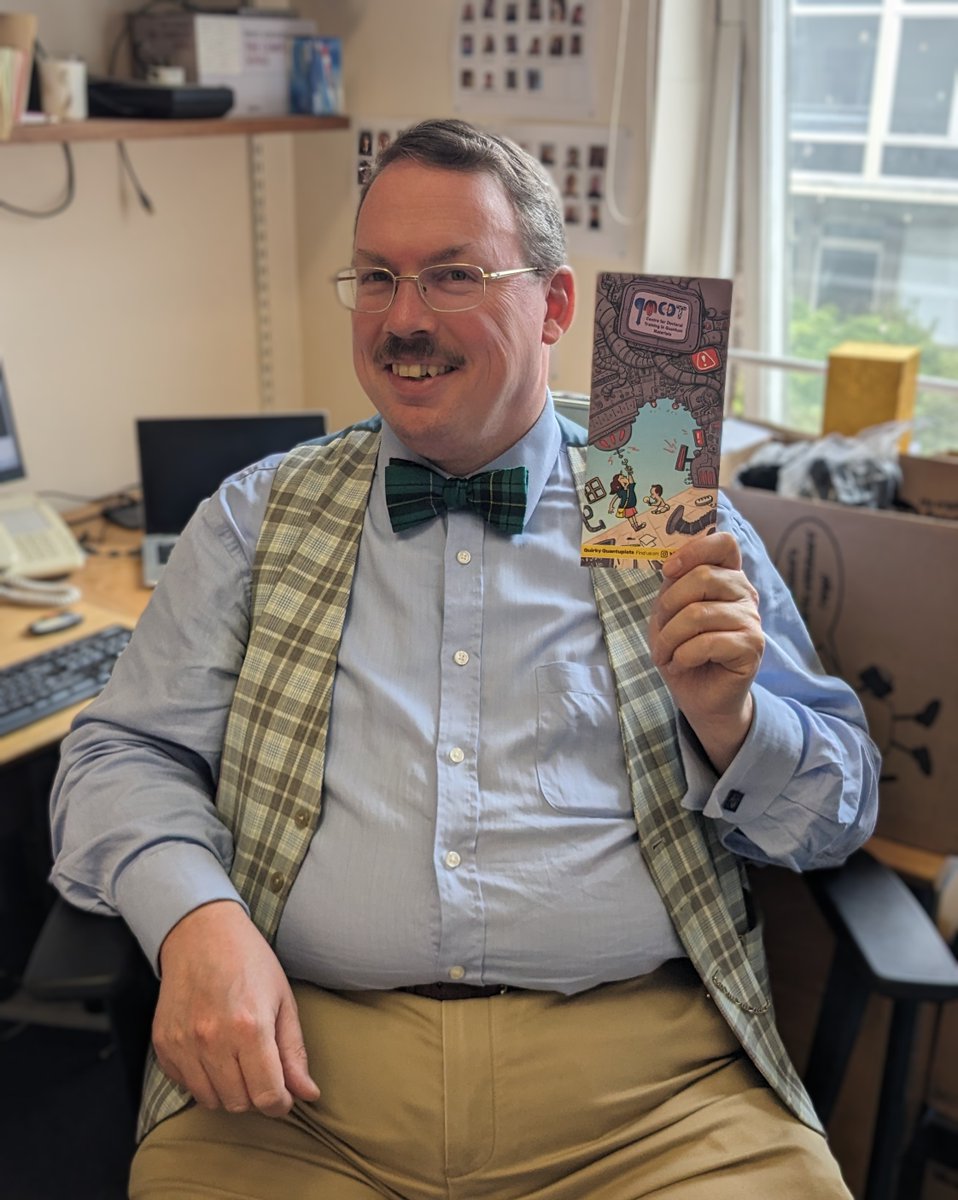
His expertise, company and poems will be dearly missed and everyone at QQ would like to thank Chris for all he has done and wish him good luck in his new ventures.
Chris has worked at St. Andrews for 18 years as a lecturer, supervisor, operations director for the CDT and has helped organise our public outreach efforts (including this account).
How do you make something new from something old? This is becoming an increasingly important question in modern quantum matter research where researchers seek to engineer materials with specific properties (1/)
In recent years, physicists have gone beyond two twisted sheets of graphene, studying more than 2 layers with various patterns of relative twists and the stacking of different mixes of materials. Each of these has their own interesting properties. (7/7)
This preprint argues that the background is really due to the lutetium itself, so it can't be ignored. In fact, they find that the resistance of LuH is higher than pure lutetium, so LuH actually seems to be a bad conductor! (4/4)
The thick plottens! You might recall the announcement in March that high-Tc superconductivity had been found in N-doped lutetium hydride (LuH), and the ensuing controversy. A further arxiv preprint has just been added to the melee. (1/4)
https://t.co/7WmLw2NYKy
They argued that this leftover non-zero resistance was due to some "background", e.g. the measurement apparatus or something adding its resistance to the mix. So, they subtracted the background off, and the remaining resistance dropped nicely to 0. (3/4)
Time for an ancient Greek paradox with a quantum twist!
Suppose our quirky mascot decides to do a spot of archery. We observe this practice, and decide to set up a camera to periodically take photos of the arrow as it travels from the bow to the target.
Although, on our scale, it is not possible to stop the motion of an arrow by simply watching it, there does exist a quantum version of the Zeno effect.
As it turns out, the dynamics of quantum systems can be slowed down or arrested by frequent "observations" or interactions.