@samir_sawarkar Yeah still bad imo. if it's locked to your server IP the browser calls just fail, so for it to work from the frontend the restriction has to be loose. and the usage limit only caps how much someone burns before your app stops working for everyone
@flaviusburca the one gap is when the memory matters right now, like the user just corrected something. for that I'd drop it in as a short message at the end of the convo, the model sees it this session and the prefix stays cached
@sukin_s yeah keying it on "no rule matched" makes way more sense, a confidence score can be confidently wrong. 66.7 to 81.2 just from feeding the misses back is a big jump
@Mohamed_abidii the timestamp one bites so many people. if the model actually needs the time, put it at the end of the last user message instead of the system prompt, the prefix stays byte-identical and the cache keeps hitting
@Mr_Baddie_lord The timeout part makes it worse than it looks. a client timeout often doesn't stop the request on the provider side, so the first call can still get billed and then the retry pays for the whole history again. a timeout above your normal p95 latency helps a lot
@dym6100 nice math. one catch for agents: the default cache on Anthropic lives about 5 min, so a turn that waits on a slow tool or a human comes back cold and pays full input again. worth tracking cached share per run, not just total tokens
@biniam_abebe The lease part is underrated. without it two agents grab the same task and you pay for the work twice, and nothing errors, the bill is just fatter. what happens to a lease when an agent dies mid task?
@MOHAKJAISWAL04 Token costs is the one people skip until the first weird bill. log model and tokens per call with a task id from day one, then you can see which step of the agent eats the money, not just the monthly total
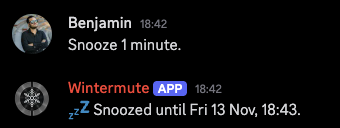
Agent threads I can't handle yet were cluttering my Discord list, so my agents built the snooze from @theo 's @t3dotcodes app 😎
/snooze hides the thread. It comes back:
later → 18:00
tomorrow → noon
after reset → when my Claude quota resets
Then the agent posts where things are.
I was tired of my agents posting cron errors and me asking "what happened?" every time.
Now a script checks their jobs every 15 min, no LLM. Only a real failure wakes the agent: it fixes it, or sends me one message.
36 jobs stopped spamming me.
New rule for all my agents, Claude Code and Codex included: challenge everything, my requests too.
If they think it's a bad idea, they say why in 2 lines and suggest something better. Only once though. If I still want it, they do it 🫡
My AI agents kept fixing the symptom and making the same mistake 2 days later.
Now when one messes up, I ask "Did you learn from this?"
That phrase makes it find the cause and change a skill, a rule or a script so it can't come back.
"I'll be more careful" doesn't count 😆
@AITransformLead the per-task number is the one to watch, but it's an average over their test mix. on short simple calls you mostly pay the per-token price, so the 2x can actually show up. worth replaying a day of your own traffic on both before switching
@LabubuNoBB batching works when approvals can wait. otherwise keep the cached prefix as short as you can, so the cold read after a long wait costs less
@Khalil_Preview checkpointing is the right call. one thing to add: save the tool results too, not just the step. if the resume has to rerun a read to rebuild context you pay those input tokens twice anyway
@theagenticdaily the 89% tracks. most teams redesign after the bill lands, not before. watching cost per completed task catches runaway loops way earlier than the monthly invoice does
@MRRydon the part that changes is who's watching. a chat bill tracks people at keyboards, a persistent agent spends at 3am with nobody looking. worth giving each agent its own key so when that 45% jumps you can tell which one did it
@jasonlk The P0 exception is the useful part. Two numbers tend to work better than one: a soft line that pings a human, and a hard line an agent can only cross with a logged reason. Then going over is a decision you can review later, not a cap that quietly stopped meaning anything