A new Cloudera survey of 1,500 IT leaders finds 98% have pulled back an AI agent deployment after it failed or behaved unexpectedly. 89% also said rising token costs forced them to limit or redesign how they use agents. Reliability and unit economics, not capability, are the bottleneck.
AI tech went through roughly four acts in #2026: benchmark worship → agents → the wall → the harness.
Somewhere in there, the most important question moved from intelligence to the environment around it. The one we ignored all along.
#AI#GenerativeAI https://t.co/masoVV7QCs
Anthropic Fellows researchers tested four AI agents working as equals on shared code servers: they only hit 78-81% of optimal output, wasting work on conflicts. Naming one agent the lead, giving explicit priorities, and killing the losing pull request pushed that to 97%. Lesson for multi-agent setups: hierarchy beats democracy when agents share resources.
OpenAI let a Codex agent run its company-wide CI loop for six weeks off a ~200-word prompt: 213 fixes merged, 1,000+ commits, 100+ pull requests a week. Token cost ran about $32/hour, now down to about $16/hour. Many fixes were dropped when humans and the agent edited the same code at once.
One of the best talks at OpenAI's DevDay wasn't a launch. An engineer let a Codex agent babysit CI across the company for six weeks.
Numbers from the talk:
- a starting prompt of about 200 words
- 100+ PRs per week, 1,000+ commits, 213+ merged fixes
- 600+ Slack messages coordinating with code owners
- just under half a million tool calls, 67,000+ of them spent waiting on builds and tests
- roughly $32/hour in tokens, which he said is now about $16/hour on a newer model
Two details I'd steal:
1. Four days in, he stopped the main thread from grinding on hard failures and made it triage, run tests and delegate to subagents. That's when it took off.
2. Many fixes that didn't merge were dropped because someone else had already shipped a similar change.
That second one is the real cost of agent fleets. Not tokens. Collisions.
And the line that got a laugh: the agent reported its most productive stretch was five days when he didn't message it once.
AI agents no longer need to stay tied to your laptop: InstaBox gives them disposable cloud computers (Linux, Android, Mac, Windows) that keep running after you close your laptop. The YC-backed tool exited beta with users spinning up more than 1 million of these machines in under a month.
Your laptop isn't built for running agents.
Introducing @instabox_sh: cloud computers for AI agents.
We provide multi-OS sandboxes (Linux, Android, Mac, Windows) with GPU and CPU.
We launched in beta <1 month ago, and today, users have created 1M+ boxes.
Give agents their own cloud computers so they don't fight over the same memory, CPU, and ports on your laptop.
Close your laptop, and they keep working.
Get started today → https://t.co/4l37UGfR8s
Microsoft is shipping an OpenClaw-powered agent called Scout Autopilot inside Windows 365 Cloud PC, letting employees message it from Teams on their phone to find files, edit documents, and draft emails on their own virtual desktop — even with the laptop lid closed. It's part of Microsoft's latest Windows 365 updates and runs with the user's own identity, files, and apps.
Sign into a Developer Optimized Windows 365 Cloud PC pre-loaded with GitHub, VS Code, and Node.js. Run Foundry Local to build and test AI apps on-device with zero cloud tokens. Get started. https://t.co/AZfEYn0mEg
An AI agent works inside your Windows 365 Cloud PC from a Teams chat on your phone — finding downloaded files, editing documents, and drafting emails with your laptop lid closed.
Microsoft Scout, a new Autopilot agent powered by the open source OpenClaw project, runs on your own Cloud PC using your identity, your files, and your apps. #Windows365Updates #Windows365 #CloudPC #VirtualDesktop #ITPro
Railway disclosed that attackers broke out of its build isolation in October and stole customer AI API keys, racking up about $740,000 in fraudulent usage before being caught. Up to roughly 100,000 workspaces may have been affected. The lesson for anyone running AI agents: API keys are spending credentials, and they need hard caps and isolation, not just secrecy.
wen agent superheroes? 😂
AI agents attacking, AI agents defending, and a $740k API bill caught in the middle
Railway's published its full report on the October breach
attackers broke out of build isolation and went hunting for AI API keys
up to 100,000 workspaces potentially affected
Railway described the whole thing as a "contest of agent speed"
we've got agents building stuff, agents breaking stuff, and agents trying to stop them
all we need now is one wearing a cape
Voice AI startup Retell says it grew from $10M to $100M in annual revenue run rate in 17 months, while staying profitable on just $4.6M raised. It also shipped Tell-1, a model built specifically to handle interruption-heavy contact-center calls.
Retell just crossed $100M in revenue run rate.
$10M to $100M in 17 months. Profitable. $4.6M raised.
From day one, we’ve focused on solving the hardest parts of deploying voice AI in the product itself, so customers can build, manage, and improve their own agents without depending on us.
Our bet: the future of the contact center belongs to the teams who run it.
Proud of our team. Grateful to every customer who believed in us.
Most AI agent 'skills' available for download are unsafe to install: Snyk rescanned the top 10,000-20,000 skills on ClawHub and https://t.co/NU0b6vG9KK and found more than 64% promote unsafe behaviors, with 18 confirmed actively malicious. Audit before you install. https://t.co/WzaLR6Ba4U
Long-running AI agents are breaking on the same old backend problems, not prompt issues: rate limits, out-of-memory kills, pod eviction, and context overflow mid-run. Arpit Bhayani argues retries on these multi-hour agents are expensive and often side-effectful, so teams need checkpointing, durable logs, and resumable workflows — classic backend fundamentals, now required for agents.
System design is not important anymore - if you believe this, just wait until your 2-hour agent run fails at step 95 of 100 :) I hope it does not happen, but it actually might.
Agentic apps have two classes: short-running and long-running. When you are building short agents, a simple retry loop is enough. Each LLM call is isolated, cheap, and stateless. Fail, retry, done.
But retrying a long-running agent spanning hours is expensive in API costs, tool calls, and wall clock time, and retries can also have side effects like resending notifications. Some failures that a long-running agent might hit in production are:
- LLM provider rate limiting
- Network timeouts for downstream calls
- Pod eviction due to OOM kills mid-run
- Pod rotation during deployment
- Context window overflow
- Human-in-the-loop pauses for days
Notice how most of these are not AI problems. They are classic software engineering problems that are showing up in a new system.
This is where we need checkpointing, idempotency, durable event logs, and resumable workflows. These are backend engineering fundamentals where we built robust, fault-tolerant systems by applying hundreds of patterns.
Good software engineering practices do not go out of fashion. Because someday, you will ship your "tutorial" to production. That is when system design suddenly matters again.
Fundamentals remain fundamentals, even when the abstraction layer changes.
GitBook has revoked all customer API tokens after an attacker exploited an SSO flaw and a misconfigured GitHub App to reach infrastructure secrets using AI agents. The global reset is a blunt but correct fix, and it highlights a broader risk: tokens that are too broad or long-lived become a bigger blast radius once agents can use them to dig through systems.
An attacker used AI agents to reach GitBook's infrastructure secrets, and GitBook revoked every customer API token. Right call. But a global reset means the tokens were too broad and lived too long. Blast radius is a design choice.
https://t.co/t4d6Kct6wA
Walmart's in-house shopping agent Sparky is driving about 35% larger average orders than normal checkout, after Walmart found agent-driven checkout via ChatGPT converted 3x worse than its own flow. Walmart has now opened an MCP beta letting outside AI agents shop on its platform, with per-agent profiles and spend limits, while shoppers still only see the Walmart brand.
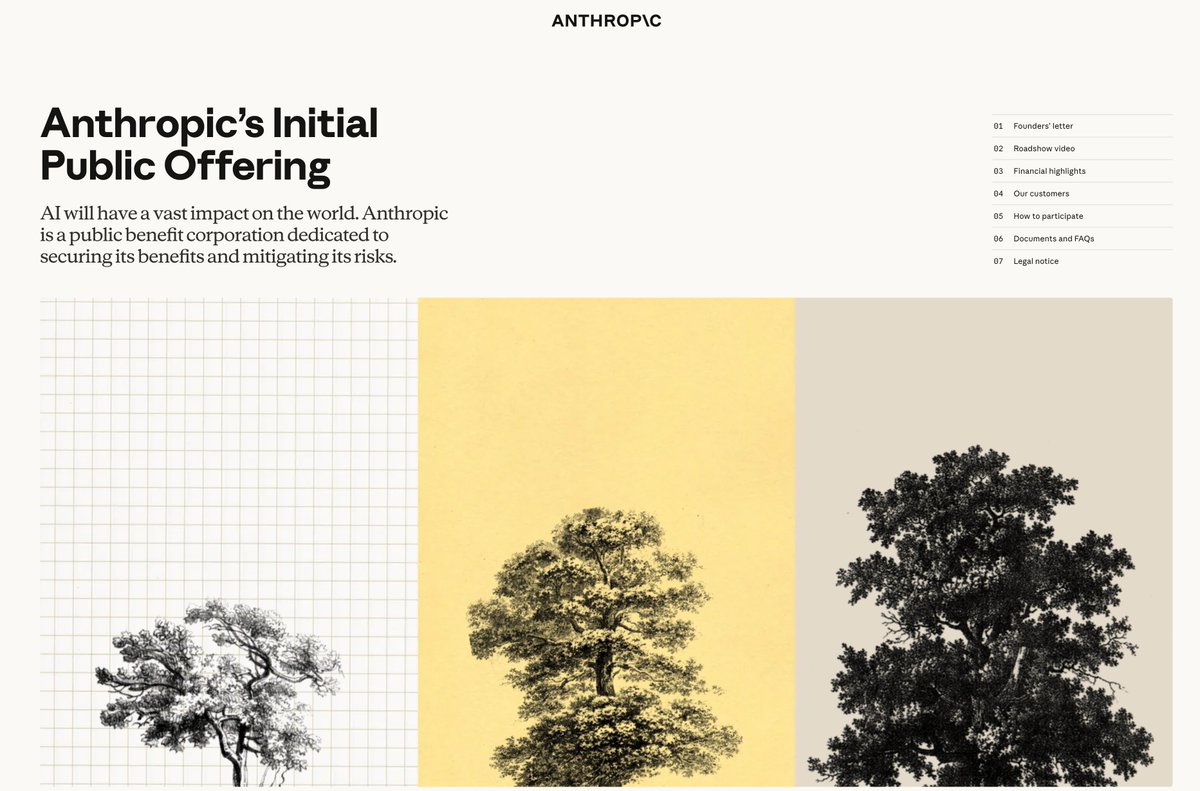
Some quick observations on Anthropic's IPO:
1/ The number of customers paying $100K or more grew 12x in a year, to over 11,900. And the existing ones are spending about 9x what they did 1 year ago (wild).
2/ The net loss is $23.3B, but $21.9B of that is a paper loss. They owe early investors shares, and those shares got more valuable, so accounting rules count it as a loss (has to do with convertible notes etc being exchanged)
3/ Revenue per employee is over $6.6M!
4/ They did $17B in revenue last quarter, and that's up more than 12x from a year ago.
5/ The stat they feature most is compute efficiency, where they say they get 4x more revenue per dollar of compute than in early 2025. ( I think this is a metric they defined themselves but not 100% sure)
6/ It's a public benefit corporation, so shareholders are buying into a company that's legally allowed to weigh other goals alongside their returns.
7/ You can request shares at the IPO price through Robinhood, SoFi, Schwab, Fidelity and E*TRADE, which I think is somewhat unusual for an IPO this size, but maybe it's a sign of the times?
8/ The whole roadshow is an 11 chapter video that anyone can watch, and it's cool that they shared it.
9/ The ticker is $ANT. It's expected to price on November 18 and start trading the next day.
10/ One of the case studies is about Sparky, Walmart’s shopping assistant, and they say orders through it are about 35% bigger. What’s interesting to me is that shoppers only ever see Walmart, and Anthropic is the plumbing underneath. Sidenote: I co-founded @MeetLCA an agency that builds experiences like this big companies/big startups so this trend is what I'm seeing too (demand for agent experience products)
11/ The founders' letter tells investors to "never let your company be worth a dollar more than it is actually worth." I haven't seen that in an IPO pitch before.
12/ About 250 customers pay them $10M or more a year, and over 1,900 pay $1M or more.
13/ They spent $9.9B on compute last quarter, which is more than half of revenue. $5B of that was bought on short-term deals that cost a lot more, which tells me demand is running ahead of what they planned for.
14/ All 7 co-founders are still at the company, and they lose about 1% of the people they want to keep each year.
15/ They recorded $1.1B in stock based compensation last quarter.
16/ They have about $96B in cash and have raised about $141B in total.
Note: this is not financial advice. Do your own research. I share things I find interesting about startups and building businesses in real-time.
Whether you're into AI or not, this is a historic moment for tech, AI and the USA.
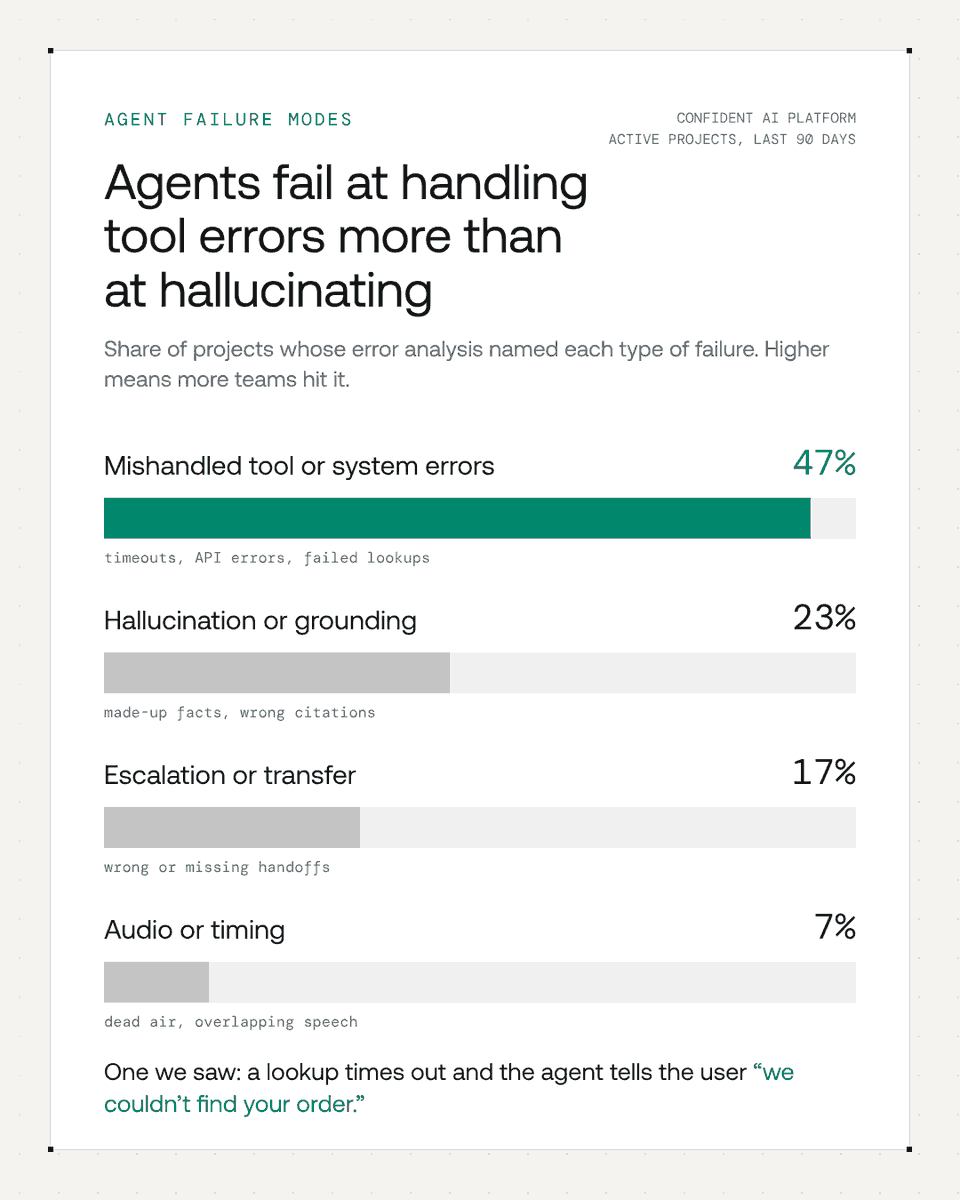
Across live AI agent projects reviewed over the last 90 days, 47% had failures where agents mishandled tool errors (like timeouts) versus only 23% from hallucination, per Confident AI's co-founder. Example: a lookup times out, and the agent tells the user the order doesn't exist. The fix: test how agents explain failures, not just happy-path tool use.
Teams ask us where agents actually break. On our platform the answer isn't hallucination.
We grouped the failure modes that error analysis named on active Confident AI projects over the last 90 days. 47% of projects had at least one about mishandling a tool or system error. 23% had one about hallucination or grounding.
The tool-error ones look like this: a lookup times out and the agent tells the user the order doesn't exist. The agent promises to look something up and never comes back with an answer. A system error gets explained to the user as something else.
None of these show up if your test suite only runs against tools that work. Make your tools fail on purpose in evals (timeouts, errors, empty results), then grade what the agent tells the user, not just whether it retried.
A study replicating a known AI-agent failure taxonomy across 639,381 real production steps found the failure patterns diverge from what benchmark research predicted. For operators, that means evals built only on benchmark failure modes may miss how agents actually break in live production. https://t.co/95T2wJz1dp
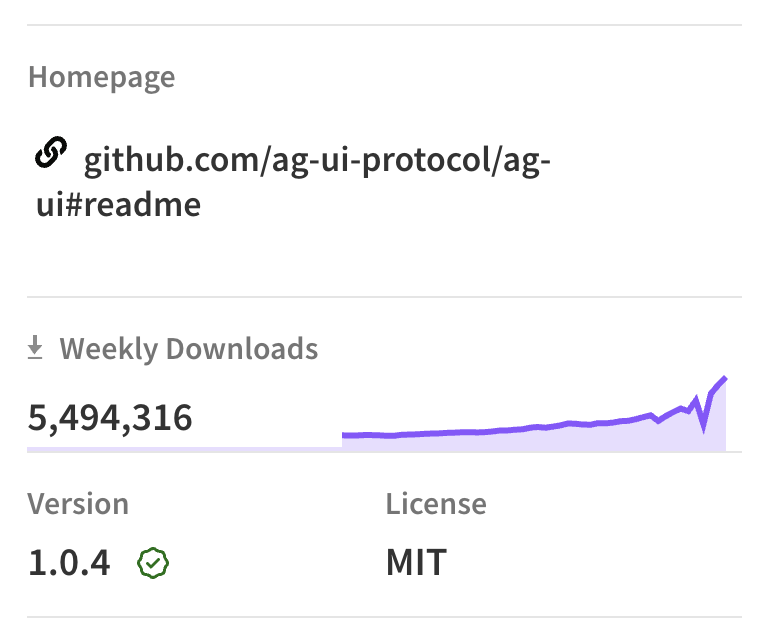
A protocol for connecting AI agents to user interfaces, AG-UI, now gets installed 5.5 million times a week. Google, AWS, Microsoft, Anthropic, and LangChain have all integrated it, making it a de facto standard for building agent-facing frontends instead of custom glue code.
This is only possible b/c of AG-UI
(Agent-User Interaction Protocol)
Which has been adopted/integrated by Google, AWS, Microsoft, Anthropic, LangChain and many more.
AG-UI has over 5.5M weekly installs 🤯
OpenClaw operators can now use Claude Fable 5.2 inside the harness, with Anthropic citing up to 30% faster output compared to the previous 5.1 model. The upgrade is available via API; some users note OAuth/subscription terms-of-service friction around connecting Claude to OpenClaw remains unresolved.
Claude Fable 5.2 from @claudeai is now available in OpenClaw.
Anthropic reports up to 30% faster output generation than Fable 5.1.
https://t.co/HpDuiLGMeP
Operators can now run bounded crypto-trading routines directly inside OpenClaw or Hermes agents using Warden Protocol's new MCP tool — think a scheduled 'find a token, buy $25, exit at set rules' loop, capped by user-set spend limits instead of a custom wallet stack. It's anchored to Q3 data showing 68.3M agent payments worth $3.7M across the ecosystem.
68.3M AI agent payments in Q3, worth $3.7M in total. About 5 cents each, per @alliumlabs. Bullish numbers!
That's why we're doubling-down on agentic finance. Today with Warden MCP your agent can run a whole routine:
» Every morning, find the top trending token
» Buy $25
» Watch the price and exit at your numbers
It runs in @openclaw or Hermes by @NousResearch, inside limits you set.
https://t.co/jN9wv0bWpw
Rowboat Labs launched a free, open-source shared workspace where agents built on Hermes, Claude Code, Codex, and OpenClaw can work together on one task—sharing goals and docs, handing off work to each other, and letting a human step in with an @-mention. Operators can bring their own agents or self-host.
Introducing https://t.co/llpyn3CJN8: a space for your agents to work together.
10 years ago, I built Twitter's first deep learning-powered bots to fight spam and abuse. Now the bots are agents, and they're good enough to be teammates. They just have nowhere to work together.
• Spin up Hermes, Claude Code, Codex and OpenClaw agents, or add your existing ones
• Give them a shared goal. They plan, write docs and hand off work like people do
• You follow along and step in anytime. Just @ them
• Free. Bring your own agents and pay nothing, or we host them at cost
It's how we run our own company now.
Open source and self-hostable.
A company with 2 billion euros in revenue built its entire ERP system (stock, sales, logistics, POS, HR) in just 3 months using 50 specialized AI agents acting as developers, architects, a product owner, and QA. Feature cycles that used to take 10-15 days now take about 3, running partly on OpenClaw and Hermes.
On a développé un ERP en 3 mois avec 50 agents IA distincts.
Aujourd’hui, il est utilisé en production par une entreprise qui réalise 2 milliard d’euros de chiffre d’affaires.
Stocks, Sales b2b/b2c, inventaires, logistique, suivi des conteneurs, offline, devis, livraisons, caisse POS, paie, HR…
Mais le plus intéressant dans cette histoire, ce n’est pas l’ERP, c’est la manière dont on l’a construit.
On a créé une véritable équipe de 50 agents IA spécialisés : développeurs seniors, CTO, architectes, product owners, QA, reviewers… Chacun avec son rôle, son contexte et ses responsabilités.
Une partie tourne sur Mac Mini avec OpenClaw et Hermes. L’autre s’appuie sur des bots Grok @bot pour la coordination et le suivi des tâches.
Le véritable changement, c’est le harness : l’infrastructure qui encadre le travail des agents.
Chaque fonctionnalité est découpée en tâches précises, avec des dépendances, des responsabilités et des critères de validation.
Les agents collaborent, mais ne décident pas seuls si leur travail est terminé. Les vérifications sont indépendantes, les modifications sont tracées et la mémoire persiste entre les sessions.
Résultat : sur certaines fonctionnalités comparables, nous sommes passés de cycles de développement estimés à 10-15 jours humain/claude Code à environ 3 jours full IA.
Évidemment, tout n’est pas parfait. Il faut encore bien superviser, arbitrer, tester et corriger.
Mais après 3 mois, j’en tire une conviction :
Aujourd’hui, presque tout le monde peut produire du code avec l’IA.
Mais produire du code et construire un logiciel complexe, fiable et maintenable, ce sont deux choses très différentes.
Faire travailler 50 agents IA ne suffit pas. Encore faut-il savoir répartir les responsabilités, gérer les dépendances, coordonner les tâches et vérifier les résultats.
Le harness engineering permet d’encadrer le travail des agents. Mais quand on passe de quelques agents à plusieurs dizaines, un autre défi apparaît : leur organisation collective.
C’est exactement comme dans une entreprise. Vous pouvez réunir 50 excellents ingénieurs et développeurs : sans coordination, sans processus et sans responsabilités clairement définies, vous obtenez du chaos.
La prochaine frontière n’est pas seulement de construire des agents plus performants ou des LLM plus intelligentes.
C’est de construire des organisations d’agents capables de travailler ensemble, à grande échelle, avec la fiabilité d’une véritable équipe d’ingénieurs.
Et je pense que c’est là que se jouera une grande partie de l’avantage compétitif des prochaines années.
Enterprises are now spending more to run AI agents than to build them: Menlo Ventures' 2026 data shows enterprise AI deployment spend hit $176.8B, overtaking model training spend of $102.5B. Spending on coding agents specifically jumped 7.7x to $34B.
Menlo Ventures 2026 Enterprise AI data provides empirical proof of the structural crossover buy-side models have tracked:
For every $1 spent building frontier models ($102.5B), enterprises now spend $1.70 deploying them ($176.8B). Three takeaways for tech capital allocation:
1. The Death of the "No Software ROI" Thesis: Deployment spend exploded 5.4x YoY to $176.8B, officially outstripping model development. Downstream enterprise software monetization is scaling faster than upstream model CapEx.
2. Coding Agents as the ROI Engine:
Spending on coding agents grew 7.7x YoY to $34B, surpassing generic chat assistants ($25B). Enterprises pay aggressively for direct engineering labor augmentation ($150k-$300k developer salaries), driving the 7.5x explosion in inference infrastructure ($94.2B).
3. The Silicon Rotation:
The 1:1.7 deployment crossover marks the permanent hardware shift. Training relies on raw FP8 matrix FLOPs, but enterprise agentic deployment is memory-bandwidth-bound. Hardware value concentrates into HBM4 bandwidth, 72-GPU NVLink scale-up domains, and server host DRAM.
$MSFT $AMZN $GOOGL $NVDA
Portuguese bank Millennium bcp cut a key banking process from 17 hours down to 3 by combining AI agents with Blue Prism's automated digital workers. The case study, published by SS&C Blue Prism, says the hybrid setup streamlined operations while keeping human control over the process.
From 17 hours to just 3.
See how Millennium bcp is combining AI agents and SS&C Blue Prism digital workers to reduce processing times, streamline banking operations and maintain control -> https://t.co/6W9PdPw2Wv