@iFixit I am old enough to have experienced when replaceable, albeit proprietary Li-Ion batteries were the norm in most electronic devices. There is zero technical excuse.
Also experienced when [alkaline] batteries were not only replaceable, but had a non-proprietary, worldwide standard.
In other words, China has been able to deflate a real estate bubble without causing any notable negative impact to its economy or provoking a recession.
Maybe western economic elites should take a look at this...
The annual "Europeans are poor because they have no AC" debate has started on X again. But, as the map below shows, every place where the climate would justify installing air conditioning, already has it.
I tried to map AC penetration in Europe by region/province where possible, with the latest available data.
One can obviously notice that there is a correlation between proximity to Mediterranean/ distance from Atlantic/North Sea
A quick late night map so data quality varies...
Yet another reminder that you are not buying media online, you are merely renting it.
If you don't have a physical copy on DVD / BD, or alternatively a video file downloaded to your computer, you don't own it.
Sony is making what is, perhaps, the best case I have ever seen for pirating movies.
Did you purchase “Terminator 2”, “Evil Dead”, or “Hot Fuzz” on your PlayStation? Tough luck. You can’t watch those anymore.
“You will own nothing, and you’ll be happy.”
https://t.co/pB5N63AmMW
@EricNjiiru Yes, it would be absolutely normal, because FIFA dictating terms, to host countries, including visa free entry etc, has been common practice in past World Cups.
Why should he make an exception for the US now, or for the UK in 2035?
@AlanDaitch Luego - sí - estamos entrando en una era inédita, al estar la manipulación al alcance de cualquiera, como bien dices en tus últimos párrafos.
Same reason why you cannot post a negative review of a restaurant in Germany on Google by the way - a lèse majesté law with a very low threshold for what is defined as "insult", zero tolerance for humor, satire or criticism, and no room for free speech.
A German teenager faced criminal proceedings under Section 188 of the German Criminal Code for insulting Chancellor Olaf Scholz.
In November 2024, he tweeted his frustration over slow Fortnite update speeds of 37.9 GB downloading at just 123 kB/s. The post received only 503 views.
The case opened in 2025 but was dropped without charges after the teen deleted the tweet.
He later shared the official letter of accusation online in 2026.
This incident expose Germany’s laws granting special legal protection to politicians from insults, with a record 4,792 such investigations in 2025
La campaña de acoso y linchamiento contra Jon González @jongonzlz por publicar datos económicos incómodos, promovida desde el mismo Gobierno, es una de las razones por las que el anonimato en Internet es tan clave para garantizar la libertad de expresión.
Ellos mienten. Los datos no.
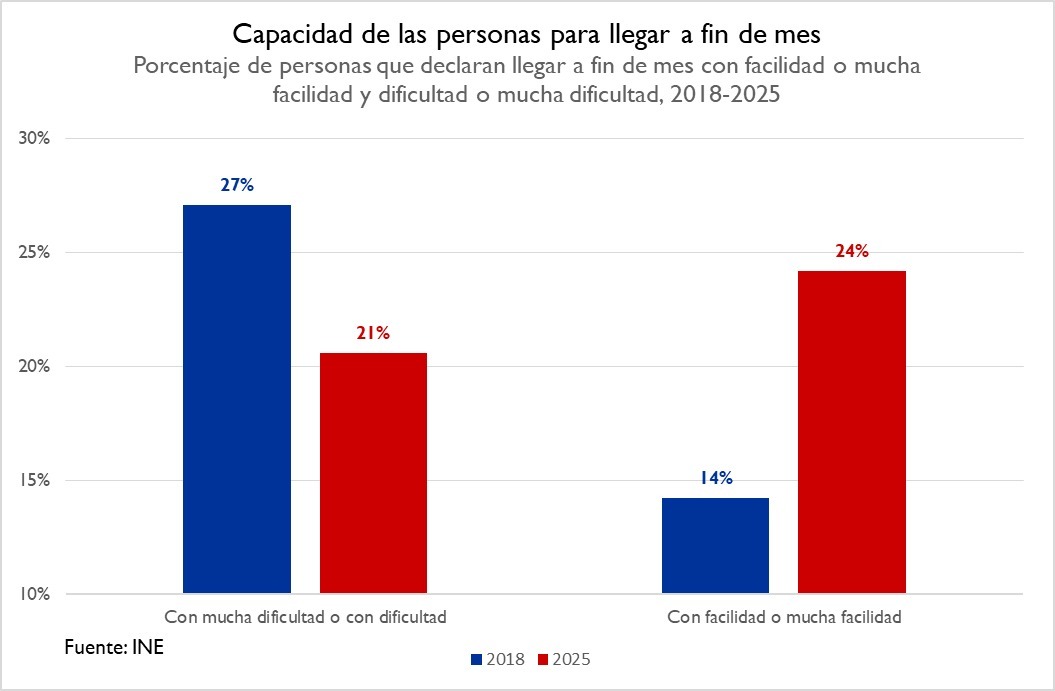
Queda trabajo por hacer. Pero, si algo está claro, es que la economía de los hogares es hoy mejor que en 2018.
Vamos por el buen camino. Debemos seguir.
El 18 de mayo Bizum activa el pago contactless en tiendas físicas.
Acercas el móvil al datafono, NFC, sin PIN. El dinero no viaja por la red de Visa o Mastercard. Va directo de tu cuenta a la del comercio vía transferencia instantánea.
→ 30,6 millones de usuarios en España
→ 111.000 comercios ya integrados
→ 39 entidades bancarias detrás
→ 105 millones de pagos en eCommerce el último año
→ 3,4 millones de transferencias instantáneas al día en 2025
Arranca con CaixaBank, Sabadell y Bankinter. El resto se irá sumando durante el año.
Cada vez que pagas con Visa o Mastercard, hay una empresa estadounidense decidiendo las reglas del juego, fijándolas comisiones (entre el 0,2% y el 2% por transacción) y guardando los datos de tu comportamiento. Bizum cambia esa ecuación: rails domésticos, comisiones más bajas para el comercio, liquidez inmediata, datos en banca española.
1. ¿Hasta dónde puede llegar la cuota de Bizum frente a tarjetas en 2-3 años si la adopción del eCommerce (donde ya reduce abandono de carrito) sirve de referencia?
2. ¿Qué hacen Visa y Mastercard cuando un sistema doméstico les empieza a comer cuota en su mercado más rentable, el contactless de proximidad?
3. ¿Por qué ningún otro país europeo grande tiene un equivalente real? ¿O está España a punto de exportar el modelo, como Italia hizo con Satispay?
4. Si Bizum entra fuerte en físico y unifica experiencia con online, ¿sigue teniendo sentido pagar comisiones a Stripe, Adyen o PayPal por la mayoría de tus pedidos españoles?
From the people who brought you operating system-level ID verification, we now have: a lifelong smoking ban.
The UK is getting more and more Orwellian by the day
The state "knows best" what is good for your health.
If you support this ban because it doesn't affect you (you don't smoke), or if you claim, "Smoking is bad, so it must be banned across the board," then you are completely missing the essence of individual freedom.
In that case, logically, you must also approve a ban on desserts, sugary drinks, and mandatory exercise for all citizens, because these are things that, like cigarettes, shorten people's lives, and the resulting cardiovascular diseases and diabetes kill hundreds of millions of people every year.
I have never smoked, but I consider society's view of smoking to be a litmus test of individual freedom.
And personally, as a non-smoker, I would rather live in the free Balkans, where everyone smokes, than in the UK, where people will be criminalized for smoking.
In the UK, a smoking ban has been approved for people born after 2008
https://t.co/OK9c0V8oCW
Tech oligopolies have become outspoken policymakers, there is no need for lobbying behind the scenes anymore. Their oligarchs constitute an informal third chamber, parallel to the US Congress and Senate, and will eventually (if not already) rival them in power.
Because we get asked a lot.
The Technological Republic, in brief.
1. Silicon Valley owes a moral debt to the country that made its rise possible. The engineering elite of Silicon Valley has an affirmative obligation to participate in the defense of the nation.
2. We must rebel against the tyranny of the apps. Is the iPhone our greatest creative if not crowning achievement as a civilization? The object has changed our lives, but it may also now be limiting and constraining our sense of the possible.
3. Free email is not enough. The decadence of a culture or civilization, and indeed its ruling class, will be forgiven only if that culture is capable of delivering economic growth and security for the public.
4. The limits of soft power, of soaring rhetoric alone, have been exposed. The ability of free and democratic societies to prevail requires something more than moral appeal. It requires hard power, and hard power in this century will be built on software.
5. The question is not whether A.I. weapons will be built; it is who will build them and for what purpose. Our adversaries will not pause to indulge in theatrical debates about the merits of developing technologies with critical military and national security applications. They will proceed.
6. National service should be a universal duty. We should, as a society, seriously consider moving away from an all-volunteer force and only fight the next war if everyone shares in the risk and the cost.
7. If a U.S. Marine asks for a better rifle, we should build it; and the same goes for software. We should as a country be capable of continuing a debate about the appropriateness of military action abroad while remaining unflinching in our commitment to those we have asked to step into harm’s way.
8. Public servants need not be our priests. Any business that compensated its employees in the way that the federal government compensates public servants would struggle to survive.
9. We should show far more grace towards those who have subjected themselves to public life. The eradication of any space for forgiveness—a jettisoning of any tolerance for the complexities and contradictions of the human psyche—may leave us with a cast of characters at the helm we will grow to regret.
10. The psychologization of modern politics is leading us astray. Those who look to the political arena to nourish their soul and sense of self, who rely too heavily on their internal life finding expression in people they may never meet, will be left disappointed.
11. Our society has grown too eager to hasten, and is often gleeful at, the demise of its enemies. The vanquishing of an opponent is a moment to pause, not rejoice.
12. The atomic age is ending. One age of deterrence, the atomic age, is ending, and a new era of deterrence built on A.I. is set to begin.
13. No other country in the history of the world has advanced progressive values more than this one. The United States is far from perfect. But it is easy to forget how much more opportunity exists in this country for those who are not hereditary elites than in any other nation on the planet.
14. American power has made possible an extraordinarily long peace. Too many have forgotten or perhaps take for granted that nearly a century of some version of peace has prevailed in the world without a great power military conflict. At least three generations — billions of people and their children and now grandchildren — have never known a world war.
15. The postwar neutering of Germany and Japan must be undone. The defanging of Germany was an overcorrection for which Europe is now paying a heavy price. A similar and highly theatrical commitment to Japanese pacifism will, if maintained, also threaten to shift the balance of power in Asia.
16. We should applaud those who attempt to build where the market has failed to act. The culture almost snickers at Musk’s interest in grand narrative, as if billionaires ought to simply stay in their lane of enriching themselves . . . . Any curiosity or genuine interest in the value of what he has created is essentially dismissed, or perhaps lurks from beneath a thinly veiled scorn.
17. Silicon Valley must play a role in addressing violent crime. Many politicians across the United States have essentially shrugged when it comes to violent crime, abandoning any serious efforts to address the problem or take on any risk with their constituencies or donors in coming up with solutions and experiments in what should be a desperate bid to save lives.
18. The ruthless exposure of the private lives of public figures drives far too much talent away from government service. The public arena—and the shallow and petty assaults against those who dare to do something other than enrich themselves—has become so unforgiving that the republic is left with a significant roster of ineffectual, empty vessels whose ambition one would forgive if there were any genuine belief structure lurking within.
19. The caution in public life that we unwittingly encourage is corrosive. Those who say nothing wrong often say nothing much at all.
20. The pervasive intolerance of religious belief in certain circles must be resisted. The elite’s intolerance of religious belief is perhaps one of the most telling signs that its political project constitutes a less open intellectual movement than many within it would claim.
21. Some cultures have produced vital advances; others remain dysfunctional and regressive. All cultures are now equal. Criticism and value judgments are forbidden. Yet this new dogma glosses over the fact that certain cultures and indeed subcultures . . . have produced wonders. Others have proven middling, and worse, regressive and harmful.
22. We must resist the shallow temptation of a vacant and hollow pluralism. We, in America and more broadly the West, have for the past half century resisted defining national cultures in the name of inclusivity. But inclusion into what?
Excerpts from the #1 New York Times Bestseller The Technological Republic: Hard Power, Soft Belief, and the Future of the West, by Alexander C. Karp & Nicholas W. Zamiska
https://t.co/8igjazz1On
If Ukraine was to persist as a state within its 1991 SSR borders, it should have adopted a Belgian / Canadian model: one formal state, two distinct communities living with their backs to each other. Trying to impose one over the other eventually leads to partition of the country.
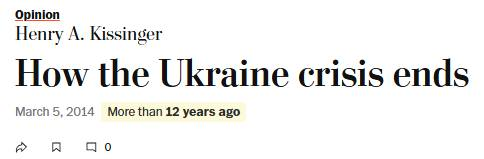
In March 2014, Henry Kissinger warned against Ukraine becoming a pawn in a competition between NATO and Russia, as this would tear apart Ukraine and redivide Europe for decades:
- "Far too often the Ukrainian issue is posed as a showdown: whether Ukraine joins the East or the West. But if Ukraine is to survive and thrive, it must not be either side’s outpost against the other—it should function as a bridge between them… The west is largely Catholic; the east largely Russian Orthodox. The west speaks Ukrainian; the east speaks mostly Russian. Any attempt by one wing of Ukraine to dominate the other—as has been the pattern—would lead eventually to civil war or break up. To treat Ukraine as part of an East-West confrontation would scuttle for decades any prospect to bring Russia and the West—especially Russia and Europe—into a cooperative international system"
https://t.co/JezArAOgCK
@exQUIZitely@FrankRundatz Interesting article but unrelated to the downfall. IE vs Netscape was never about which was the better software, it was just a classic case of a company (in this case Microsoft) abusing its market dominance and using its financial muscle to impose its own product on the market.
If I have to pay $7.99 to rent a 30 year-old movie off Amazon when I have a Prime subscription, then we should just reopen Blockbuster. I’d rather have their employees judge my life choices.
While it was an incredibly long support life for what we're used to from the tech oligopolies, it is also a reminder that you do NOT own digitally consumed content, you are merely renting it.
Physical books can still be read centuries later, digital is dead after 15 years.
In an email to customers, Amazon announced that it would be ending service for Kindle devices older than the 2012 edition. Those devices will lose access to the Kindle Store. https://t.co/9XuUik6say
Lebanon is part of the theater of the #IranWar. Therefore, it is included in a ceasefire by default, without the need for an explicit mention.
What would need an explicit mention is the opposite: if certain parts of the theater of war, in this case Lebanon, were to be excluded.
JD Vance:
I think the Iranians thought that the ceasefire included Lebanon, and it just didn't.
We never made that promise. We never indicated that was gonna be the case.
What we said is that the ceasefire would be focused on Iran, and the ceasefire would be focused on America's allies, both Israel and the Gulf Arab states.
@theepicmap Iran hasn't closed Hormuz, the insurance premiums following the US/Israel attacks have de facto shut it down. Similarly, a war between Spain and Morocco could shut down the Strait of Gibraltar due to insurance premiums.
@iAnonymous3000 I don't think you understand, this is not about which one is the better browser engine, but about the Chromium browser engine monopoly, controlled by one company, Google, that is de facto setting the standards of the internet.
Sánchez is the main (only?) EU leader doing sth for European strategic autonomy instead of desperately trying to please Trump like all others. (His domestic policy of systematically eroding independent institutions, however, is extremely harmful for Spanish democracy) #JustSayNo