@breenemachine@Kpler Hormuz crossings are monitored by the @kpler analyst team, who confirm transits using satellite imagery, AIS data, and "boots on the ground" intelligence. Our Risk & Compliance team also issues a daily report covering the sanction status and risk profile of crossing vessels.
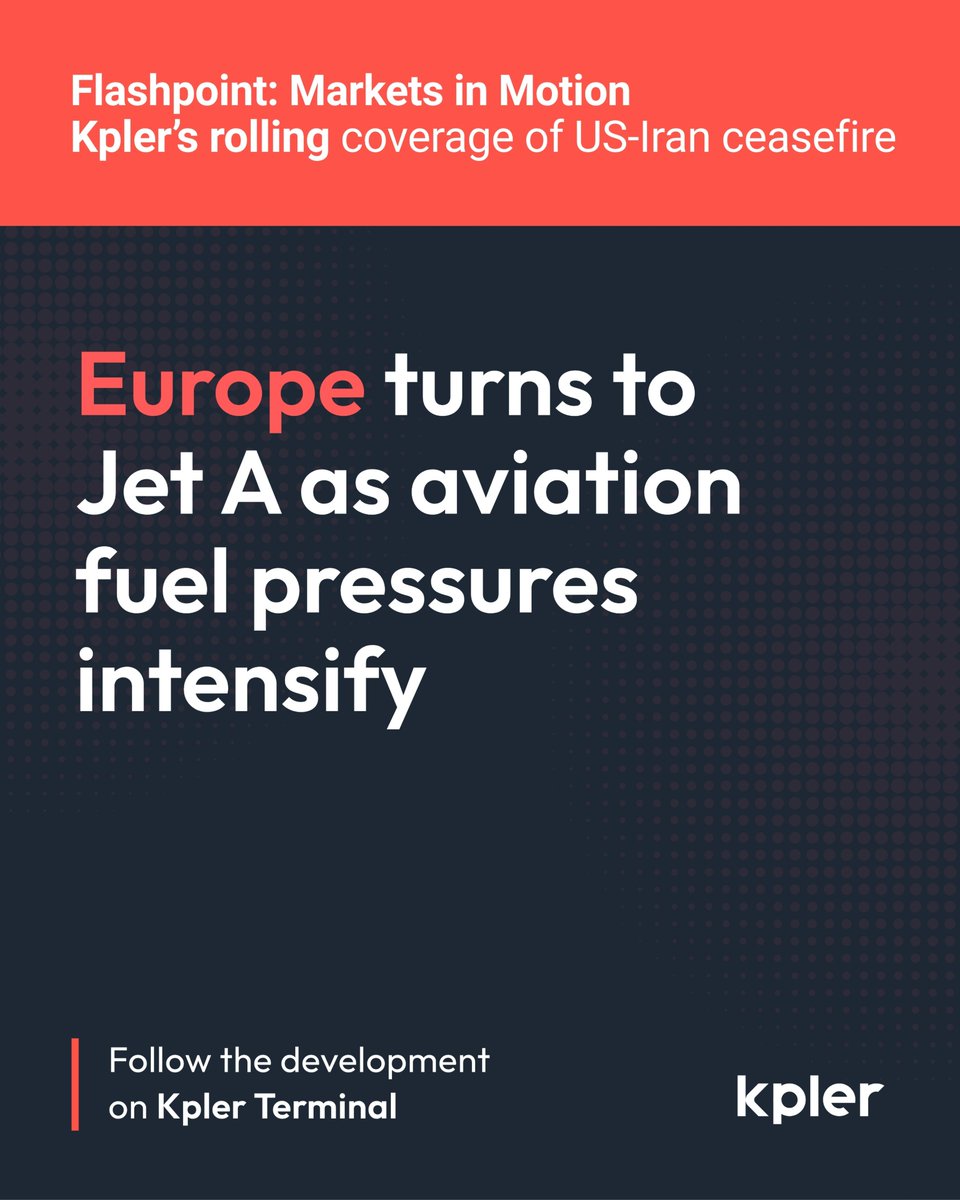
Jet A loophole tested
Europe’s decision to permit Jet A into the Jet A-1 supply pool reflects the severity of current aviation #fuel stress rather than a structural market shift. With falling inventories and US to Europe jet flows at record levels, regulators have prioritised supply flexibility ahead of the summer travel season. However, downstream infrastructure, contamination risks, chain of custody requirements and Jet A’s higher freezing point create operational limits, particularly for long haul and polar routes. If disruption to Middle East supply flows extends into winter, the current framework is unlikely to be sufficient.
Stay ahead of the market with #Kpler Insight: https://t.co/oqtzNn6cL3
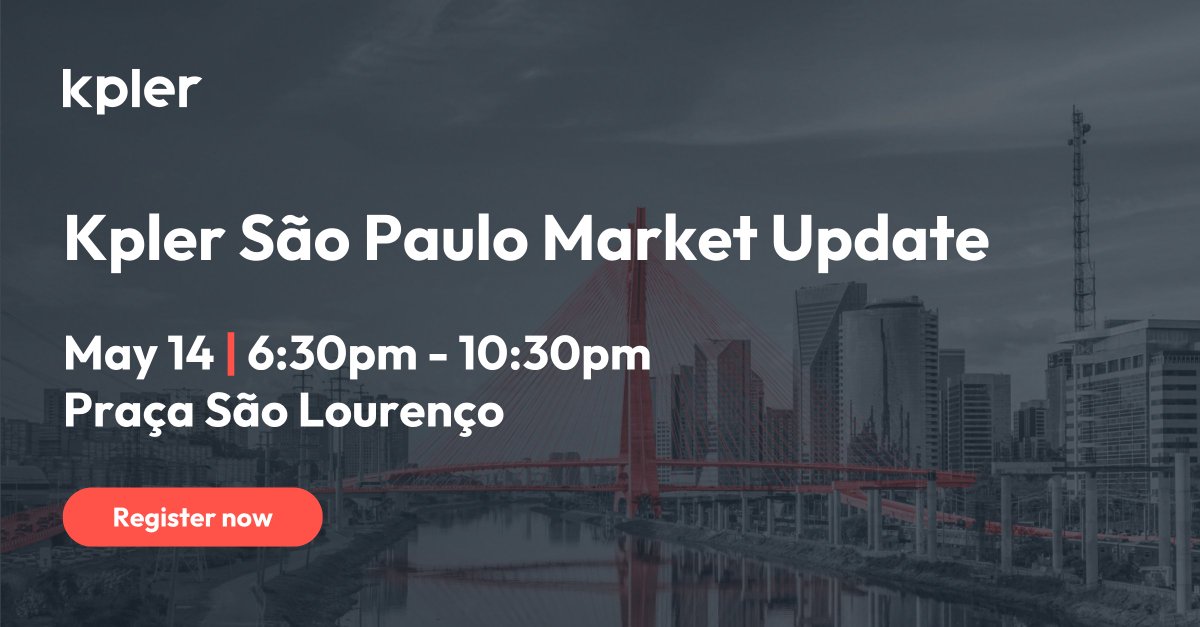
🇧🇷 We're coming to São Paulo
Join Kpler on May 14 for the Kpler São Paulo Market Update, where our experts will explore how Middle East disruptions are impacting Latin American energy markets, from Brazil's #oil boom and Venezuela's market recovery to the sanctions effects reshaping global commodity flows.
Walk away with sharper market intelligence, stronger connections, and a clearer view of Brazil's #energy future.
Event Details:
🗓️ Thursday, May 14, 2026
🕡 6:30pm - 10:30pm
📍 Praça São Lourenço, São Paulo
Register: https://t.co/y44OZE48sJ
This playback of the last four hours in the Strait of Hormuz (16:00–20:00 UTC) shows roughly a dozen vessels, mainly cargo ships, approaching the crossing before turning around and heading back.
Video via @MarineTraffic.
#kpler#Hormuz
Playback video of the ship movements in the Strait of Hormuz via @MarineTraffic for the last 4 days (28-31 March). Based on @Kpler data March 28th was the day with the most crossings (13) after March 2nd.
#kpler#marinetraffic#hormuz
Saudi crude reroute pushes Yanbu to its limits
Yanbu is being pushed toward its operational ceiling as Saudi Arabia reroutes #crude flows away from the closed Strait of Hormuz. Exports are averaging 3.4 Mbd in March, with the recent week hitting 4.6 Mbd and peak days above 5 Mbd, testing system limits.
Congestion is building rapidly, with 30+ tankers waiting offshore and delays stretching to around five days, signalling that terminal capacity, rather than pipeline supply, is becoming the primary constraint. Eastbound cargoes must also transit the Bab el Mandeb, adding an additional layer of geopolitical risk to an already stretched system. As flows increase, the system is increasingly expressing strain through delays, rising freight exposure, and higher delivered costs into key Asian markets.
Stay ahead of the market with #Kpler Insight: https://t.co/J0wY6EpiTH
I’d like to remind all that we verify each vessel case by case to come up with this. There are many false positives and uncertainties involved due to patchy AIS signals, satellite navigation interference, spoofed locations AND bad weather across this region currently…
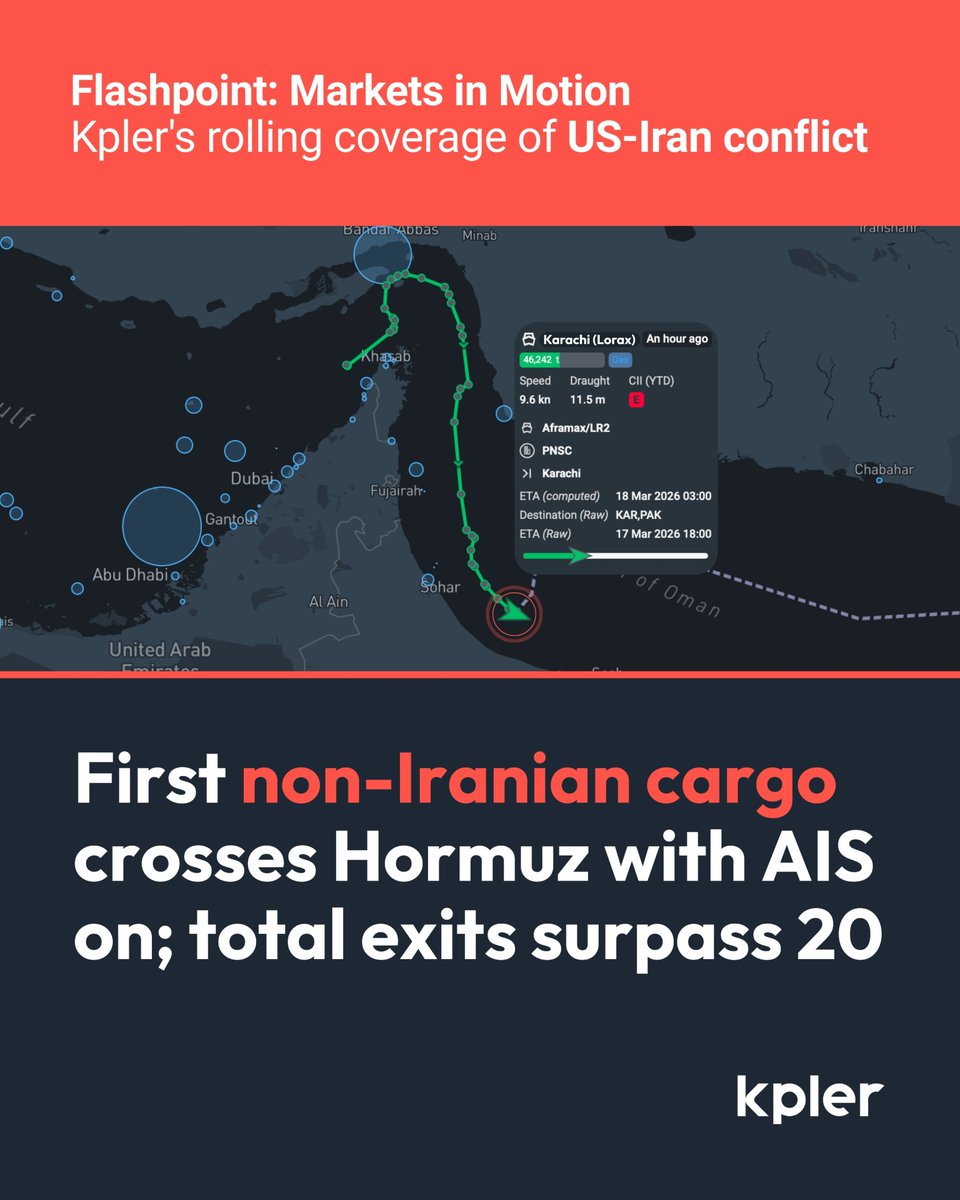
First non Iranian cargo through Hormuz
As the US Iran conflict enters its third week, vessel tracking data suggests limited movement is cautiously resuming through the Strait of Hormuz. The Aframax Karachi, carrying Abu Dhabi’s Das #crude, became the first non Iranian cargo to transit the chokepoint while broadcasting its #AIS signal. The vessel took an unusual route through Iranian territorial waters, indicating that negotiated safe passage may be allowing select shipments to leave the Gulf. More than 20 long range tankers have now exited the strait, though many still rely on dark transits. The developments suggest a fragile and highly controlled reopening of one of the world’s most critical energy corridors.
Stay ahead of the market with #Kpler Insight: https://t.co/ymWyh1rpqc
"That's a moment of physics-defying fantasy!" The amazing Angel Barajas 🇨🇴 catches a Cassina-Kolman combination ONE-HANDED on Horizontal Bar...and goes on to stick his dismount like it's nothing. Incredible scenes from the Antalya World Cup final! #Gymnastics
Imagine - a bird crashing through the windscreen of your airplane into your face, taking out your left eye. And then being able to turn your head to deflect the blood in the roaring wind, and safely land.
This man, my friend Syd Burrows, did just that. After the accident he changed his callsign to Cyclops and flew a full career.
Syd passed away today at 95.
He was proud to be the inspiration for the main character in my Apollo Murders thriller series. A long, beloved, good life, well-lived. Ad Astra, Syd.
https://t.co/DM2CBrGFWZ
Latest @MarineTraffic Brief is out. It covers recent vessel behaviour in the Strait of Hormuz (including AIS interference), Russian crude flows to India, attack reports in Iraq/Oman, and a shadow‑fleet update. A little something for everyone... https://t.co/Fex6yqB37d
Sam Altman said people saying “please” and “thank you” to ChatGPT costs OpenAI tens of millions of dollars a year in compute. 67% of Americans do it anyway.
Run the math on why.
A 2024 Waseda University study tested LLM responses across politeness levels in English, Chinese, and Japanese. Impolite prompts produced measurably worse outputs: more bias, more errors, more refusals. Moderate politeness consistently beat both extremes.
The mechanism makes sense once you see it. Polite prompts pattern-match to higher-quality training data. When you write “Could you help me structure this analysis?”, the model pulls from professional, well-reasoned text. When you write “give me the answer,” it pulls from Reddit.
Google DeepMind’s Murray Shanahan explained it simply: the model is role-playing a smart intern. Treat the intern like a colleague, you get colleague-quality work. Bark orders, you get minimum-viable compliance.
Now look at the cost side. OpenAI handles over a billion queries daily. Each GPT-4 query uses roughly 2.9 watt-hours, ten times a Google search. But OpenAI just raised $40 billion at a $300 billion valuation. Tens of millions in politeness tokens is a rounding error on a rounding error.
67% of users do it anyway, and 55% of them say it’s because it’s “the right thing to do.” They’re maintaining a behavioral habit that governs every other interaction in their life. The parent who teaches their kid to say please to Alexa isn’t doing it for Alexa. They’re doing it because the alternative is raising someone who learns that being rude gets faster results.
Telling 900 million people to stop saying thank you so OpenAI can save 0.01% of operating costs is the most engineer-brained optimization take on the internet. You’re training yourself to treat every interaction as a transaction. And that habit doesn’t stay in the chat window.
It’s hard to ignore the ripple effect when a bottleneck halfway across the world hits local prices. Beyond the gas pump, this surge will eventually touch everything from grocery bills to travel plans. Here’s hoping for some stability soon so things stay manageable for everyone.
Oil surges above $100
Crude prices have climbed above $100 a barrel as prolonged disruption in the Strait of Hormuz restricts Middle Eastern exports and tightens global supply expectations. #Tanker traffic through the strait remains bare minimal with a risker manoeuvre by turning AIS off, while most shipowners reluctant to transit the route. Storage pressure across Gulf producers is mounting, prompting output cuts and raising the risk of further shut ins if #crude cannot be lifted. Alternative routes via Fujairah and Saudi Arabia’s Yanbu terminal are operating at record levels but remain insufficient to offset the loss of Hormuz shipments. With exports from the region running at roughly a third of typical volumes, Asian refiners are increasingly turning to long haul supplies from the Atlantic Basin while the market braces for further price volatility.
Stay ahead of the market with #Kpler Insight: https://t.co/dkrDSTac7V
Logistics is a human endeavour.
Beyond the data on the Hormuz blockade lies a massive challenge for the region's food security and the brave seafarers currently in harm's way to keep the world moving.
Love the work we do at @kpler & @MarineTraffic to help navigate these times.
Hormuz blockade threatens Gulf supplies
Kpler data highlight how Gulf supply chains depend on container hubs connected to the Strait of Hormuz. Dubai’s Jebel Ali, the region’s largest container gateway with capacity near 19m TEU, anchors much of this trade, alongside Khalifa Port in Abu Dhabi and Saudi Arabia’s Dammam port. While the strait is blocked, vessels will not be able to access these ports. Alternatives including Khorfakkan, Sohar and Jeddah are emerging, although their throughput capacity is significantly lower. Together with road networks across the Peninsula, these corridors handle much of the region’s containerised imports, including food and everyday consumer goods.
The immediate effect of a continuing blockade would likely be seen in supplies of fresh produce, meat and dairy, which rely on near daily imports to stock supermarket shelves. The region imports more than 90 per cent of its food, meaning shortages could emerge if disruption lasts weeks.
Stay ahead of the market with #Kpler Insight: https://t.co/u8gL4rJwU9
Big shifts happening in container shipping right now. The latest deep‑dive from the @MarineTraffic Container Intelligence team really captures how quickly things are moving — and how disruptive the Strait of Hormuz situation has become. Full analysis: https://t.co/yzZabDsswG