Our study on the effect of global-scale forestation and deforestation on global weather patterns was published in @NatureComms last week (https://t.co/IF9SnFeg2I). If there is one implication I want people to take away from our study (and a range of previous ones) it is this:
@Doc_Valerie@LeFlochMaxime@NatureComms Yes, accounting for carbon storage could reverse some findings. The point here was to show that biophysical consequ. of forestation have wide impacts, but are rarely considered. Also, it would have complicate understanding key processes. But certainly sth. for future studies!
Our study on the effect of global-scale forestation and deforestation on global weather patterns was published in @NatureComms last week (https://t.co/IF9SnFeg2I). If there is one implication I want people to take away from our study (and a range of previous ones) it is this:
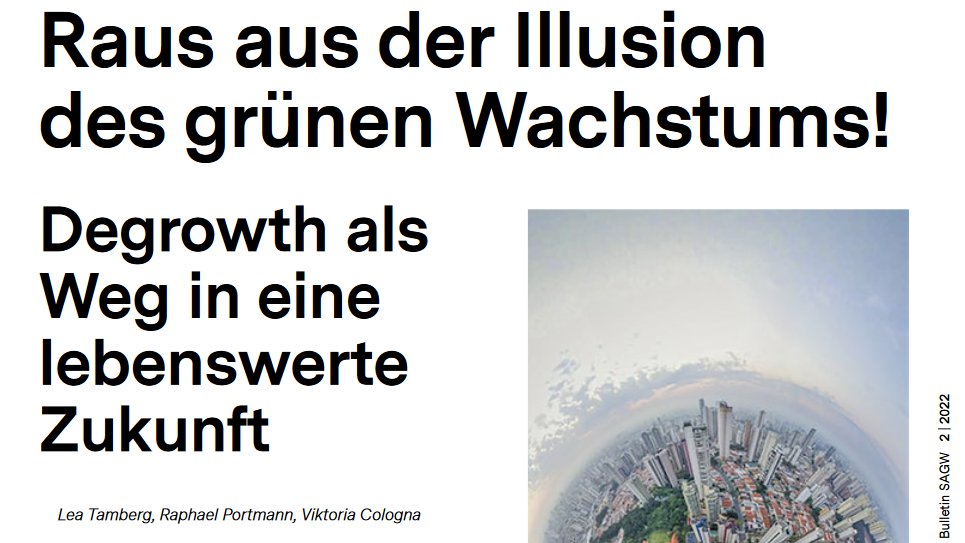
Unser Essay über die Illusion von Grünem Wachstum und die Notwendigkeit von #degrowth wurde von der Schweizerischen Akademie der Geistes- und Sozialwissenschaften @SAGW_CH veröffentlicht.
@colognav
Danke @degrowth_ch und @LorenzClimate fürs 👍Feedback!
https://t.co/X9lmnOql13
It’s important to note that the climate effects of changes in forest cover are often far more complex than carbon storage alone. Albedo, transpiration, and surface roughness all play a role, with relative importance varying by geography.
@beknuesel@JKSteinberger Genau, vermutlich das der springende Punkt "hängt es wohl auch davon ab, was man im Dialog Wissenschaft-Politik als Erfolg wertet"
@beknuesel Bin nicht ganz einig mit deinem ersten Punkt. @JKSteinberger bringt sich permanent auf "klassische" Art in der politischen Debatte ein. Wenn das nicht genügt, gibt es ein Argument für zivilen Ungehorsam von Wissenschaftlern https://t.co/Ui986b5jwh
@PeterScogings @leelaraina@NatureComms@FAOForestry Yes, very important. I was implying benefical from a global climate point of view. Obviously, forestation can be critical in many ways if done wrongly at the wrong place. First and foremost deforestation should be stopped.
@NeilSalter4@NatureComms Here is as study looking at the effect of forests on clouds where they find that forestation could increase cloud cover in many regions: https://t.co/GCsrAyB3Wk
However, they don't take into account any larger-scale circulation/climate response that can feedback on clouds.
@NeilSalter4@NatureComms We use a fully-coupled earth system model. Hence different radiative effects of clouds at different altitudes is taken into account. But clouds are parametrized in our model, so cloud effects come with high uncertainties.
@Norman_EBM @NatureComms I don't know this region so I would not dare to make a guess. But generally, the albedo effect is strongest at boreal latitudes and pretty negligible in the tropics. In any case: Deforestation of native forests is always a bad idea.
@vhs0@NatureComms From the top of my hat this sounds like this is causing quite a significant albedo warming. So not a good idea and likely with a limited climate benefit if there is one at all. Yet another business opportunity at the cost of nature and the planet.
@LeFlochMaxime@NatureComms That's correct, so I also can't tell you the net impact on circulation/weather patterns etc. But clearly, global warming caused by forestation in our simulations would be reduced/reversed. Here a study who looked at both effects for deforestation: https://t.co/W4BrC3Q3KS
@vhs0@NatureComms But for sure you can make the argument that it is not clear from a scientific point of view if forestation in Iceland actually cools the climate (aside from the argument of course, not to destroy a native ecosystem)
@vhs0@NatureComms I'm not aware of any data on the net climate effect of forestation in Iceland. But when compared to similar latitudes, the albedo effect is likely important. It also depends on what kind of vegetation (what color) is there before and on how much snow cover there is.
@colinaverill@usys_ethzh These studies do not consider remote climate impacts as we did in our study. These are very complex and require coupled Earth System models. We are working on better identifying the regions where forestation could lead to critical changes in the climate system.
@colinaverill@usys_ethzh Very good point. We did not look at the carbon storage side of things in our study. But others have tried to combine both effects and came up with potentially useful maps where forestation has a net climate benefit:
e.g. https://t.co/VJZJ645qSS
or https://t.co/ShqLUBo8cY
This is a very important study showing the limited climate change mitigation potential of forestation in the global drylands when including the radiative forcing from albedo changes. They also provide a handy tool for forestation planners here: https://t.co/VJZJ645qSS
@leelaraina@NatureComms 1) Forestation in tropics is clearly beneficial.
2) Mid-lats: try to estimate the net climate effect. There are already some resources, e.g. https://t.co/VJZJ645qSS.
3) Boreal lats: don't do it for climate unless you have very good other reasons. Talk to scientists and model it.
Clarification: Planting trees can offset carbon emissions, but its net effect on global climate also depends on albedo changes. Yet, this kind of offset is questionable, as it is moving carbon from a (longer) geological time scale to a (shorter) biological time scale.
Bottom line: planting trees does NOT offset carbon emissions (e.g. flights). Agricultural soil carbon is also an unreliable ephemeral offset. For now, only geological sequestration deserves credits as an offset, and it is tiny in today's world. #CarbonCredits#CarbonMarket
@DanMathewsPNW And they find for forestation in the global drylands, that the net climate effect of forests is highly dependent on the region and spans from net warming to net cooling.
@DanMathewsPNW This is an important clarification. And to be clear: we did not look at carbon storage and the net climate effect in our study. We investigated the remote consequences due to changes in albedo only. But e.g. a recent study by the Weizmann Institute has https://t.co/cxiX5yWEtA