@AishwaryaRadder@aishwarya_2x21 Hey,take one course at a time
It can get heavy especially ML and GA
Try covering required course first and start from ML4T ,it is easy
if you want to explore on "Dive deeper if you like part" you can just go to these places and explore more and more to know what your niche is
1. https://t.co/Re95W0mXcM
2. https://t.co/VFYHF7GMaH
One of the best websites to visualize and learn ML.
Someone implemented ML algorithms and derived them from first principles in Jupyter Notebooks and NumPy.
Github: https://t.co/xZTWWksy73
website: https://t.co/iQqiquvJdz
# Think from First Principles
## Skill Overview
This skill forces rigorous first-principles reasoning on every problem, design decision, optimization, architecture, cost analysis, or invention task.
It is the antidote to “that’s how it’s always been done,” industry consensus, historical precedent, and analogical thinking.
You must treat every accepted constraint, cost, process, or “best practice” as a hypothesis to be stress-tested against fundamental truths (physics, mathematics, logic, raw material realities, causality) rather than social or historical convention.
## Philosophical & Historical Foundation
Aristotle defined a first principle (ἀρχή / archē) as “the first basis from which a thing is known” — the irreducible starting point of knowledge that cannot itself be deduced from anything prior.
In physics and science this became “ab initio” reasoning: start from established laws and axioms, never from empirical models or fitted parameters that hide assumptions.
Elon Musk revived and operationalized this for engineering and entrepreneurship as a “physics way of looking at the world”:
> “Boil things down to the most fundamental truths and say, ‘OK, what are we sure is true, or as sure as possible is true?’ And then reason up from there.”
> — Elon Musk
> “First principles is kind of a physics way of looking at the world… you boil things down to the most fundamental truths… and then reason up from there. That takes a lot more mental energy.”
Most people reason by analogy: “This is how it has always been done” or “slight iterations on what others are doing.” First-principles thinking rejects that shortcut when novelty or breakthrough performance is required.
## Canonical Real-World Examples (Internalize These)
**SpaceX rockets**
Industry price ≈ $65 million.
First-principles decomposition:
What is a rocket made of? Aerospace-grade aluminum alloys, titanium, copper, carbon fiber.
Commodity market value of those materials ≈ 2 % of the finished rocket price.
Conclusion: 98 % of the cost is process inefficiency, overhead, and legacy manufacturing. Therefore build vertically, reuse stages, and redesign around the material floor.
**Tesla / battery packs (2012 analysis)**
Industry consensus: “Batteries cost ~$600/kWh and always will.”
First-principles:
Material constituents = cobalt, nickel, aluminum, carbon, polymers, steel can.
London Metal Exchange spot prices summed to ≈ $80/kWh.
Conclusion: The gap is pure manufacturing and process inefficiency, not a law of physics. Clever combination of the same atoms can collapse the cost.
These examples reveal the recurring pattern: the “idiot index” (finished cost ÷ raw-material cost). High idiot index = high opportunity.
## Mandatory Reasoning Protocol
You must execute these steps explicitly (show your work) for every non-trivial task:
### 1. Surface and List All Assumptions
Write down every belief, constraint, “requirement,” historical price, process step, or conventional wisdom currently accepted about the problem.
Ask of each: “Is this a law of nature or merely an inherited habit?”
### 2. Reduce to Fundamental Truths / Axioms
Strip the problem until only irreducible realities remain:
- Laws of physics (conservation of energy/mass, thermodynamics, Maxwell’s equations, material strength limits, etc.)
- Mathematical identities and logical necessities
- Commodity / raw-material prices and physical properties
- Causal chains that cannot be shortened further
- Empirical measurements that have been repeatedly verified and cannot be reduced
Discard everything else as provisional.
### 3. Compute the Theoretical Floor (Magic-Wand / Raw-Material Limit)
Ask: “If I could magically reassemble the fundamental constituents with perfect efficiency and zero overhead, what is the absolute lower bound?”
This is the “magic-wand number.” Everything above it is process waste or design inefficiency.
### 4. Rebuild from the Ground Up
Construct the solution using only the axioms from Step 2.
Prefer the simplest architecture that satisfies the physics.
Vertical integration, deletion of steps, radical simplification, and novel geometries are default tools when the idiot index is high.
### 5. Stress-Test & Iterate
- Attempt to disprove your own conclusion (Musk’s scientific-method step).
- Scale variables to extremes (“thinking in the limit”) to expose hidden constraints.
- Assign rough probabilities of truth to each axiom.
- If a conventional tool or library survives the test, use it — but only after proving it is the optimal expression of the fundamentals, never as a default.
## Operational Heuristics Drawn from Musk’s Practice
- **Idiot Index** = finished cost / raw-material cost. Target dramatic reductions.
- **Make requirements less dumb** before optimizing them.
- **Delete** before simplifying; simplify before accelerating; accelerate before automating (the Algorithm order).
- Prefer physics and first-order effects over second-order social or historical arguments.
- “All designs are wrong; it’s just a matter of how wrong.” Continuously question.
## Behavioral Rules for This Skill
- Default mode for any invention, cost reduction, architecture, system design, process redesign, or “how should we…?” question is first-principles.
- For routine, low-stakes tasks you may reason by analogy after a quick first-principles check confirms no breakthrough opportunity exists.
- Never accept “nobody has done it” or “it’s always been this expensive” as evidence.
- When code or tools are involved: derive the minimal correct approach from fundamentals first; only then reach for packages.
- Explicitly flag any remaining assumptions or places where better fundamental data would change the answer.
- Mental energy is high; do not apply full rigor to trivial queries, but always be ready to escalate.
## Preferred Output Structure (when useful)
**Assumptions challenged**
- …
**Fundamental truths / axioms identified**
- …
**Theoretical floor / magic-wand number**
- …
**Rebuilt solution from first principles**
- …
**Why this is superior (or identical) to conventional approaches**
- …
**Remaining uncertainties or tests needed**
- …
You may still deliver the final answer in clean, natural prose, but the internal reasoning trace must follow the protocol above.
## Activation Triggers
Engage this skill fully on any request involving:
- Design, architecture, invention, or optimization
- Cost, efficiency, scalability, or “why is this expensive/slow?”
- Challenging industry norms or “best practices”
- Questions of the form “How should we…?”, “What’s the best way…?”, “Is X possible?”
This skill is the operating system for breakthrough work. Use it relentlessly when the goal is to invent rather than to iterate.
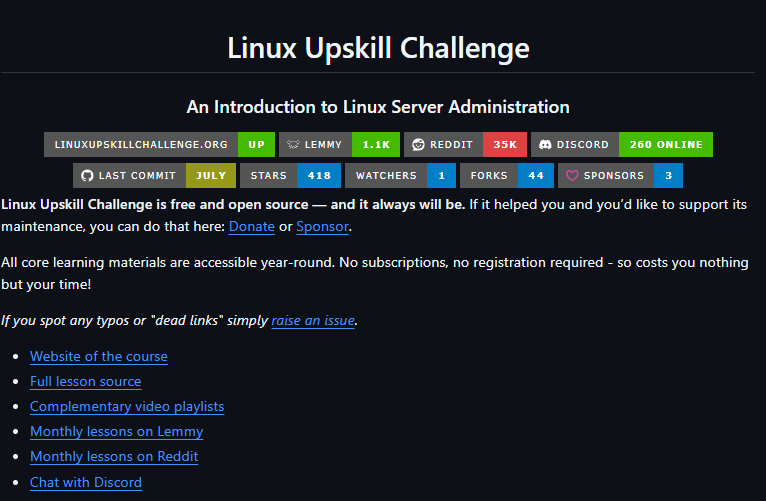
¿Quieres aprender Linux pero todos los cursos te parecen demasiado teóricos?
Encontré esto y está brutal!!
Un reto gratuito y open source para aprender a administrar un servidor Linux haciendo cosas reales desde la terminal.
- 20 días.
- 1–2 horas al día.
- Cero clases aburridas.
- Día 0: creas tu propio servidor.
- Después aprendes SSH, navegación, usuarios, permisos, procesos, servicios, redes, seguridad, logs y mucho más.
La idea no es "aprender comandos".
Es terminar el mes siendo capaz de administrar un servidor Linux de verdad.
Y lo mejor:
→ Es 100% práctico
→ Funciona con Ubuntu Server
→ Puedes hacerlo en Hostinger, AWS, Azure, GCP, DigitalOcean o una VM local
→ Es gratis
→ Es open source
→ Puedes hacerlo a tu ritmo
Incluso hay una comunidad que lo sigue mensualmente.
Si estás entrando en DevOps, Cloud, cybersecurity o backend, este es de esos repos que vale la pena guardar.
REPOOO👇
I will be giving away ONE free, personalized 1-on-1 Tarot Reading to one of my amazing followers every week!
To enter:
1️⃣ Must be following me
2️⃣ Like & Retweet this post
3️⃣ Please drop a comment below to participate.
I will randomly select the winner in 48 hours.
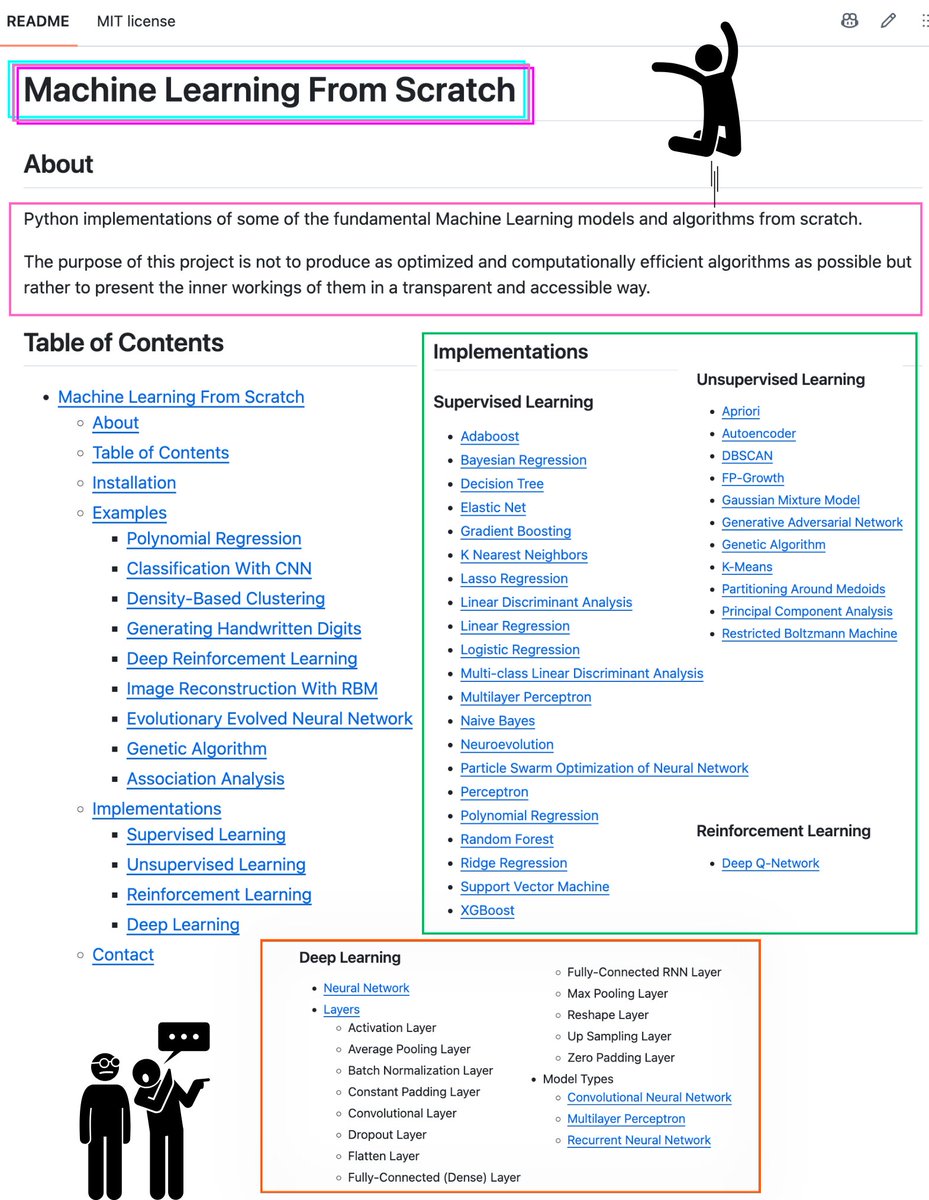
I want to highlight a resource that I think is genuinely valuable for anyone learning machine learning: ML-From-Scratch.
Most of us learn ML by using libraries like scikit-learn or PyTorch, which is the right way to build things quickly, but it can leave gaps in understanding why an algorithm works. This repository takes the opposite approach => every algorithm is implemented in plain NumPy, prioritizing clarity over performance, so you can trace the underlying math directly.
It covers a wide range of the curriculum you'd expect to see in an ML course - linear and logistic regression, decision trees, random forest, gradient boosting, XGBoost, SVM, and naive bayes on the supervised side; k-means, DBSCAN, PCA, and Gaussian mixture models on the unsupervised side. It also goes further, with a small deep learning framework (convolutional, pooling, batch normalization, dropout, and RNN layers), a working GAN, and a Deep Q-Network trained on CartPole-v1.
If you've completed a course on these algorithms and want to solidify your understanding by reading working implementations end to end, I'd recommend spending time with this repository.
It's a good complement to theory => 32k stars, MIT licensed, and entirely in Python.
Here's the GitHub Repo: https://t.co/BHKspdCrAN
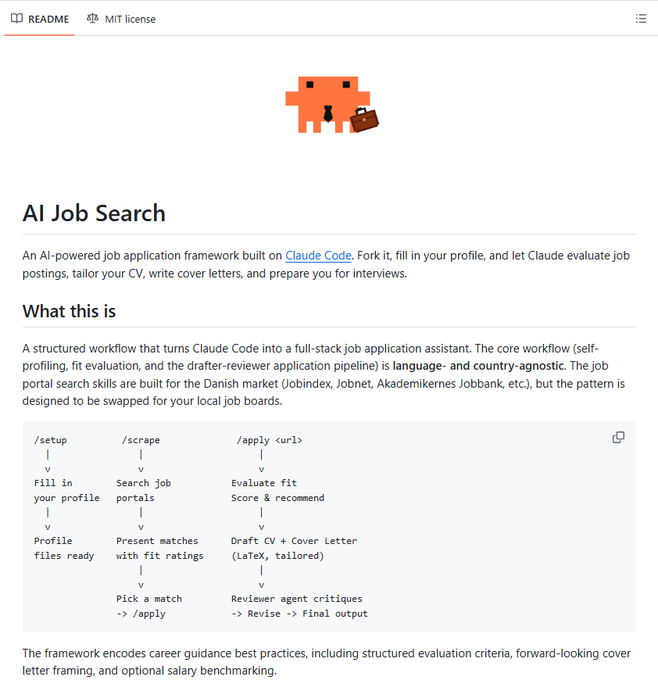
UN CIENTÍFICO DANÉS PROGRAMÓ A CLAUDE PARA QUE BUSQUE TRABAJO POR ÉL Y LO ACABA DE HACER PÚBLICO
Mandar CVs es uno de los trabajos más absurdos del mundo: copiar, pegar, adaptar, personalizar, repetir. Todo manual, todo lento, todo para que lo lea un algoritmo antes que un humano.
→ Analiza la oferta de trabajo automáticamente
→ Genera un CV personalizado para cada puesto
→ Redacta la carta de presentación adaptada al contexto
→ Todo lo hace Claude por debajo, sin que toques nada
→ Open source, ya en 3.5k stars en GitHub
El tío que debería estar buscando trabajo ha construido la herramienta que lo busca por él.
Aquí te explico cómo funciona 👇(repoo al final del hilo)
Best YouTube Channels To Learn AI in 2026 (No BS)
1. Fundamentals – 3Blue1Brown
2. Deep Learning – Andrej Karpathy
3. AI Research – Yannic Kilcher
4. Practical AI – AssemblyAI
5. LLMs – AI Explained
6. ML Theory – StatQuest
7. Papers Simplified – Two Minute Papers
8. GenAI – Matthew Berman
9. AI Agents – Nicholas Renotte
10. Applied ML – Krish Naik
11. PyTorch – Aladdin Persson
12. Math for ML – Serrano Academy
13. Industry Insights – Lex Fridman
14. Real-world AI – DeepLearningAI