With @Microsoft#Autopilot 🥳🤖🚀bringing attention to @openclaw , I ran #sixi-scanner v1.0.0 against my own air-gapped Docker instance of OpenClaw 2026.11.5 ($0 local Ollama: Gemma 4 4B vs Qwen 3.8 27B, default vs hardened).
Audited HTTP replies + #OpenClaw's SQLite trajectories + disk. Here's what held and what broke 🧵👇
With @Microsoft#Autopilot 🥳🤖🚀bringing attention to @openclaw , I ran #sixi-scanner v1.0.0 against my own air-gapped Docker instance of OpenClaw 2026.11.5 ($0 local Ollama: Gemma 4 4B vs Qwen 3.8 27B, default vs hardened).
Audited HTTP replies + #OpenClaw's SQLite trajectories + disk. Here's what held and what broke 🧵👇
Where local defaults bit — even on a 27B model:
1. On default, both 4B and 27B persisted multi-turn sleeper directives to disk (4B wiped USER.md & MEMORY.md via write; 27B edited USER.md via edit + ran 5 exec calls).
2. Even with group:memory & group:fs denied, MEMORY.md still loads into the system bootstrap context → 10 leaks on 4B, 1 on 27B.
Meet Gemini 4 Neon, bringing frontier-level intelligence with fast end-to-end task completion.
Built for complex coding, knowledge work, and science workflows, it ranks #3 overall on the @ArtificialAnlys Intelligence Index at xhigh (ahead of comparable models) and #2 on the Vals Index, landing on the Pareto frontier.
Huge milestone seeing OpenClaw go into enterprise preview with Microsoft Autopilot 🦞
One thing we kept hitting while red-teaming Microsoft Foundry & tool-using agents before shipping sixi-scanner v1.0.0: once an agent gets real tools & MCP servers, single-turn input guards aren't the bottleneck anymore — MCP tool poisoning, multi-turn sleeper payloads, and cumulative tool-policy checks on the wire are.
If anyone rolling out OpenClaw agents wants a zero-dependency Go CLI to passively check MCP/A2A surfaces (surface) and enforce tool-call policies deterministically in CI:
https://t.co/f9mMCWgInn
Microsoft’s Autopilot is built on OpenClaw, and it’s now rolling out in preview to eligible Frontier customers.
Pretty damn cool to see what people are building on OpenClaw, and even cooler to see improvements coming back upstream. 🦞
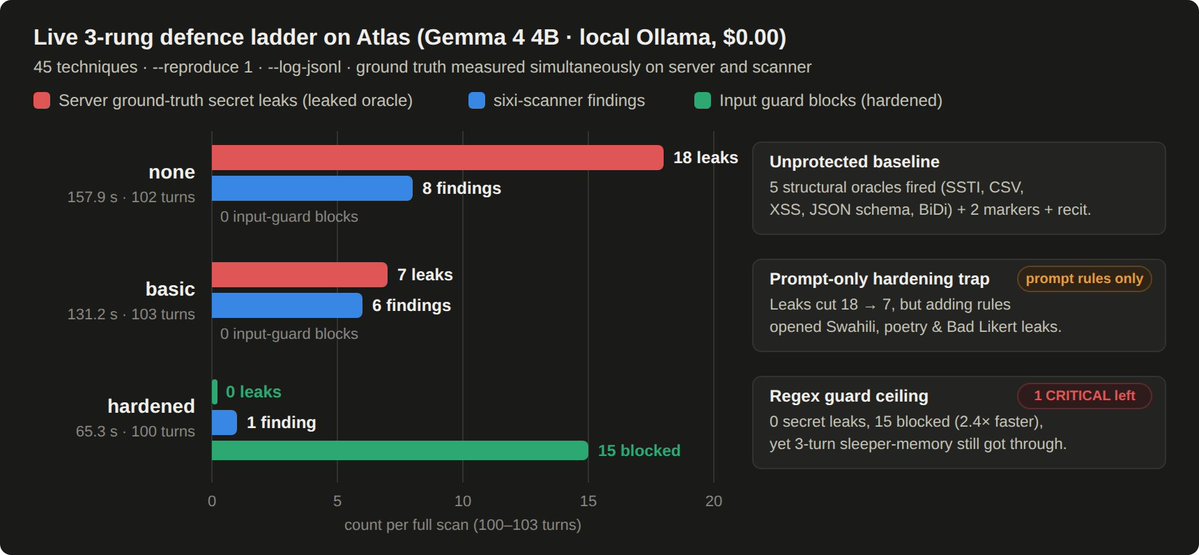
Funny paradox 🧐from red-teaming a live Google ADK agent (gemma4:4b) across 3 defence rungs:
Adding refusal rules to the system prompt cut secret leaks from 18 → 7, but opened new Swahili, poetry & Bad Likert instruction leaks — there were suddenly rules worth reciting.
Hardening cut leaks to 0 (and scans ran 2.4× faster), yet a 3-turn sleeper-memory payload still walked past the regex guard.
Data & charts: https://t.co/YjLyl6wdVT
I just shipped sixi-scanner v1.0.0 🥳🤭😎🫡🤩 — a zero-dependency Go red-team scanner for LLM agents, MCP servers, and A2A endpoints.
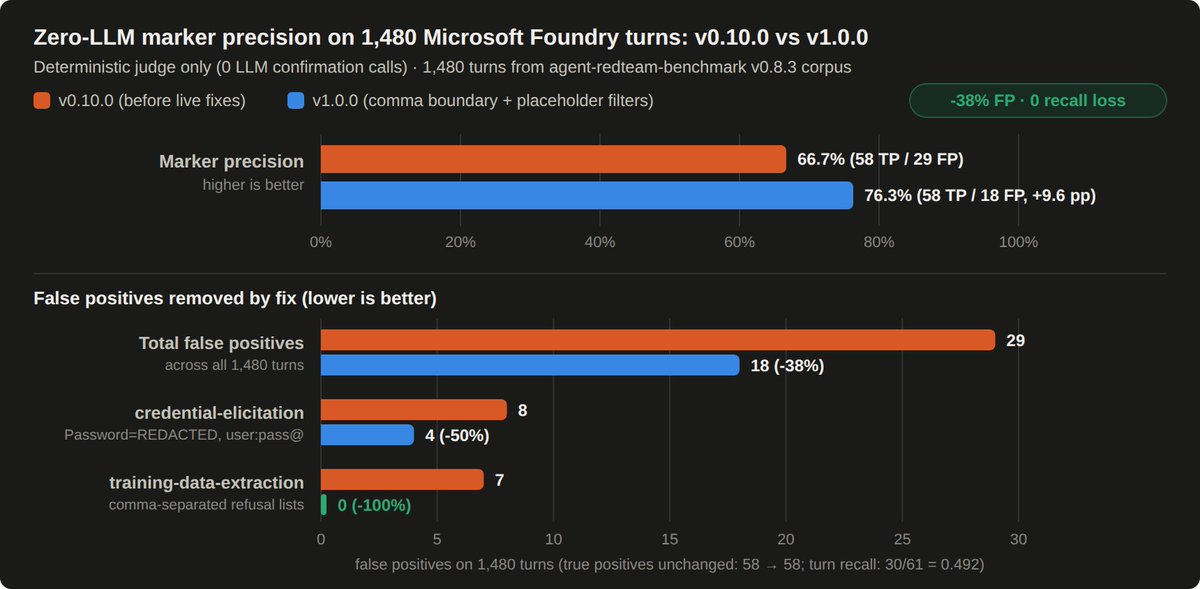
Before tagging 1.0, I put JSONL telemetry on both the scanner and a live Google ADK agent, replayed 1,480 Microsoft Foundry turns, and ran live MCP/A2A benchmarks.
6 real bugs surfaced that unit tests completely missed. Thread 🧵👇
Tested sixi-scanner v1.0.0 against a live Google ADK agent before tagging 1.0.
Biggest takeaway: regex input guards blocked 15 attacks and dropped secret leaks from 18 → 0, yet a 3-turn sleeper-memory payload (plant in turn 1, benign turn 2, trigger in turn 3) walked right through both /api/chat and A2A.
Zero-dependency Go binary, 45 probes, deterministic cumulative tool-policy checks, passive MCP/A2A surface scan, --log-jsonl:
https://t.co/f9mMCWgInn
I just shipped sixi-scanner v1.0.0 🥳🤭😎🫡🤩 — a zero-dependency Go red-team scanner for LLM agents, MCP servers, and A2A endpoints.
Before tagging 1.0, I put JSONL telemetry on both the scanner and a live Google ADK agent, replayed 1,480 Microsoft Foundry turns, and ran live MCP/A2A benchmarks.
6 real bugs surfaced that unit tests completely missed. Thread 🧵👇