On the sad saga of the #AI171, a full year after the crash.
Air India AI 171 Crash Interim Statement - What AAIB did not say https://t.co/FZRD47ji9T
by @kdineshnair of @Cockpit_Vista
@S_Sivakumar@parvathimenon Excellent points in the book extract and the discussion here! I've added a couple of points as a comment in Substack directly.
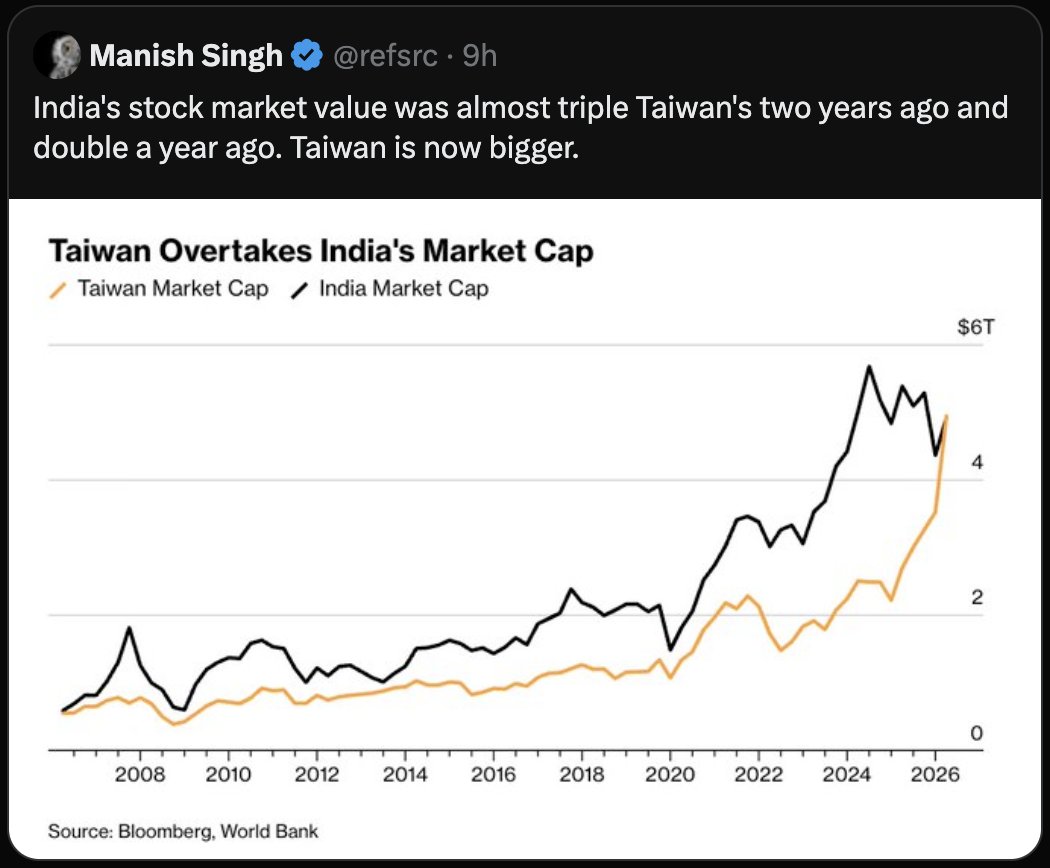
"The mood remains sombre on India, even bleak. Zero interest. Even 6,000 bps of underperformance vs EM equities over the last 12 months has failed to stir interest. India has now underperformed EM equities even over a 10-year horizon." Mr Akash Prakash on his recent US trip.
@Scholars_Stage@Noahpinion And even less so in India where we’re led to believe things can happen in an autocratic setup, not in a democratic one. That India’s chaotic democracy is to blame for the slow economic progress because competing requirements of the electorate makes policy interventions slow.
There's a convenient story Indians are told about Chinese industrial dominance:
- Beijing picks sectors to win
- It also picks national champions to support.
- This is how BYD, Huawei and CATL were built.
The lesson, we're told, is to copy this and back India's biggest conglomerates unconditionally.
What if this view is wrong?
- Truth is China's present day national champions were once fringe players on the outside and had to claw their way in.
- Industry policy money wasn't even intended to be directed at them - they earned their way in.
How China's champions actually came up:
- Autos were closed - you couldn't start a private carmaker, you went through the state automakers. Geely and Chery broke the rules and snuck past to set up plants anyway.
- Huawei started in small markets and county-government contracts Cisco and Ericsson ignored
- BYD began with cheap, almost-laughed-at cars
- CATL — a 2011 spinoff from a Hong Kong battery firm, an outsider that became indispensable
The pattern we see:
- big state firms sit at the front of the room, and newcomers can't get in that way
- outsiders slip in through the side door, and the state lets them, as long as they stay loyal
- work insanely hard, don't pick fights with the govt (just ask Jack Ma), and win as the underdog
Where this leaves India:
- Some of our industrial policy is aimed squarely at the big, established players
- The schemes are built for firms large enough to bid: investments in the thousands of crores and the like.
- The firms you'd actually want to catch early can't clear that bar
- Truth is outsiders are also making giant strides - how do we catch them? India's BYD and CATL could be here. Not among the giants!
How do we align industrial policy to allow the "outsiders" a fair chance at govt backing/support to become national champions?
Read this story:
https://t.co/d7eHWiFO2m
The real China model in recent years: capital from state governments. Several Indian states have sector-specific SEZs. But are not competent beyond basic land allocation.
🚗🔋 Many think Beijing masterfully planned China's EV takeover. Fengming Lu (@ANUBellSchool ) and I spent 3 years and 60+ interviews finding out what actually happened in our latest article @TheChinaJournal. A thread 🧵
@SirJambavan@bithika11 I heard Kanda Sashti Kavacham blaring from a temple (gopuram, red&white striped walls, and all) in … Manipur.
Turns out there’s a small settlement of Tamils who moved out of Burma back in the day. But fully integrated into the local community now.
China spent $100 billion trying to steal this technology. They failed completely. India walked in through the front door and got it in a single afternoon.
On 16 May in The Hague, Tata Electronics and ASML signed an MoU. Two Prime Ministers watched it happen. PM Modi on one side. The Dutch Prime Minister on the other. $11 billion on the table. India's first full scale 300mm semiconductor fab. Located in Dholera, Gujarat.
Not a pilot plant. Not a research facility. A real factory at TSMC level scale.
Now understand what ASML actually is because this is where the story gets extraordinary.
ASML is a Dutch company that holds a 100 percent monopoly on Extreme Ultraviolet lithography machines. There is no competitor. There is no substitute. There is no alternative supply chain anywhere on earth. Every advanced chip in every smartphone, every AI server, every guidance system, every satellite depends on machines that only one company on the planet can build. And that company just committed to India.
China understood this years ago. They poured over $100 billion into SMIC, YMTC and every domestic semiconductor initiative they could build. They attempted smuggling. They attempted industrial espionage. They lobbied every government that would listen. The United States and the Netherlands blocked EUV exports to China anyway. Made in China 2025 was supposed to solve this problem. It did not come close.
India did not steal it. Did not lobby for decades. Did not spend a hundred billion dollars chasing a technology it could never reach.
India signed a partnership. In one afternoon. While two Prime Ministers watched.
Now look at the defence dimension because this is the piece that changes everything about India's strategic position.
Tejas Mk1A depends on imported chips. BrahMos guidance systems depend on imported chips. Akashteer, India's AI integrated air defence network that achieved 100 percent kill rates during Operation Sindoor, depends on imported chips. The S-400. Indian satellites. Every advanced weapons system India operates has a chip dependency that sits outside Indian control.
One sanction. One supply chain disruption. One geopolitical decision made in Washington or Taipei. And India's most advanced military systems face a vulnerability that no amount of battlefield brilliance can compensate for.
Dholera ends that dependency permanently. Atmanirbhar chips means Atmanirbhar weapons. Those two sentences together represent the most important shift in India's strategic autonomy since the nuclear tests.
The geopolitical architecture of this deal is as important as the technology itself.
The United States is actively constructing a China-free trusted semiconductor supply chain. The goal is to ensure that the most advanced chip manufacturing capacity never sits inside Chinese influence. India joins that supply chain at Dholera not as an American ally or a dependent partner but as a sovereign node with its own fab, its own capacity and its own strategic autonomy intact.
This is what genuine strategic positioning looks like. Cutting edge technology access without political alignment. Partnership without subordination.
Now look at the chart that tells the real story of why this matters commercially.
TSMC's revenue comes 44 percent from smartphones and 37 percent from high performance computing. That is the AI chip market. The data center market. The market that every technology company on earth is desperate to access right now.
SMIC, China's best attempt at a domestic alternative, draws 31 percent from smartphones and 32 percent from smart home devices. Consumer electronics at the lower end of the value chain.
This is not just a gap in technology. It is a gap in which markets each company can serve. TSMC sits at the top of the global technology economy. SMIC sits several steps below it. And the gap is widening not closing because the export controls on EUV machines mean China cannot access the equipment needed to close it.
India through the Tata-ASML partnership is entering this ecosystem at the top. Not starting from the bottom and working up. Starting with access to the machines that make the chips that power the most advanced technology on earth.
TSMC took thirty years to build what it has. India is not starting that journey from zero. It is starting from a partnership with the only company whose machines make that journey possible.
One machine. One factory. One city in Gujarat.
The chips that will guide India's missiles, power India's AI systems and secure India's communications for the next generation are going to be made in Dholera.
China spent a hundred billion dollars and got nothing.
India signed one MoU and got everything.
This happened because Taiwan invested in semiconductors (like India is doing since last 5 years) 25-30 years ago.
India did not invest in semiconductors and electronics manufacturing in 2000s as it should have. But glad it is doing so now.
Due to the AI chips boom now, a few chip companies of Taiwan have skyrocketed in valuation recently. TSMC alone is 40+% of Taiwan's stock index.
The people who try to make India look bad showing such stats now will be the same who will criticize too if, say, just one private company from India makes up 40+% of India's Nifty.
Re-engineering the workflows of life:
AI can handle computation, memory, replication, and dissemination of knowledge, but not your personal understanding. For people in positions of authority - whether CEO or Govt - you can delegate work to AI but not accountability.
"You cannot govern a technology you have only been briefed on."
Singapore Minister for Foreign Affairs, Dr. @VivianBala, echoing @karpathy and @yacineMTB on why he runs NanoClaw: "you can outsource memory and computation, but you cannot outsource your understanding"
https://t.co/z4Aidf89ha
He also shared his tech stack for running his second brain for Singapore's Foreign Affairs Ministry and parliamentary affairs:
- @AnthropicAI Claude Agent SDK
- Baileys + WhatsApp
- Mnemon (Graph Memory)
- @ollama + @nomic_ai
- @ggerganov Whisper.cpp + OneCLI
With special notes on how he handles security and isolation, and what implications he sees for Singapore Inc.
@S_Sivakumar Reading this thread on what is also World Baking Day, snacking on a muffin laden with sodium-rich leavening agents, unhealthy (but heavenly!) saturated fats and refined sugars.
BP? What BP?
The vibes in SF feel pretty frenetic right now. The divide in outcomes is the worst I've ever seen.
Over the last 5yrs, a group of ~10k people - employees at Anthropic, OpenAI, xAI, Nvidia, Meta TBD, founders - have hit retirement wealth of well above $20M (back of the envelope AI estimation).
Everyone outside that group feels like they can work their well-paying (but <$500k) job for their whole life and never get there.
Worse yet, layoffs are in full swing. Many software engineers feel like their life's skill is no longer useful. The day to day role of most jobs has changed overnight with AI.
As a result,
1. The corporate ladder looks like the wrong building to climb.
Everyone's trying to align with a new set of career "paths": should I be a founder? Is it too late to join Anthropic / OpenAI? should I get into AI? what company stock will 10x next? People are demanding higher salaries and switching jobs more and more.
2. There’s a deep malaise about work (and its future).
Why even work at all for “peanuts”? Will my job even exist in a few years? Many feel helpless. You hear the “permanent underclass” conversation a lot, esp from young people. It's hard to focus on doing good work when you think "man, if I joined Anthropic 2yrs ago, I could retire"
3. The mid to late middle managers feel paralyzed.
Many have families and don't feel like they have the energy or network to just "start a company". They don't particularly have any AI skills. They see the writing on the wall: middle management is being hollowed out in many companies.
4. The rich aren’t particularly happy either.
No one is shedding tears for them (and rightfully so). But those who have "made it" experience a profound lack of purpose too. Some have gone from <$150k to >$50M in a few years with no ramp. It flips your life plans upside down. For some, comparison is the thief of joy. For some, they escape to NYC to "live life". For others still, they start companies "just cuz", often to win status points. They never imagined that by age 30, they'd be set. I once asked a post-economic founder friend why they didn't just sell the co and they said "and do what? right now, everyone wants to talk to me. if i sell, I will only have money."
I understand that many reading this scoff at the champagne problems of the valley. Society is warped in this tech bubble. What is often well-off anywhere else in the world is bang average here.
Unlike many other places, tenure, intelligence and hard work can be loosely correlated with outcomes in the Bay. Living through a societally transformative gold rush in that environment can be paralyzing. "Am I in the right place? Should I move? Is there time still left? Am I gonna make it?" It psychologically torments many who have moved here in search of "success".
Ironically, a frequent side effect of this torment is to spin up the very products making everyone rich in hopes that you too can vibecode your path to economic enlightenment.
“India in oil refining is where Taiwan is in semiconductors. What was India’s refining capacity in 1997? Jamnagar came and changed the game. Today, we need a Jamnagar for rare earths.”
— @samirsaran to @rajshamani
Brilliant conversation—do watch.
Profits are a sin. Capitalism is amoral. Talent is inhuman.
I shudder to think of a world where the USA elects AOC as President after Trump’s term. That’s like the US electorate telling itself and the world, “Let’s see how much worse we can make things.”
AOC: “There’s a certain level of wealth and accumulation that is unearned. You can’t earn a billion dollars. You just can’t earn that. You can get market power, you can break rules, you can abuse labor laws, you can pay people less than what they’re worth, but you can’t earn that”
"The objectives of Operation Sindoor were achieved and likely exceeded expectations. Whether India should have extended the campaign beyond 88 hours remains open for debate. Why Pakistan sought a ceasefire is clear. It did so after losing the ability to continue the fight on terms that could change the outcome."
- @SpencerGuard
A man with no working truck convinced Wall Street he had built the next Tesla. His company hit $30 BILLION. All he did was push it down a hill with no engine.
> Trevor Milton founded Nikola in 2014, named after the same inventor as Tesla.
> The goal was to build hydrogen powered trucks that would make diesel obsolete. He had no trucks.
> In 2018 he released a promotional video called Nikola One In Motion. It showed a sleek semi truck accelerating smoothly down an open highway.
Investors went wild.
> What nobody knew was that the truck had no engine, no fuel cell, and no propulsion system of any kind.
> Milton's team towed it to the top of a hill, tilted the camera to hide the slope, and let it roll.
> He spent the next four years doing the same thing with words. On podcasts, television and social media.
> Investors were told Nikola could produce its own hydrogen. It could not. They were told the trucks were ready for production. They were not. They were told orders were flooding in. They weren't.
> In June 2020 Nikola went public. Within days the company was worth $30 BILLION, more than Ford.
> Milton's personal stake hit $7.3 BILLION overnight.
> A $32.5 MILLION ranch in Utah followed. A record for the state at the time.
> In September 2020 Hindenburg Research published a report calling Nikola "an intricate fraud" built on "an ocean of lies." Milton resigned within ten days.
> A federal jury convicted him of securities fraud and wire fraud in 2022. Sentenced to four years in prison the following year.
> He never went. He was free on $100 MILLION bail pending appeal.
> He and his wife donated $3.2 MILLION to Donald Trump's 2024 campaign.
> In March 2025 Trump gave him a full pardon. The pardon erased $168 MILLION in restitution to defrauded shareholders.
> Nikola filed for bankruptcy the following month, leaving thousands of investors with nothing.
The company never had a product. The only thing that was real was the $30 BILLION valuation, the $7 BILLION that landed in his pocket and the pardon that made sure none of it had to be returned.
@sridharkswamy@Ananth_IRAS But Dr. Kalam would have none of that. He insisted we join him, saying “Don’t worry, I won’t eat you! You are also going to the mess, no? We can all have good food there.” 4/4
@sridharkswamy@Ananth_IRAS The drivers of these cars are trained to ignore us hitchhikers and drive on. But this car stopped. We assumed the car was unoccupied. Only to open the door and find Dr. Kalam indeed was inside. We stepped back instinctively and politely waved the driver on. 3/n