Insane.
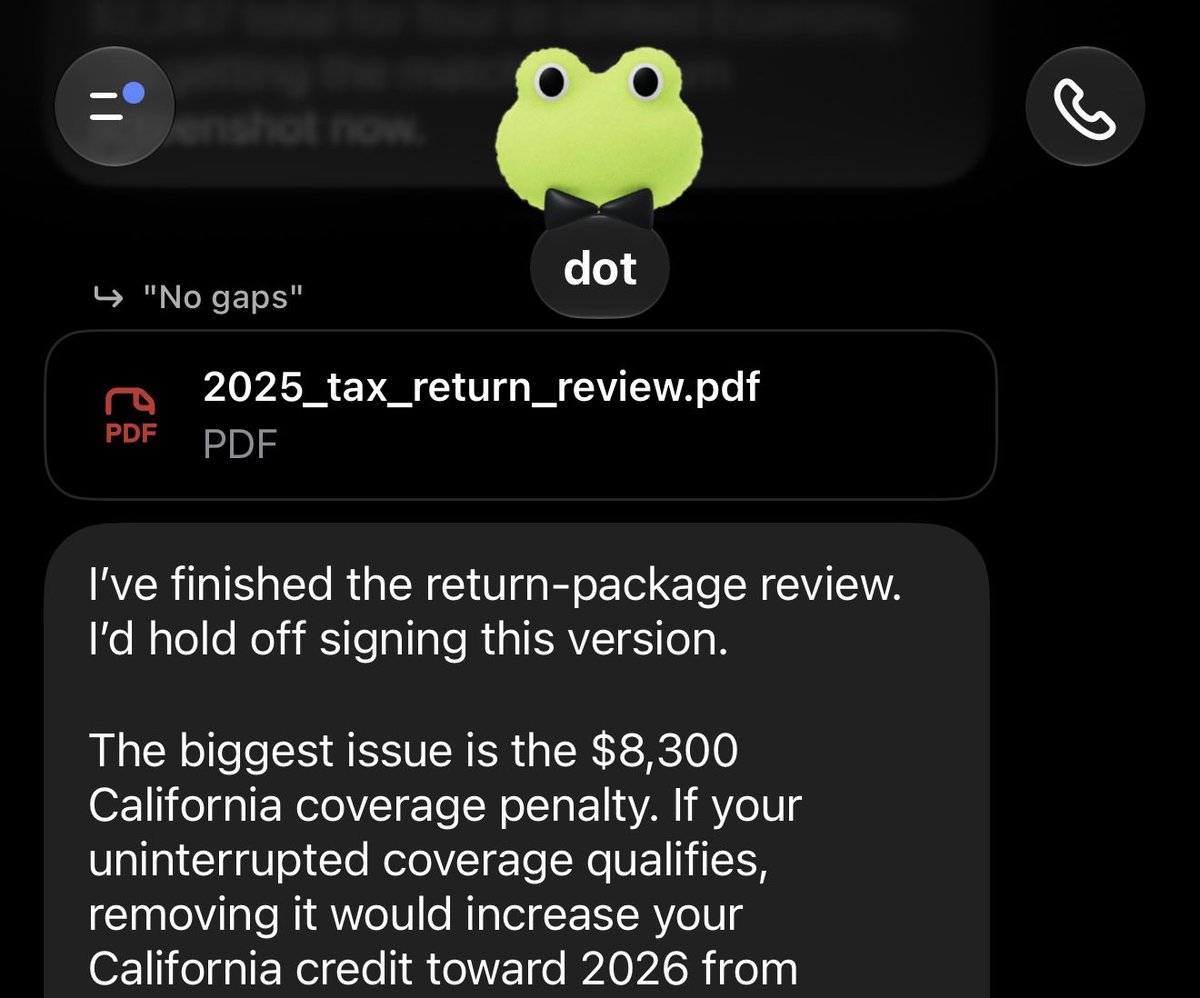
My dot found an $8,300 mistake in my tax return. The return was prepared by a tax firm that is best in class!
People, if you’re not using ChatGPT for your Finances, you are definitely leaving money on the table.
ChatGPT is now the largest medical record sync from hospitals to consumers, passing Apple.
I'm glad we can all access our medical records through the apps we choose. Rightly so!
We're working with Epic and hospitals to reduce the API load on their servers. The current setup is archaic - the equivalent of refreshing your inbox instead of getting a push when email arrives.
FHIR Subscriptions can solve this & reduce strain on the system.
Today’s my 6-month anniversary at OpenAI.
Joining was one of the best decisions I’ve ever made.
Hearing how everyone is using Finances in ChatGPT to save money, feel more in control, and make decisions about their lives is incredibly rewarding.
What a ride so far 🚢 🚢 🚢
1. Finances on web and iOS
2. Finances for US Pro
3. Finances for US Plus
4. Finances on Android
5. Apple Card and Apple Savings support
6. Proactive weekly Finances updates
7. Stock watchlists
8. Credit scores, reports, and monitoring
9. Voice + Finances
10. Coinbase connections through Plaid
11. Dots + Finances
12. Finances for US Free and Go users
13. 1,000+ bug fixes and polish improvements along the way!
Grateful for our team and everyone building with us.
So much more to do.
I spoke with The Daily about what’s happening to math in the age of AI—and what it feels like to be a mathematician right now.
The conversation went places I hadn’t expected.
I’m grateful to @RachelAbramsNY, @annieminoff, and their team.
https://t.co/UwbytBe1Fk via @NYTimes
We’re releasing a broad range of new mathematical results produced by an internal frontier model.
We’ve been consulting with the independent Advisory Group on Mathematics and Artificial Intelligence at the Institute for Advanced Study, and we have drawn on their advice and public recommendations to inform how we release these results.
https://t.co/7N6TPlft1P
Reading all those recent beautiful essays by Terry Tao, Kevin Buzzard and @wtgowers, I could not resist, but write up my deeply personal perspective on how I perceive and see things:
https://t.co/fvWb4b7jGU
Finances in ChatGPT is rolling out to Free and Go users in the U.S.
Securely connect your accounts with @Plaid and @Experian to make sense of your money and credit, with answers based on your own financial information.
@ebloch One one side is friction + brand mistrust, on the other is yield $.
In the past, the left side, esp. friction overwhelmed the equation. Friction will soon be gone, leaving brand to carry all the water.
With rising rates, the right side of the equation gets even stronger.
The Next Rung
At some point I realized that almost all of the code I had ever written had been deleted. At the very least, refactored or rewritten, but my LOC were for the most part confined to the dustbin of repo history. I was lamenting the fact that the stuff that did survive felt like it was all some embarrassing junk I had thrown together in a couple of days before moving on to the next thing, and I wondered what mark I had really left on the code. The trend accelerated once I became a manager and my dwindling contributions were swiftly consumed by normal code churn. Most of the coding I did was nights-and-weekends tinkering on personal projects.
I was turning all this over in my head and spiraling a bit thinking about what really makes a great software engineer and was I ever one and would I ever be one. I realized the people I admired most weren't the galaxy-brained folks who built magnificent "future-proof" systems that would still work in ten years but the ones who could see just one move ahead. When the next big problem arrived, their design was just malleable enough to make the transition straightforward. Their code felt almost designed to churn.
Great software engineering is building rungs on a ladder. The code that got mowed over in a refactor had to exist for the refactor to happen. It served its purpose and now sails off in a Viking funeral. What is the alternative? Climbing back down?
All that code I wrote to indulge myself on nights and weekends? I still have absolute git blame dominion over it. 100% of the lines have my name on them. And they do not matter at all, and the way you can tell is that they're not churning. Many of those repos haven't seen a commit in a decade. With vanishingly few exceptions, churn is a sign of life. The stuff that doesn't last is the stuff that matters.
—
"The models are the worst they will ever be."
I hear from my friends at the labs that some researchers act almost as if programming (even with agents!) is a waste of time, because the models are going to eventually just be able to do it all for you. Yes, of course nobody writes the code by hand anymore. Some people have given up on reading it altogether. Some people don't even try to understand how it works anymore. But it is a mistake to assume that just because the code is disposable, the understanding is too.
For my part, the amount of handwritten code I'm producing does indeed round to zero. But not understanding what's actually going on underneath is insanity for anything non-trivial. You might be able to get away with this someday, but you cannot build a system of any complexity whatsoever using even the best models without good technical guidance, and you cannot give good technical guidance if you have no idea WTF is going on.
Maybe we will get to the point where you can just let go and let Claude. But we are not there yet, and we will never get there if we try to operate as if we are already living in some imagined future instead of the real one we live in today.
There is a difference between being able to see a rung and being able to grab it. We have to keep building. We have to keep climbing.
https://t.co/AR1VTGXJfd
Helpful (and dare I say fun?) new feature in ChatGPT Health: tap on anything in your synced data and get a helpful summary of everything related to that metric. No prompt required!
Makes use of your chat-wide memory, so can be incredibly personalized and specific to you.
My next podcast episode is almost guaranteed to save you some money.
It's with my friend @ebloch, product lead for ChatGPT Finances at @OpenAI.
I asked him to share six practical personal finance prompts that anyone can try to:
1. Find tax savings proactively
2. Maximize credit card rewards
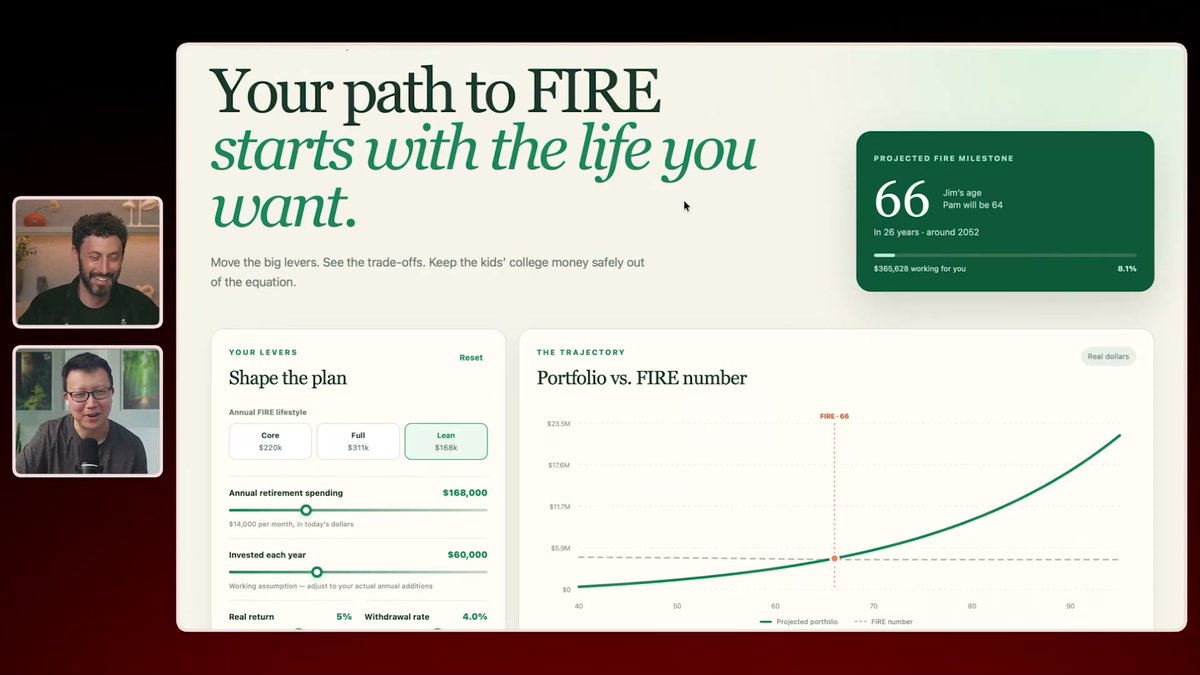
3. Create interactive forecasts like your path to financial independence
...and more
📌 Subscribe to get our full episode tomorrow: https://t.co/NSTj7ijxE0
@GergelyOrosz This generalization is odd - it doesn’t feel as well researched as your usual opinions.
1. RN delivers an experience very close to full native.
2. Most updates can be OTA getting closer to web deploy speeds.
I’d choose RN for almost anything these days.
Stock watchlist rolling out in ChatGPT + Finances for US Plus/Pro!
Tell Chat what stocks to follow. It’ll keep an eye on what’s happening and proactively bring you updates.
Try: “@Finances add Nvidia, Microsoft and Berkshire to my watchlist.”