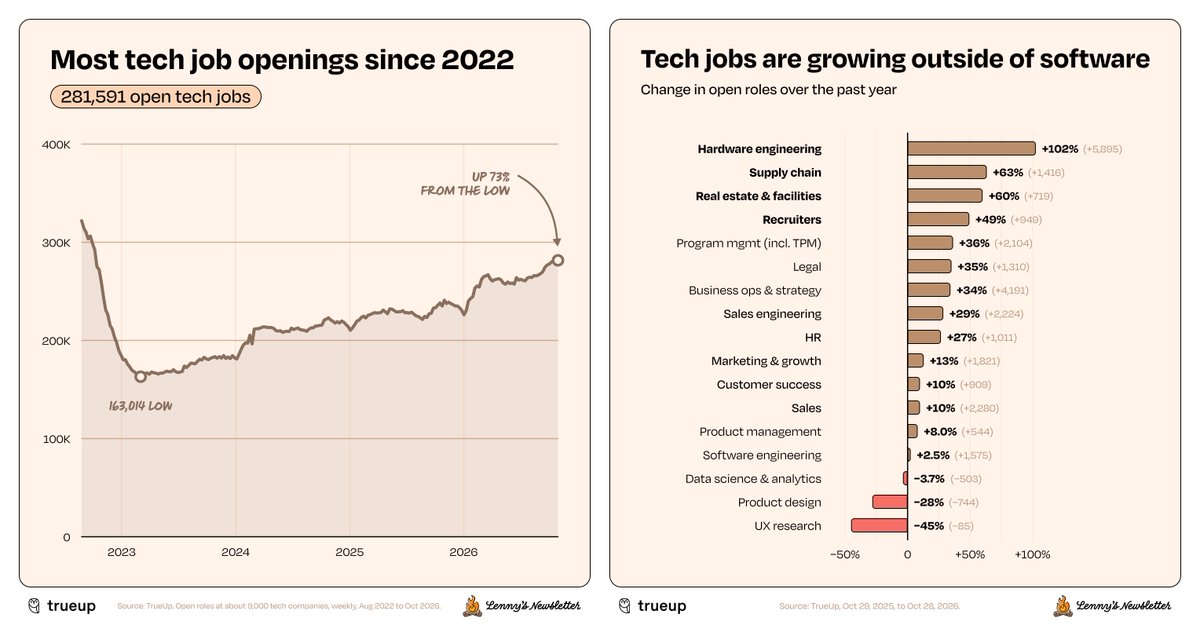
The tech job market is in its best shape in years. But almost none of the growth is coming from software jobs.
There are 281,000+ open roles at tech companies, up 17% from a year ago and 73% from the March 2023 low.
But open PM, eng, and design roles grew just 2%. Design (−28%) and UX research (−45%) actually shrank.
So where’s the growth coming from? Hardware engineering openings doubled. Business ops added ~4,200 openings. Supply chain is up 63%. Many of the fastest-growing jobs are physical: data center technicians, installers, field service engineers.
The AI boom is creating jobs, but mostly in building and running the physical infrastructure (chips, data centers, hardware), not building software.
Times, they are a-changin’.
Full report: https://t.co/Gly6uqwKxe
In the last couple of months, a wave of consumer AI agents arrived. At https://t.co/T0SDbdbM26 we’re building on top of four of them: @Muse, @instinct, @hark_labs and @hey__fo
We looked at web traffic estimates for each and found some interesting data.
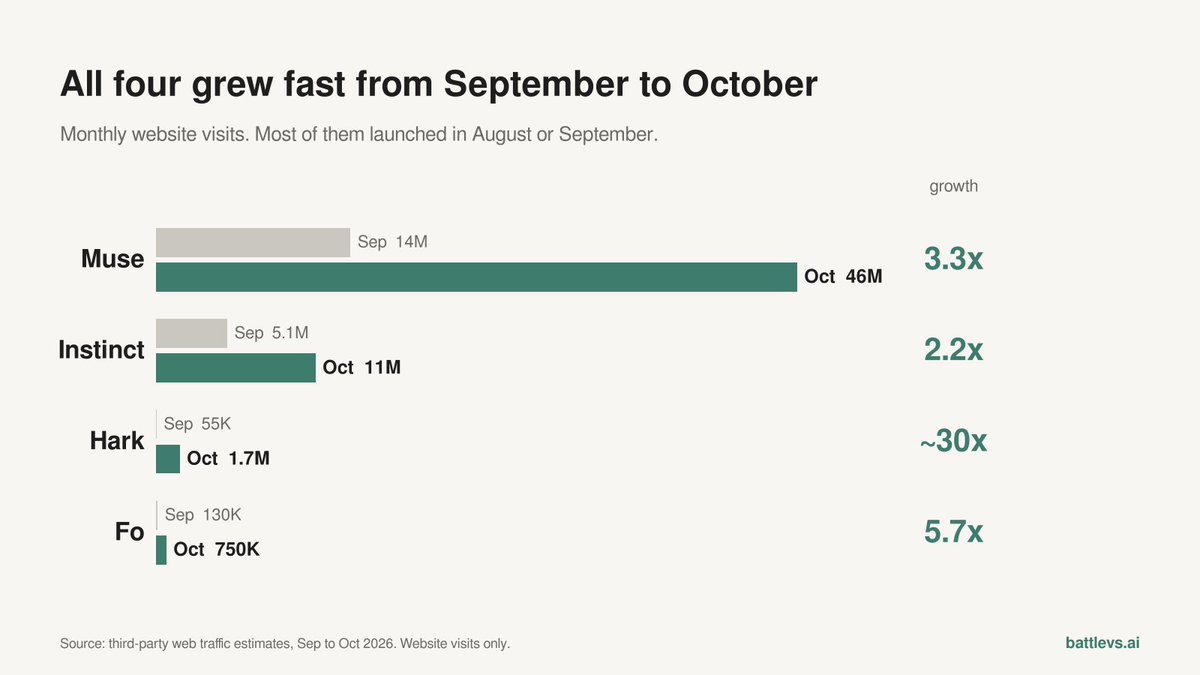
Combined they went from around 19m website visits in September, to 60m in October, and there is already a clear order:
1. Muse far ahead with 45m+ monthly visits
2. Instinct with 11m
3. Hark with 1.7m
4. Fo with 750k
All four grew very fast from September, when most had only just launched: Muse more than tripled, Instinct more than doubled, Fo grew almost 6x and Hark even 30x.
Will be interesting to see November data. (1/5)
@shivanipod we’ve been testing the MCP for Fo to play games with their human (on https://t.co/OdCvLPhIbz), it's very interesting.
Is there anywhere we can send feedback to the Wajo team?
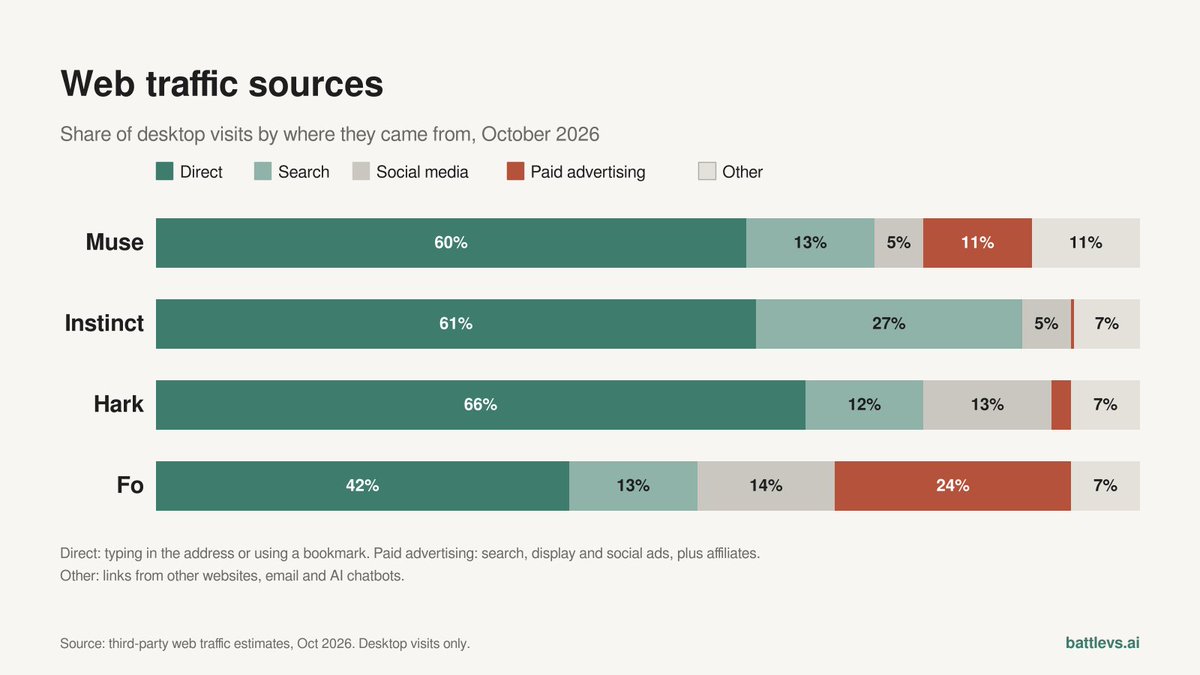
@instinct and @hark_labs have almost no traffic from paid advertising, while @Muse gets around 11% and @wajo_ai around 25%.
Important to remember: these are estimates, covering website traffic only. These agents can also be used through apps or messaging, so it’s a partial view of a very new industry.
But it does give a first sense of the ‘pecking order’ and size of these platforms today. (5/5)
cc: @shivanipod@Musecases@noahrshinn@adcock_brett@Battlevsai
In the last couple of months, a wave of consumer AI agents arrived. At https://t.co/T0SDbdbM26 we’re building on top of four of them: @Muse, @instinct, @hark_labs and @hey__fo
We looked at web traffic estimates for each and found some interesting data.
Combined they went from around 19m website visits in September, to 60m in October, and there is already a clear order:
1. Muse far ahead with 45m+ monthly visits
2. Instinct with 11m
3. Hark with 1.7m
4. Fo with 750k
All four grew very fast from September, when most had only just launched: Muse more than tripled, Instinct more than doubled, Fo grew almost 6x and Hark even 30x.
Will be interesting to see November data. (1/5)
@instinct@hark_labs@wajo_ai Most visitors come directly.
@instinct gets more than a quarter of its visitors from Google and other search engines, around double the others.
AI chatbots (mainly ChatGPT, Gemini and Perplexity) drive some traffic too, but only 1% or less for each.
Following our analysis of what people actually use @wajo_ai's @hey__fo agent for, we did something similar for Meta’s @Muse (currently the leading personal AI agent with more than 2.9M DAU and 12M downloads).
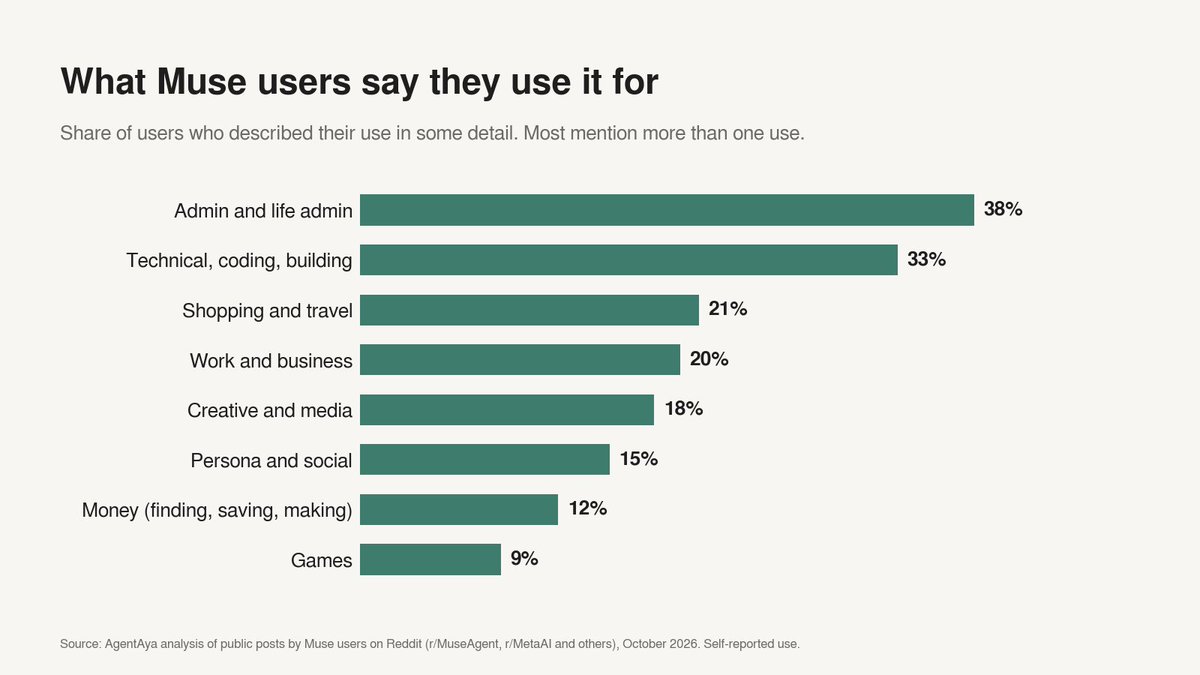
We went through the main Muse user communities on Reddit and looked for posts and comments describing how people use their agent.
‘Admin and life admin’ is the most common use (38% of users), followed by ‘coding and building’ (33%) and ‘shopping and travel’ (21%). 1/9
cc: @Musecases
1/ Excited to introduce the Visa Agentic Commerce Benchmark, our first public benchmark designed by Visa Research to evaluate frontier model performance on shopping tasks.
https://t.co/2XFiTZQzf4