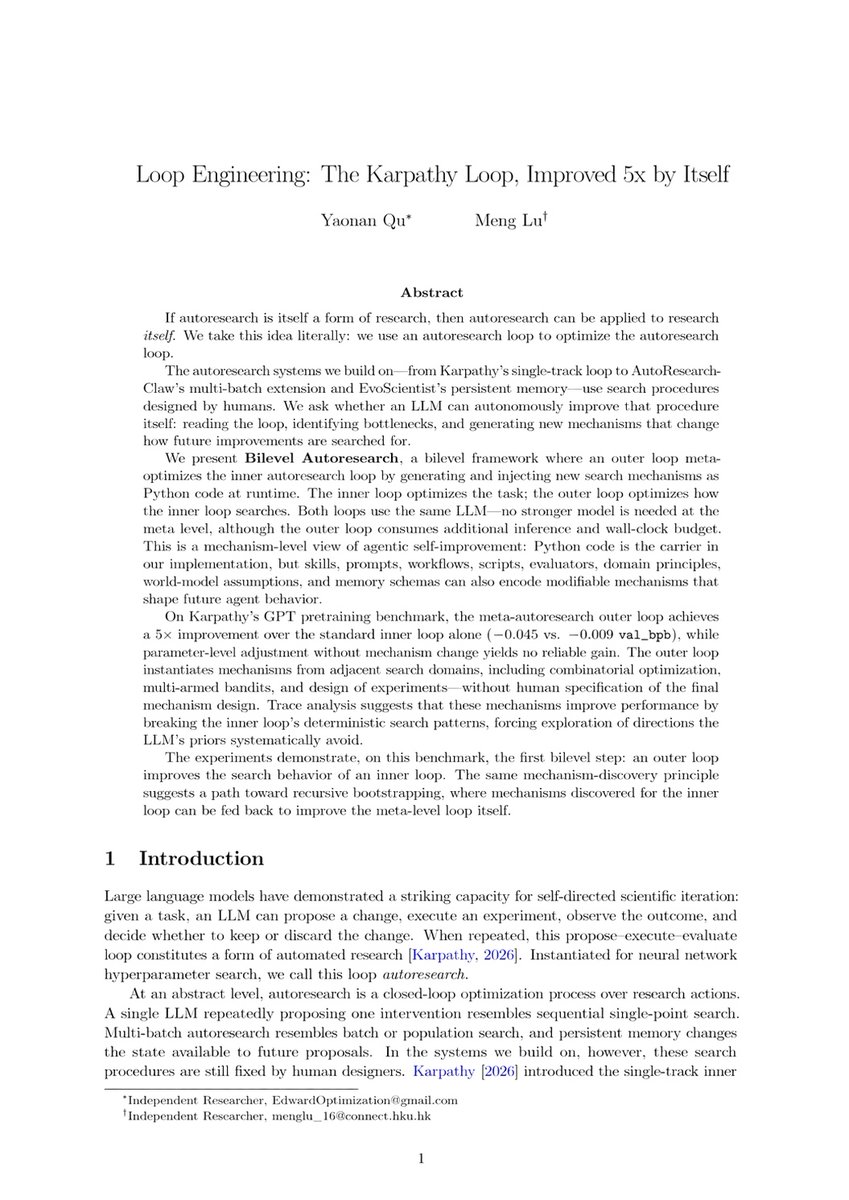
Two Hong Kong students just made Karpathy's loop 5x better - dropped 18-page PDF
The twist: the loop got 5x better the moment you put another loop on top of it
here's the whole method, step by step:
step 1 → Karpathy's loop gets stuck - the LLM keeps reproposing the same changes, falling back to its priors
step 2 → so they add an outer loop that reads the inner loop's code and finds where it's stuck
step 3 → the outer loop writes new search logic as Python and injects it live - 5x better, same model
how to steal this for your agents:
step 4 → write a second agent whose only job is to read the first one's logs and find where it's stuck
step 5 → let it rewrite the rules - workflow, skill, prompt - not just retry the task
step 6 → auto-revert every rewrite on failure, so a bad change never breaks your pipeline
the result: 5x better than Karpathy's loop alone - same LLM, no smarter model, it's the architecture
this 18-page PDF is what comes after the Karpathy loop
read it now - the full build workflow is in the article below ↓
UNA INGENIERA DE ANTHROPIC LO DIJO CLARO: NO TIENES QUE PROMPTEAR A CLAUDE, TIENES QUE CONSTRUIR UN SISTEMA QUE SE PROMPTEA SOLO
en 45 minutos te muestra como armar un agente que se mejora a si mismo.
guardalo y miralo
An China guy discovered a method to learn any knowledge instantly using AI.
The key is Obsidian + any AI — Kimi, Claude, or Gemini.
Most people learn slowly: read, forget, read again, forget again.
His method: use AI to transform any content into small, interconnected notes.
Use Obsidian to link them, so every piece of knowledge is never isolated.
Slow method: highlight books, keep going, forget after a week.
Fast method: AI breaks it into atomic notes, Obsidian links them into a network.
Six months later, a new idea instantly connects to twenty things you already know.
I compiled the full A–Z guide to building a second brain with Obsidian — works with Kimi, Claude, or Gemini — that most people have never discovered.
Article below
this is f**king dangerous
a free github repo with 4.8K stars just dropped the entire "loop engineering" framework for trading agents.
12 steps to build a self-running quant desk: strategy intent → market data → signals → trading agent → verify → refine → rerun.
save and bookmark no matter what
THIS DOCUMENT FROM ANTHROPIC WILL LITERALLY GET YOU PROMOTED
> the fastest way to reach a senior position is to automate your current job
this technical paper shows how to encode your daily workflows into Claude
build custom "Skills" to force the AI to do the heavy lifting:
> package your routines into automated folders
> the agent executes your tasks flawlessly in the background
> it connects directly to your local tools via MCP servers
hand off the junior work to the agent and easily claim your promotion
grab the exact blueprint right here 👇
Ex-Google engineer explained AI agent loops, harness, evals in 20 minutes - better than 500$ courses.
trace every run → judge it with an LLM → diagnose → fix → ship.
That loop is how agents self-improve over time.
Agent loops + memory + harness + evals - thats the stack.
Watch it, then save the framework below.
42 agents. 216 threads. One dashboard. Every agent gets its own prompt, tools, skills, and budget. Deploy specialized agents across your company. From the team at Airtable.
Anthropic Managed Agents Lead:
"At Anthropic, >90% of our engineers are building with self-improving loops. In 4-6 months, it will be 100%.
my agentic loops can run for hours without spending hundreds of dollars."
in this 40-minute podcast, an Anthropic team lead reveals how to build effective agents from scratch.
Agent → harness → loops → memory = modern agent
This one video will replace 10 paid courses on vibe-coding.
Watch it today, then explore the same setup in the article below.
🚨 شوف رئيس أكبر شركة ذكاء اصطناعي في العالم صدم الكل وقال إيه !!
سام ألتمان (رئيس OpenAI) خرج واعترف بالسر اللي هيغير شكل العالم الكام سنة الجايين، ولخص المستقبل كله في جملتين مرعبين:
- قريب جداً هنشوف شركات بمليار دولار.. شغال فيها 10 أشخاص بس!
- لو أنا عندي 22 سنة دلوقتي.. هحس إني المحظوظ الأكبر في التاريخ كله.
احفظ البوست ده عندك دلوقتي عشان ترجع له قبل ما تنسى.
الحقيقة الصعبة:
99% من الناس هيقرأوا الكلام ده دلوقتي، يتحمسوا لمدة 3 دقائق بالظبط، وبعدها يرجعوا يكملوا سكرول ويعملوا نفس اللي كانوا بيعملوه في يومهم عادي!
الـ 1% بس اللي هياخدوا خطوة حقيقية، هما اللي هيقفلوا السوشيال ميديا ويبدأوا يبنوا الـ App Studio بتاعهم الويكيند ده!
أداة واحدة.. 10 دقائق مجهود.. و10 آلاف دولار في الشهر.
إليك الخطوات بالظبط إزاي تبدأ وتجيب أول 10 آلاف دولار في الشهر:
1️⃣ اصطاد المشكلة (The Pain Point):ادخل على منصات زي Reddit أو مجتمعات الفيس بوك والـ LinkedIn الخاصة بأصحاب الشركات الصغيرة (عقارات، مطاعم، عيادات). شوف إيه أكتر مشكلة يومية بتضيع وقتهم (مثلاً: تنظيم المواعيد، ردود خدمة العملاء، فواتير العملاء).
2️⃣ ابنِ الحل بـ الـ AI (The 10-Min Build):مش محتاج مبرمجين؛ استخدم أدوات الـ No-code المعتمدة على الـ AI (زي Bubble، FlutterFlow، أو Glide). اطلب من الـ AI يبني لك تطبيق بسيط جداً (Micro-SaaS) بيحل المشكلة دي بالظبط. الموضوع مش هياخد منك 10 دقائق عشان تطلع بنسخة شغالة.
3️⃣ قفل السيستم أوتوماتيك (The Automation):اربط التطبيق بـ Stripe عشان تستقبل اشتراكات شهرية، واستخدم أدوات زي Make أو Zapier عشان السيستم يبعت الإيميلات ويفعل الحسابات للمشتركين الجدد أوتوماتيك وأنت نايم.
4️⃣ العرض الصادم (The No-Brainer Offer):كلم أول 20 صاحب بيزنس بيعانوا من المشكلة دي، واديهم التطبيق فوراً "تجربة مجانية لمدة أسبوعين". لما يشوفوا إن التطبيق وفر عليهم وقت ومجهود وموظفين، غصب عنهم هيتحولوا لاشتراك شهري مدفوع (مثلاً 50 دولار في الشهر).
5️⃣ معادلة الـ 10 آلاف دولار:لو عندك تطبيقين أو تلاتة بسيطين، وكل تطبيق مشترك فيه 70 شركة بس بـ 50 دولار شهرياً.. أنت كده رسمياً كسرت حاجز الـ 10K/month وبأقل مجهود وإدارة.
السيستم ده شغال حالياً وبقوة، والـ AI فتح الباب لأي حد إنه يكون صاحب شركة برمجيات لوحده تماماً.
اعمل Bookmark (حفظ) للبوست ده فوراً عشان ترجع للخطوات دي الويكيند ده، وقولي في التعليقات: إيه أكتر مجال شايف إن مشاكله محتاجة تطبيق يحلها؟ 👇👇
لايك وفولو عشان يوصلك كل جديد!
A 23-year-old from China made $15,400 selling a single piece of code to a cafe owner. He built it with vibe coding in Claude. The owner made it back in six weeks.
No data science degree. No consulting firm. No pitch deck with fifty slides.
He connected Claude to the existing security cameras above the counter and wrote a system that watches every customer interaction in real time. It identifies who is working, counts how many cups each barista has made, tracks how long customers sit at each table, and logs every order pattern across every hour of the day.
The owner had been running the same menu for three years guessing what sold. Two weeks of this data told him that Anna was outselling Vika 2 to 1 on the morning shift, that the table by the window had an average stay of 1 hour 15 minutes and almost never ordered a second drink, and that 60 percent of afternoon customers ordered something they had never promoted.
He restructured the menu. He adjusted staffing by shift. Revenue went up.
Pause the video at
0:11 and look at the girl on the right. You noticed it too, right?
The system has already tagged her, logged her time at the table, and is tracking whether she orders again. No manager watching. No clipboard. Just code running silently on a camera that was already there.
That is what $15,400 buys a cafe owner. And what one afternoon of vibe coding in Claude can build.
A 68-YEAR-OLD RETIREE BUILT AN AI AGENT THAT RUNS ENTIRELY WITHOUT THE INTERNET
He had spent 35 years as a systems engineer, but never touched modern AI tools until his daughter showed him Claude last winter
He wanted something that could manage his daily tasks - reminders, document drafts, research summaries - but refused to trust his personal data to cloud servers
So he bought a GMKtec EVO-X2, wiped Windows, installed Ubuntu, pulled Ollama, and pointed a local Claude Code instance at his own machine
But the real breakthrough came when he wired the agent to a small Raspberry Pi running automations around his house - calendar alerts, morning briefings, document organization, all triggered by voice
No subscription. No data leaving the house. No internet required after the initial setup
While most people his age were struggling with basic smartphone features, he had built a fully offline personal AI assistant running on hardware that fits in a shoebox
He posted a short demo video showing the agent summarizing his weekly notes and drafting three emails while completely offline
His inbox filled with messages from other retirees asking how to build the same thing
Vibe coders are getting sued.
People are shipping apps with real users and skipping the boring stuff that kills them.
A 20+ year dev shared the pre-launch checklist every AI builder needs.
I added what I learned after shipping 60+ apps at the agency.
Don't skip this:
1. Protect yourself, not just your app. The moment you collect user data you're in legal territory (GDPR, CCPA). Have a privacy policy. Know where user data lives.
2. Row Level Security. Without RLS, anyone can open DevTools and read your entire database. Supabase → Auth → Policies. Zero policies means your app is naked. 5 min to fix.
3. Test the failure path, not just the happy path. Wrong password 5x. Reset for an email that doesn't exist. Verification link clicked twice. Signup with an existing email. Catches 80% of auth bugs.
4. Security baseline in 2 min. Prompt your AI: "Review my app as a security specialist and make sure I have strong security headers and a solid baseline security posture."
5. OWASP. Prompt: "Review my app against OWASP standards and highlight vulnerabilities." This is where SQL injection, XSS and auth bugs actually get caught.
6. Client-side validation is UX, not security. Attackers disable JS and hit your API directly. Validate again on the server. Every time.
7. AI code leaks data in 3 spots: .env values in the frontend, API responses returning too much, secrets in logs. Prompt: "Check my app for credential or sensitive data leaks in frontend or API routes."
8. API keys in the frontend means game over. If it's in the browser, assume it's already taken. Move it server-side or proxy it.
9. Rate limits before someone burns your API bill. Cap every endpoint hitting a paid API. I've watched a Supabase bill jump from $20 to $200 in a day.
10. CAPTCHA on public forms (Cloudflare Turnstile is free) plus CORS locked to your domain. 10 min, kills bot floods.
11. Error messages that don't leak. "User not found", not "SELECT * FROM users failed". Log full errors server-side, show users generic messages.
Build fast. Just don't ship naked.
(full breakdown in my article below)
this is f*cking gold
A senior Google engineer dropped a 424-page doc on agentic design patterns.
424 pages.
Most engineers bookmarked it and never opened it again.
if I had this a year ago, I would've shipped my first app in a day instead of 2 weeks
in the right hands, this changes everything:
A Chinese developer created an agent system in Claude Code to sell landing pages to small businesses and, working completely solo, serves about 47 clients a month, charging around $400 for each one.
He built 7 agents on Claude Sonnet capable of analyzing Google Maps in small cities, detecting businesses without websites or with totally outdated pages, and taking each opportunity all the way to a finished mockup, a promotional video, and a ready-to-send prospecting message.
No assistants.
No sales team.
No SDRs.
Just him, a MacBook, an iPhone, and an API key.
While traditional agencies maintain full teams to handle the same workflow, his only real costs are tokens and subscriptions to Lovable, Higgsfield, and Calendly.
The 7 agents operate coordinated by an orchestrator in Claude Code Router. The system consumes about 3 million tokens daily, and the average API spend is just around $480 a month.
They all work via MCP servers and share state using the file system, avoiding concurrency and shared memory issues. Even one of the agents lives directly on his iPhone and responds to leads while he's on the subway, in a taxi, or walking.
This was the main prompt he set up:
“You are the orchestrator of a solo agency that sells ready-made websites to local businesses…”
The key is that the system perfectly understands what it is, what its limits are, and what goals it must achieve.
It knows it must find leads automatically.
It knows it must convert each opportunity into a landing page, a video, and a sales message without human intervention.
And it knows exactly when to involve the owner.
The system runs 24/7:
Scout analyzes about 220 businesses daily and queues up 30 new leads.
Diagnoser generates diagnostics and personalized messages for each lead.
Builder creates between 3 and 5 complete landing pages for the best prospects.
Filmer produces a 10-second vertical video for each proposal.
Pitcher sends about 30 messages daily across 4 different channels with a response rate close to 14%.
Checker automatically reviews all messages before sending them.
Only when a deal exceeds $3,000 or the response rate drops below 12% does the system wake the owner.
And if he's on the subway or in a taxi at that moment, the Mobile agent automatically responds to the interested lead, schedules a call in Calendly, and returns the lead to the queue. The owner just has to hit “approve” and jump into the meeting.
Some real system logs:
“218 businesses analyzed in Austin, Denver, and Miami. 34 without websites, 19 with 2014-era sites, and 6 with reviews requesting redesigns.”
“30 messages sent. 14 responses. 5 positive. 3 Zooms scheduled.”
“Landing page created for a dental clinic. Responsive. 5 sections. Video rendering.”
“$3,400 deal exceeds approved limit. Sending for manual review.”
And the craziest part is that he has no dedicated servers or backend.
Just a local sandbox, an MCP router, a Claude API key, and that same key connected to his iPhone.
Of everything I've seen this year, this is probably the cleanest and most efficient example of a fully automated one-person agency:
$480 a month on APIs.
$18,800 in revenue.
7 prompts.
A file system.
And a phone in his pocket.
Save this before it's too late.
Anthropic engineer:
"At Anthropic, 90% of engineers use loops and dreaming"
That is how they build self-improving agentic systems
"Close the loop, give the agent a way to verify its own output"
In 30 minutes, an Anthropic team member shows how to build an agent that improves itself
Not one prompt
Not one answer
A loop that checks its own work
Better than most $500 agent courses
Bookmark and watch the talk
Then save the playbook below
🚨 Anthropic's CEO: "software engineering will be fully automated in 12 months."
two types of people right now:
type 1: opens Claude, types something, gets an answer, closes the tab. thinks they're using AI.
type 2: knows the hidden features, settings, and shortcuts. runs Claude like a power tool.
type 1 gets surprised in 12 months.
type 2 built the advantage already.
bookmark this. read it today.
Anthropic Applied AI team:
"We stopped trusting the agent to grade its own work. One agent builds, a second agent plays the thing and rejects it until it actually runs."
Free, by the people who built Claude. They break down the exact harness that takes one prompt and runs for hours until it ships a finished app.
A year ago an agent held a task for 20 minutes before it drifted. The same harness now runs for 12 hours and hands you the finished build in the morning.
Claude + a planner + a builder + a separate evaluator that verifies - that's the secret.
Watch the talk, then read the article below.
This is an official ANTHROPIC 33-page PDF blueprint for building "Effective AI Agents."
Not theory. Architecture patterns with real case studies from Claude, Coinbase, Stripe, Intercom, and others.
Perceive → Decide → Act → Evaluate → Repeat
Five patterns, from simple to complex:
• Single agent: one model in a loop. Handles 80% of use cases. Don't over-engineer.
• Sequential workflow: fixed steps, each agent hands off to the next. Predictable and auditable.
• Parallel workflow: fan out tasks across agents at once, merge results. Speed through concurrency.
• Hierarchical: a supervisor delegates to specialists. Like a team lead managing experts.
• Evaluator-optimizer: one agent generates, another pushes back. 2-4 cycles until quality is met.
The key insight:
multi-agent systems outperform single agents by 90.2% on complex tasks. Match complexity to value.
Read it now, then explore the article on agentic "Loop engineering" below.